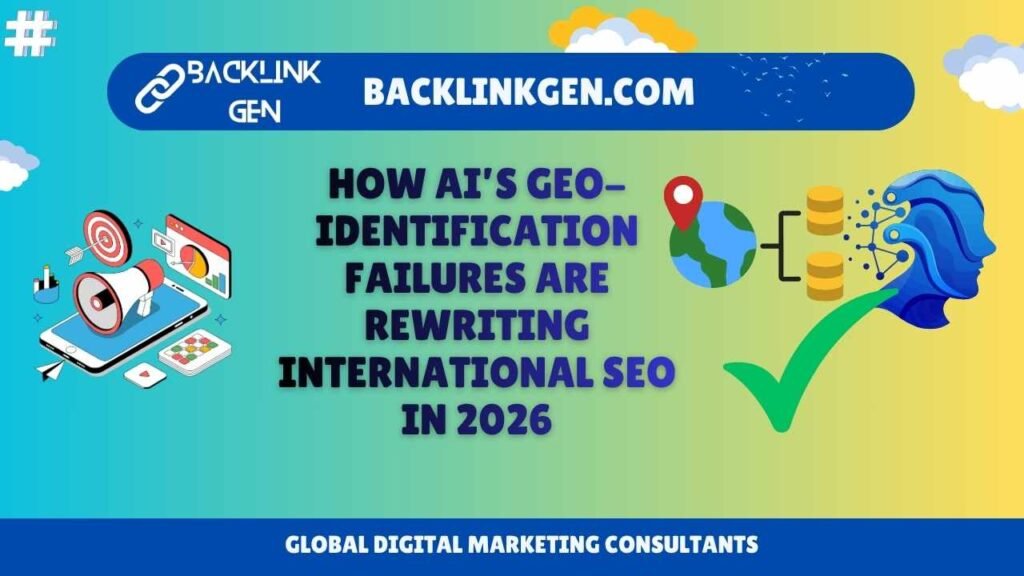
Artificial Intelligence has transformed the way users search, discover, and consume information online. Search engines, AI assistants, recommendation engines, and generative platforms now play a major role in determining which websites gain visibility and which remain hidden. While AI has improved personalization and search relevance, it has also introduced a new challenge that many businesses and SEO professionals are only beginning to recognize: geo-identification failures.
Traditionally, search engines relied on explicit signals such as country-specific domains, server locations, language tags, and geographic targeting settings. Modern AI systems, however, interpret content differently. They analyze language patterns, user behavior, contextual clues, semantic relationships, and intent. As a result, AI occasionally misidentifies the geographical relevance of content, businesses, and websites. A company targeting users in Canada may be interpreted as serving the United States, while a UK-focused website may appear in Australian search experiences.
In 2026, these geo-identification failures are becoming increasingly important because AI-generated answers, AI search summaries, and conversational search interfaces often decide what users see before they ever visit a website. This shift is fundamentally changing international SEO strategies. Businesses can no longer depend solely on traditional localization techniques. Instead, they must optimize for how AI understands geography, context, and regional intent.
Understanding this evolving challenge is essential for brands operating across multiple countries, languages, and markets. The future of international SEO will increasingly depend on ensuring AI accurately understands where your business belongs and who your content is intended to serve.
1. Understanding AI Geo-Identification and Why It Matters
Geo-identification refers to the process through which AI systems determine the geographical relevance of content, websites, businesses, products, or services. Historically, search engines relied heavily on technical indicators such as country-code top-level domains (ccTLDs), server locations, hreflang tags, and regional backlinks. AI-powered systems have expanded this approach significantly.
Modern AI models analyze content semantics, entity relationships, user behavior patterns, local references, currency mentions, address information, customer reviews, and numerous contextual signals. The objective is to understand not just where content originates but where it should be relevant.
The challenge arises when AI interprets these signals incorrectly. For example, an international company may mention several countries throughout its content. AI may struggle to determine the primary target audience. Similarly, businesses serving global markets might unintentionally dilute regional signals, causing confusion.
This issue has become more critical due to AI-generated search experiences. Users increasingly receive direct answers rather than lists of websites. If AI incorrectly identifies a website’s geographical relevance, that site may never appear in recommended answers for its intended audience.
Businesses operating internationally face significant risks. Traffic losses, reduced visibility, lower conversions, and declining local rankings can result from geographic misunderstandings. Even well-optimized websites may experience unexpected fluctuations if AI systems misinterpret their regional relevance.
As AI continues becoming the primary intermediary between users and content, accurate geo-identification is evolving from a technical SEO consideration into a strategic business necessity.
2. Why AI Makes Geographic Mistakes
AI systems are incredibly advanced, but they remain imperfect. Geographic misclassification often occurs because AI relies on probabilistic interpretations rather than definitive rules. Unlike traditional search algorithms that followed structured geographic signals, AI models attempt to infer location relevance from multiple sources simultaneously.
One common problem involves mixed-location content. Businesses operating in multiple regions frequently create pages discussing global services, international customers, and worldwide operations. These mixed signals can confuse AI systems regarding the primary market.
Language variations create another challenge. English content serves users in the United States, United Kingdom, Canada, Australia, India, and numerous other countries. Without strong localization indicators, AI may incorrectly assign regional relevance.
Entity ambiguity further contributes to errors. Certain city names, regional terms, and business references exist in multiple countries. AI systems sometimes associate content with the wrong geographic entity.
Content syndication can also create confusion. When similar content appears across multiple websites or regional domains, AI may struggle to identify the authoritative geographic source.
Additionally, generative AI models often rely on training data collected from diverse sources. If historical data contains inaccurate geographic associations, those biases may influence future interpretations.
The complexity of modern international businesses means AI geo-identification challenges will likely increase before they improve. SEO professionals must therefore focus on reducing ambiguity and strengthening regional signals throughout their digital ecosystems.
3. The Rise of AI Search and Its Impact on International Rankings
The emergence of AI-powered search experiences has fundamentally changed international SEO. Instead of presenting users with ten blue links, AI systems increasingly provide synthesized answers that combine information from multiple sources.
This shift creates a new competitive environment. Websites no longer compete solely for rankings; they compete for inclusion within AI-generated responses. Geographic relevance now influences whether content becomes part of those answers.
When AI accurately identifies a website’s target region, content has a better chance of appearing in localized responses. Conversely, geo-identification failures can remove visibility entirely.
International businesses often discover that content performing well in traditional rankings receives limited exposure within AI-generated answers. This discrepancy frequently stems from geographic interpretation issues rather than content quality concerns.
AI systems prioritize contextual relevance. A user searching for legal services in London receives different recommendations than someone searching in New York. If AI incorrectly categorizes a business’s location, visibility declines regardless of expertise.
The rise of conversational search further amplifies this challenge. Users increasingly ask location-specific questions using natural language. AI systems must interpret both user intent and content geography simultaneously.
As AI search continues evolving throughout 2026, international SEO success will depend on helping AI understand geographic relevance with greater precision than ever before.
4. How Multinational Brands Are Being Affected
Large multinational organizations face unique geo-identification challenges because they operate across multiple regions, languages, and customer segments simultaneously. While their scale offers advantages, it also increases complexity.
Global brands often maintain extensive website networks, regional subdomains, localized content hubs, and country-specific landing pages. These structures create opportunities for AI confusion if regional distinctions are not clearly communicated.
For example, a multinational software company may serve customers in North America, Europe, Asia, and the Middle East. If content lacks clear geographic differentiation, AI may prioritize one market while overlooking others.
Customer testimonials, case studies, and references can further complicate matters. A page targeting Germany might contain examples from the United States, inadvertently weakening regional signals.
Cross-border content strategies also contribute to challenges. Many organizations reuse content across markets to improve efficiency. However, AI systems may interpret duplicated or minimally localized content as geographically ambiguous.
Even established brands with strong SEO foundations have reported inconsistencies in AI-generated recommendations across regions. These discrepancies highlight the growing importance of regional clarity.
Multinational companies must increasingly invest in AI-oriented localization strategies that go beyond translation and address contextual geographic understanding.
5. The Importance of Entity-Based Localization
Entity optimization is becoming one of the most effective solutions to geo-identification problems. Search engines and AI systems increasingly rely on entities rather than keywords to understand relationships between people, businesses, locations, products, and concepts.
An entity represents a distinct, identifiable thing. For international SEO, clearly associating business entities with geographic entities helps AI establish accurate regional relevance.
Businesses should consistently connect their brands with local offices, regional contact information, local partnerships, regional events, and geographic references. These associations strengthen AI confidence regarding market relevance.
Structured data plays an important role in entity localization. Schema markup can reinforce geographic information and help AI interpret location-specific relationships more accurately.
Local citations, regional mentions, and authoritative local backlinks also contribute to stronger entity associations. AI systems often cross-reference information from multiple sources to validate geographic relevance.
Companies that build robust entity ecosystems are generally better positioned to overcome geo-identification challenges because AI receives consistent location signals from multiple channels.
As entity-based search continues expanding, localization strategies must evolve beyond keyword targeting and focus on creating clear geographic relationships across the digital landscape.
6. The Role of Hreflang and Technical SEO in 2026
Despite the rise of AI, technical SEO remains essential. Hreflang implementation continues serving as a valuable mechanism for communicating language and regional targeting to search engines.
However, relying solely on hreflang is no longer sufficient. AI systems evaluate broader contextual signals beyond technical configurations. Websites must combine technical optimization with semantic localization.
Proper hreflang implementation helps reduce duplication issues and directs users toward regionally appropriate content. Yet AI also examines content quality, local references, user engagement patterns, and entity relationships.
Technical SEO should include localized structured data, consistent URL architecture, regional XML sitemaps, and accurate geotargeting configurations. These elements collectively reinforce geographic relevance.
Site speed, mobile optimization, and regional hosting considerations remain important because user experience metrics often influence AI-driven evaluations.
Organizations should regularly audit international SEO implementations to identify inconsistencies that might confuse AI systems. Small technical errors can produce significant geographic interpretation problems.
The future belongs to integrated optimization approaches where technical SEO and AI understanding work together to establish strong regional authority.
7. Why Content Context Matters More Than Keywords
Traditional international SEO often emphasized keyword localization. While keywords remain important, AI systems increasingly prioritize contextual understanding.
A page targeting Australian users should not merely replace terminology. It should demonstrate authentic relevance through local examples, regulations, cultural references, pricing structures, and market-specific insights.
AI models evaluate content holistically. They analyze relationships between concepts, entities, and geographic indicators to determine regional appropriateness.
Contextual localization helps reduce ambiguity. When content clearly reflects local realities, AI gains stronger confidence regarding geographic relevance.
Businesses that rely heavily on generic global content may struggle because AI has fewer signals to determine regional targeting. In contrast, deeply localized content provides richer contextual information.
Regional case studies, local customer success stories, country-specific regulations, and market insights strengthen contextual relevance. These elements help AI identify intended audiences more accurately.
As AI continues evolving, context-driven localization will likely outperform keyword-focused approaches across most international markets.
8. Measuring AI Geo-Identification Performance
One of the biggest challenges facing SEO professionals is measuring how AI perceives geographic relevance. Traditional ranking tools often fail to capture AI-generated search experiences.
Organizations should monitor AI-generated answers across target regions and evaluate whether their content appears consistently. Regional visibility testing is becoming a crucial component of SEO audits.
Traffic analysis can also reveal geo-identification issues. Unexpected declines in specific countries may indicate geographic interpretation problems rather than ranking losses.
Brand mentions within AI-generated summaries provide valuable insights into regional visibility. Businesses should track where and how AI references their content.
User feedback can further identify inconsistencies. Customers sometimes report receiving recommendations intended for different countries or regions.
Monitoring entity recognition, structured data accuracy, local citation consistency, and regional engagement metrics helps identify potential weaknesses.
The ability to measure AI geographic understanding will become a critical competitive advantage as AI-driven search continues gaining influence.
9. Emerging Strategies for AI-First International SEO
SEO professionals are adapting to AI-driven environments by implementing new strategies focused on clarity, consistency, and contextual relevance.
Entity optimization, structured data enhancement, regional authority building, and content localization are becoming central priorities. Businesses are increasingly creating dedicated regional knowledge hubs rather than relying on generalized global content.
AI-first SEO strategies emphasize semantic consistency across websites, social profiles, business listings, and external references. Consistent geographic signals reduce confusion and improve AI confidence.
Regional digital PR campaigns also help strengthen geographic associations. Local media coverage, partnerships, and community involvement contribute valuable signals.
Organizations are investing more heavily in multilingual content creation rather than simple translation. Native-level localization improves contextual understanding and regional credibility.
AI testing frameworks are emerging as important tools for evaluating how generative systems interpret geographic relevance.
These strategies reflect a broader shift toward optimizing for AI comprehension rather than solely search engine rankings.
10. What the Future Holds for Global SEO
The future of international SEO will increasingly revolve around helping AI understand businesses accurately. Geographic relevance, contextual understanding, and entity relationships will become fundamental ranking factors within AI-driven environments.
As AI assistants continue replacing traditional search experiences, businesses must adapt their optimization strategies accordingly. Geographic ambiguity will become a significant visibility risk.
Organizations that establish strong regional identities, maintain consistent localization signals, and create contextually relevant content will gain advantages in AI-generated discovery systems.
Future search ecosystems will likely integrate location awareness more deeply into conversational experiences. AI systems will continuously refine their understanding of regional relevance based on user interactions and contextual data.
The distinction between local SEO and international SEO may gradually blur as AI focuses on delivering highly personalized, location-aware responses.
Businesses that proactively address geo-identification challenges today will be better positioned to succeed in tomorrow’s AI-first search landscape.
How Team Backlinkgen Can Help
At Backlinkgen, we help businesses adapt their SEO strategies for the AI-driven future. Our international SEO specialists focus on building strong geographic relevance signals that improve both traditional rankings and AI-generated visibility.
Our services include:
- International SEO audits
- Hreflang implementation and validation
- Entity-based SEO optimization
- Structured data deployment
- Regional content localization
- AI search visibility analysis
- Local citation and authority building
- Multi-country SEO strategy development
- Technical SEO optimization
- AI-first content architecture planning
By combining advanced SEO expertise with emerging AI search insights, Backlinkgen helps organizations strengthen global visibility and reduce the risks associated with AI geo-identification failures.
Conclusion
AI is transforming search at an unprecedented pace, and geo-identification has emerged as one of the most important factors influencing international visibility. As AI systems increasingly determine which businesses appear in recommendations, summaries, and conversational answers, geographic accuracy becomes essential.
Organizations can no longer rely solely on traditional international SEO techniques. Success in 2026 requires a comprehensive strategy that combines technical optimization, entity-based localization, contextual relevance, structured data, and AI-focused content development.
Businesses that proactively address geo-identification challenges will gain stronger visibility, improved regional relevance, and greater resilience within AI-powered search ecosystems. The future of international SEO belongs to brands that help AI understand exactly who they are, where they operate, and which audiences they serve.
About Author:

BacklinkGen.com Editorial Team
The BacklinkGen.com Editorial Team is led by Amit Tyagi, Gaurav Saxena and Rachit Srivastava—professionals with expertise spanning enterprise technology, artificial intelligence, digital marketing, SEO, AI Search Optimization (AIO/GEO), content strategy, and business growth. Together, they bring decades of combined industry experience across global technology initiatives, performance marketing, and digital transformation.
Every article published on BacklinkGen.com is guided by practical experience, in-depth research, and a commitment to editorial accuracy. The team focuses on delivering trustworthy, actionable, and up-to-date insights that help businesses, marketers, and professionals stay ahead in the rapidly evolving world of search, AI, and digital marketing.