By Amit Tyagi — Senior Digital Marketing Specialist & Web Development Strategist
I spent some time this week digging into Google Trends data across the past three months, comparing search volume patterns for four terms that have come to define how people are thinking about search strategy in 2026: traditional SEO, AI SEO, AEO (Answer Engine Optimization), and GEO (Generative Engine Optimization). The data is genuinely interesting — not because it confirms what everyone’s been shouting on LinkedIn, but because it shows something quite different from what a lot of the industry narrative suggests. So let me walk through what the actual search behavior tells us.
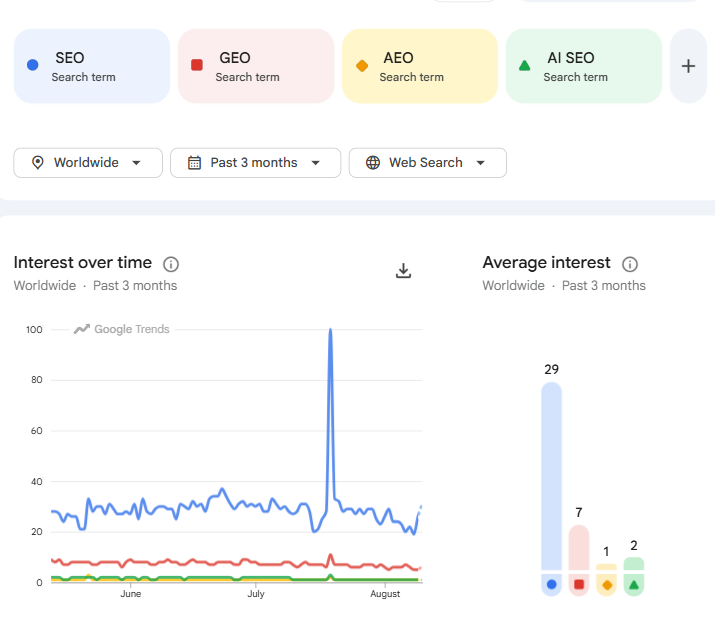
Source Google Trends Explorer: https://trends.google.com/explore?q=SEO%2CGEO%2CAEO%2CAI%2520SEO&date=today%203-m
The Spike That Tells the Real Story
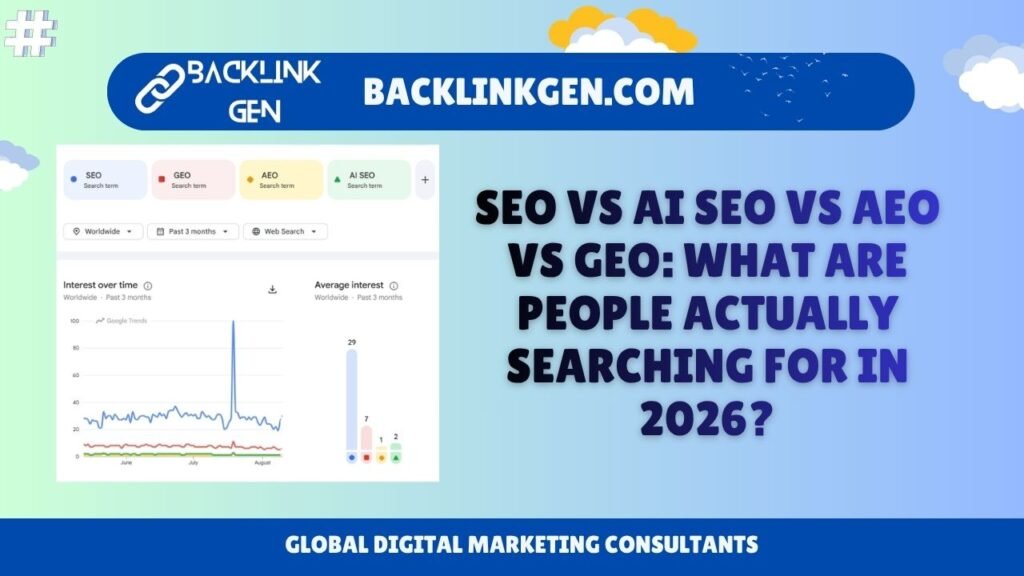
The first thing that jumps out from the Google Trends data is the sheer dominance of traditional SEO search volume. Over the past three months, interest in plain “SEO” hit a peak near 100 on the Google Trends scale — a massive spike that sits utterly alone on the chart. In the same time period, AI SEO, AEO, and GEO combined barely register as visible lines, all sitting in the single digits or low double digits, essentially flat relative to SEO’s vertical climb.
That spike in SEO volume is worth understanding, because it tells you something important about where the market actually is versus where the thought leaders think it is. If you read the usual tech commentary and marketing industry chatter, you’d assume that marketers have largely moved past traditional SEO and are now frantically scrambling to understand AI-optimized alternatives. The trends data says something different: the overwhelming majority of people searching for guidance on these topics are still typing “SEO” into Google, not “AI SEO” or “GEO.”
That doesn’t mean AI search and generative optimization aren’t real or important — they absolutely are. What it means is that the infrastructure of traditional search optimization remains the dominant concern for the actual population of site owners, marketers, and agencies doing the searching. People are still looking for basic SEO guidance, and they’re looking for it at scale.
What People Searching for “SEO” Are Actually Looking For
Digging into the top queries for people searching “SEO,” the picture gets more nuanced. The most-searched queries in this category include “google seo,” “seo company,” “seo google,” “seo free,” and “seo services” — essentially, people are either trying to understand Google’s own SEO guidance or they’re looking for vendors to help them with SEO. These are foundational searches, not sophisticated optimization queries. Search interest for these terms is trending upward in most cases — “seo company” up 20%, “seo free” up 20%, “seo services” up 2% — which suggests active, growing demand from businesses looking to either learn about SEO themselves or outsource it.
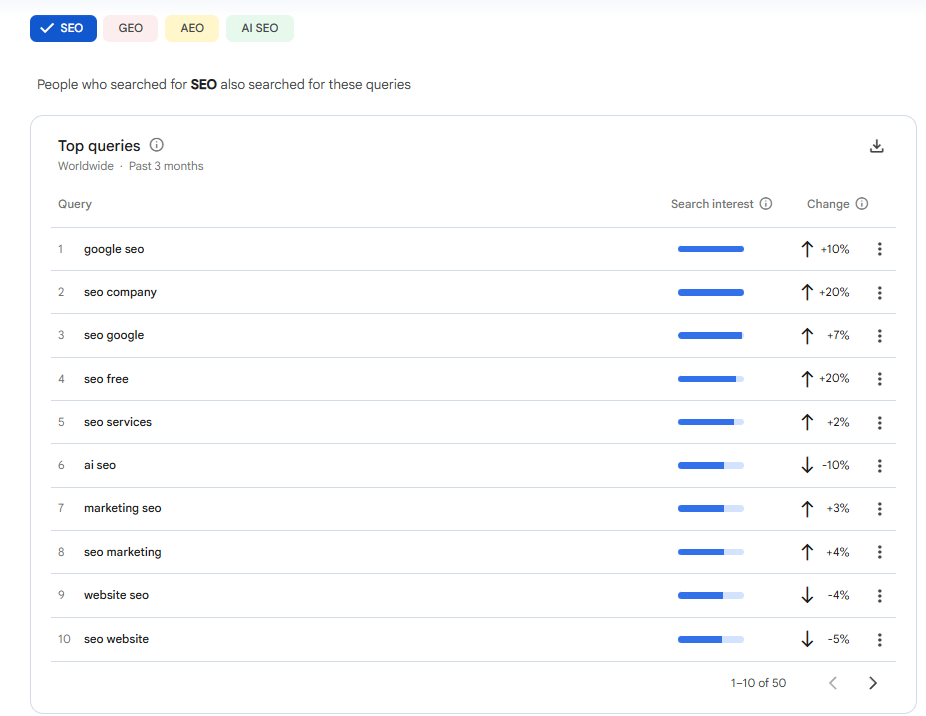
The one outlier worth noting is “ai seo,” which shows down 10% in that same period. This is the term that would capture people specifically interested in the intersection of artificial intelligence and search engine optimization. The fact that it’s declining while general SEO searches are climbing suggests that people are still approaching their search strategy through a traditional SEO lens, not an AI-first one — even as AI search itself becomes more prominent in how people find information.
The Explosive Growth Nobody’s Paying Enough Attention To
Where the data gets genuinely interesting is in the AEO (Answer Engine Optimization) category. While AEO search volume starts from a much smaller base than SEO, the growth rates are striking. Look at the top queries for people searching “AEO”: “aeo ai” is up 70%, “aeo geo” is up 80%, “geo” alone is up 70%, and several other related queries are showing similar 40-80% upward trends. This is growth that’s hard to dismiss as noise.
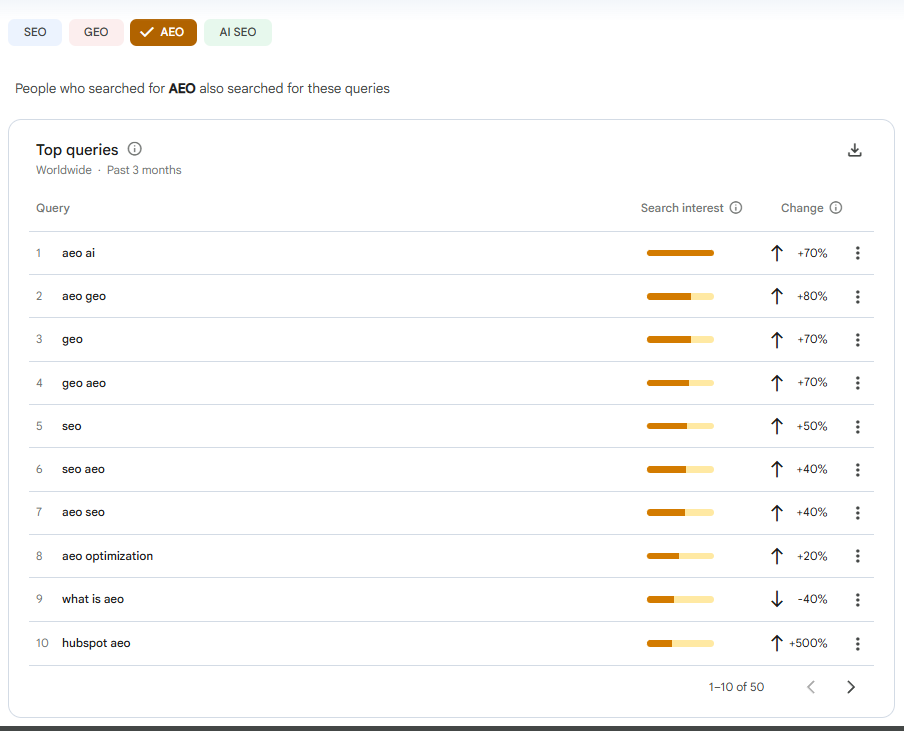
The composition of these searches also matters. People are actively searching for connections between AEO and AI, between AEO and GEO, and they’re searching for “geo” by itself, suggesting that the discipline is still forming its vocabulary and its boundaries. These aren’t settled, mature search categories — they’re emerging ones where people are still trying to understand how the pieces fit together. That’s exactly the pattern you’d expect from new concepts gaining traction in the market.
One particularly telling query is “hubspot aeo,” which shows up 500% growth — a staggering number that suggests a specific tool or platform is driving awareness of the concept. That’s how emerging categories often take off: a credible vendor packages it, explains it clearly, and suddenly search volume spikes around that specific resource. It’s not that AEO invented itself in the last three months; it’s that enough people are now searching for it that the volume became measurable.
The Revealing Story of AI SEO Search Volume
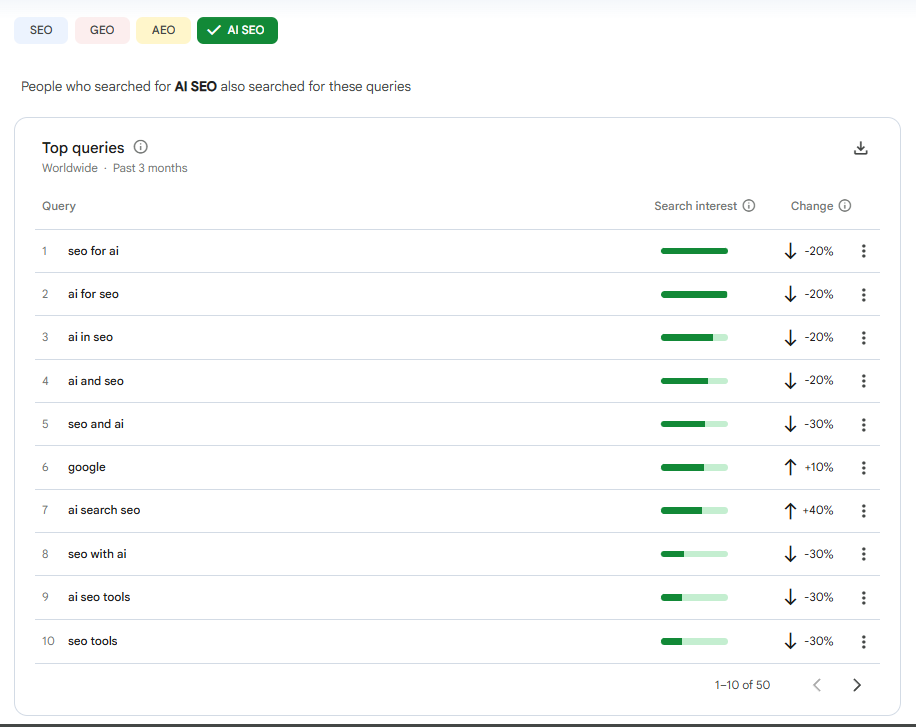
The AI SEO category paints a contrasting picture. While “AI SEO” as a general search term exists and is tracked, the top queries associated with it tell a different story: “seo for ai” is down 20%, “ai for seo” is down 20%, “ai in seo” is down 20%, “ai and seo” is down 20%, and most of the related queries show similar downward pressure. This is consistent declining interest, not a temporary fluctuation.
What this suggests is that “AI SEO” as a distinct category has not taken hold the way GEO or AEO have. People aren’t building a vocabulary around “AI SEO” in the way they are around the other emerging disciplines. The downward trend also hints at something else: initial curiosity and exploration has given way to either resolution (people got their answers and moved on) or disengagement (the term didn’t prove useful and people stopped searching for it).
This matters because “AI SEO” was, for a moment, the term that seemed like it might consolidate how people talked about optimizing for an AI-driven search landscape. The data suggests it hasn’t. Instead, the market has bifurcated into more specific terms: GEO for generative engines, AEO for answer engines, and traditional SEO for — well, traditional search, which remains where most content still gets discovered.
The GEO Category: Steady Growth From a Starting Line
GEO search volume sits in the middle ground — more active than AEO but less dominant than traditional SEO. The growth is steady rather than explosive, which suggests a category that’s gaining legitimate traction but hasn’t yet become mainstream vocabulary. This aligns with what I’ve observed in client conversations: sophisticated marketers and agencies understand GEO and are actively building programs around it, but it hasn’t cascaded down to the broader population of small businesses and individual site owners yet.
The composition of GEO searches appears to include a lot of “GEO vs. SEO” comparative queries and “GEO” plus other optimization acronyms, suggesting people are still trying to understand how GEO fits into their existing framework. That’s healthy — it means the market is treating GEO as a legitimate discipline worth understanding and comparing against established practices, rather than either dismissing it or treating it as a replacement for everything else.
What This Actually Tells Us About 2026’s Marketing Landscape
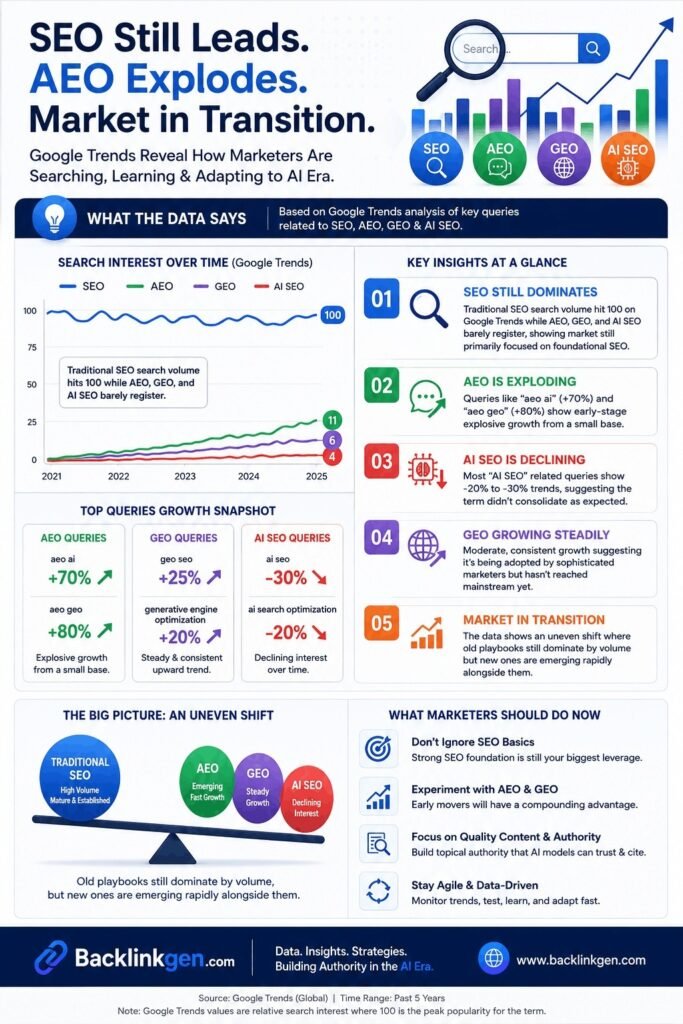
If I had to summarize what the Google Trends data reveals, it’s this: the market is in an uneven transition state. Traditional SEO remains the dominant concern by search volume, AEO is experiencing explosive early-stage growth, AI SEO as a distinct concept is actually declining, and GEO is growing steadily but hasn’t yet reached mainstream awareness. That’s not a picture of a market that has fully embraced AI-first search optimization. It’s a picture of a market where the old playbook still dominates, but new playbooks are rapidly emerging alongside it.
The practical implication is that there’s no single “right” answer to what marketers should focus on in 2026. Businesses that haven’t built a solid traditional SEO foundation yet should still prioritize that, because that’s where the majority of search volume still flows and that’s where the majority of the market is still looking for guidance. Businesses that have already built SEO competency should absolutely be adding GEO and AEO to their playbook, because the growth rates show that’s where emerging opportunity is concentrating. And the declining interest in “AI SEO” as a category suggests that businesses should stop waiting for a universal “AI search” playbook and instead get specific: understand how your content performs in generative engines, understand how it performs in answer engines, and optimize accordingly rather than treating them as one undifferentiated “AI search” problem.
Conclusion
Google Trends doesn’t tell you what’s optimal or what will matter most in six months — it tells you what’s happening right now, at scale. And right now, the market is searching for traditional SEO guidance at historically high levels, while simultaneously beginning to explore AEO at explosive growth rates. That tension between the old and the new is exactly where smart marketers should be operating in 2026: defending and maintaining the SEO foundation that’s still driving the majority of search visibility, while actively experimenting with and building competency around GEO and AEO for the channel share that’s consolidating around newer platforms.
The question isn’t SEO or AI search anymore — it’s how you build proficiency across both while the market itself is still figuring out the vocabulary and the boundaries.
Here is an infographic to conclude our research:

Amit Tyagi is a Senior Digital Marketing Specialist and Web Development Strategist with over 15 years of experience in SEO, website development, and data-driven digital growth. He has successfully built and optimized more than 50 websites across various industries, helping businesses improve online visibility, generate leads, and increase revenue through strategic digital marketing.
His expertise spans search engine optimization (SEO), content strategy, conversion-focused web development, marketing automation, and analytics-driven decision making. Amit combines technical development skills with advanced digital marketing strategies to create high-performing digital ecosystems for brands.
Throughout his career, Amit has worked on eCommerce, B2B platforms, and enterprise-level digital projects, delivering scalable solutions that align technology with business goals. He is also known for sharing insights on modern SEO trends, AI-driven marketing, and future digital strategies.
Amit believes that the future of marketing lies at the intersection of technology, data, and strategic storytelling.