Look, I’ve spent 18 years managing digital marketing campaigns for everything from state government projects to US-based IT firms. And I’ve learned something that most marketers get completely backwards.
We obsess over customer acquisition. We spend fortunes on Google Ads, Facebook campaigns, and SEO to get people in the door. But here’s what actually happens in most businesses: you acquire a customer, they make one purchase, and then they disappear. Forever.
The numbers are brutal. According to research from the Harvard Business Review, acquiring a new customer costs 5-25 times more than retaining an existing one. Think about that for a second. We’re sprinting on a treadmill, burning resources just to stay in place.
But what if I told you there’s a way to flip this completely? What if every customer who buys from you once becomes an advocate who brings others in?
That’s what I call the Authority Loop. And after working with clients ranging from government agencies to e-commerce platforms, I’ve seen it transform businesses.
The Problem Nobody Talks About
When I started consulting for digital marketing, everyone wanted to talk about conversion rates. How do we get more clicks? How do we improve our CTR? How do we rank higher for our target keywords?
Nobody wanted to talk about what happens after the sale.
Here’s the reality: a customer who has bought from you once is exponentially more valuable than a prospect who hasn’t. They already know your brand. They already trust you enough to spend money. They’ve experienced your product or service firsthand.
And yet, most companies treat them like they don’t exist after transaction complete.
In my work with state government digital transformation projects and USA-based IT firms, I noticed the same pattern. The organizations that succeeded weren’t the ones spending the most on ads. They were the ones turning customers into authorities. They were building systems that made customers want to talk about their brand.
This is where the Authority Loop comes in.
The 4-Part Authority Loop Explained
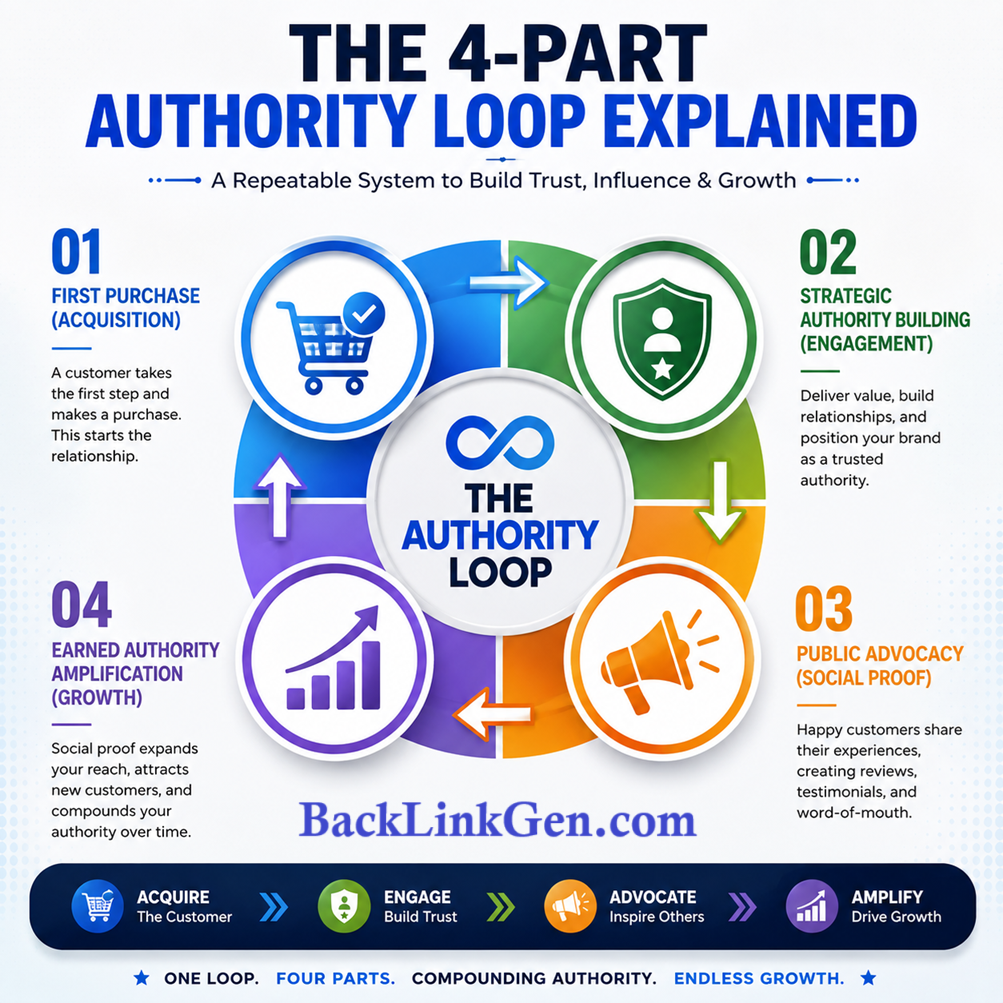
The Authority Loop is simple but powerful. It has four parts, and each one builds on the last:
- First Purchase (Acquisition)
- Strategic Authority Building (Engagement)
- Public Advocacy (Social Proof)
- Earned Authority Amplification (Growth)
Let me break each one down.
Part 1: The First Purchase and the Relationship Foundation
You’ve done your job in this phase. You’ve ranked your website, run your ads, and convinced someone to buy. But here’s where most businesses drop the ball.
The moment after purchase is critical. This is where you build the foundation for everything that comes next.
I learned this managing PPC campaigns and digital transformation initiatives. When a customer completes a purchase, their attention hasn’t left you. They’re in the moment. They’re engaged. And most companies respond with a generic automated email.
Instead, you need to set expectations for a great experience. Send a personal follow-up within 2-4 hours. Not a template. Something that shows you understand what they bought and why it matters.
When I consult on retention strategy for my clients now, this is always step one. The welcome phase is your chance to impress them before they even receive the product.
Part 2: Strategic Authority Building Through Education and Value
This is the phase that separates winners from losers.
After someone buys, they need to feel like they made the right choice. And the best way to do that is by teaching them how to get maximum value from what they bought.
At BacklinkGen, our editorial team (myself, Gaurav Saxena, and Rachit Srivastava) focuses on this constantly. We don’t just publish content for SEO traffic. We publish content that solves real problems for people who follow our work. That’s authority building.
For your customers, this might look like:
- Video tutorials on using your product
- Guides on getting the most ROI from your service
- Email sequences that share insider tips and best practices
- Webinars or live Q&A sessions
- Private community groups for your customers
In my Google Ads management work, I’ve seen clients get incredible retention when they create detailed guides on optimizing their campaigns. It’s not about selling more. It’s about making your customer successful.
This phase typically lasts 30-90 days. Your goal is to turn a customer into someone who is genuinely skilled at using what you sold them.
Part 3: Public Advocacy and Social Proof
Here’s where things get interesting.
Once your customer is skilled and satisfied, you invite them into the public conversation. You ask them to share their story. You encourage them to leave reviews. You get them to post about their results on social media.
This isn’t pushy. It’s authentic. Because at this point, they actually want to talk about you. They’ve gotten real value. They’ve achieved real results.
I’ve done SEO optimization for 40+ websites in WordPress and WooCommerce. The ones that grew fastest weren’t always the ones with the best products. They were the ones whose customers were talking about them everywhere.
Social proof is powerful. According to a study from BrightLocal, 98% of consumers read online reviews before making a purchase decision. Those reviews aren’t coming from your marketing team. They’re coming from people like your customers who felt compelled to share their experience.
Make this easy. Create a simple process for customers to:
- Leave video testimonials
- Write case studies
- Share results on LinkedIn or Twitter
- Answer questions in your community
When I was optimizing digital marketing strategies for government technology initiatives, I found that government agencies were skeptical until other government agencies vouched for solutions. Same principle applies in every market.
Part 4: Earned Authority Amplification
This is the final phase, and it’s where compounding growth happens.
Your customers become authorities themselves. They mention you in their networks. They recommend you without you asking. They become so associated with your solution that when people in their industry need what you sell, your name comes up naturally.
This is organic growth. This is earned authority. This is what every business dreams about but few actually achieve.
Here’s what this looks like in practice:
A customer becomes successful using your product. They start getting asked about their success. In explaining how they did it, they mention your solution. Someone asks them for a recommendation. They recommend you. That person becomes a customer. That person sees results. They tell others.
This is the loop. This is compounding growth.
When I consult with clients on long-term digital marketing strategy, we’re always working towards this. We’re not trying to constantly acquire customers. We’re building a system where satisfied customers bring in new ones naturally.
Making the Authority Loop Work in Your Business
Let me be practical here. This isn’t theoretical. I’ve implemented versions of this framework across e-commerce stores, SaaS platforms, and service businesses.
Here’s what you need:
First: An amazing product or service. You can’t build an authority loop on something mediocre. Your customer has to genuinely get value.
Second: Systems for communication. You need email sequences, a community platform, and easy ways for customers to share their story.
Third: Content that educates. This is where GA4 analytics matters. You need to track which education content actually moves customers forward.
Fourth: A process for gathering and sharing testimonials. Make it as simple as a form or a video upload tool.
Fifth: A network where your customers gather. This might be a private Slack community, a Facebook group, or a forum.
The investment upfront is real. But the return is exponential. Because now instead of spending 5-25 times more to acquire new customers, you’re getting them through word of mouth.
The Real ROI
Let me give you real numbers based on my experience managing digital marketing budgets.
A typical e-commerce business spends 1000-2000 USD monthly on ads to maintain 10 new customers per month. That’s 100-200 USD per customer acquisition cost.
If the average customer lifetime value is 500 USD, you need at least 3 repeat purchases to break even on acquisition cost.
But what happens when you build an authority loop?
Suddenly, every customer becomes a marketing channel. If even 20% of your customers bring in one new customer per year, you’ve doubled your growth without doubling your ad spend.
I’ve seen this happen for clients. A client managing SEM campaigns initially thought they had hit their growth ceiling. Then we implemented this framework. Within 6 months, 30% of new customers came from referrals and organic mentions.
The Authority Gap
Most businesses have a huge gap between what they spend on customer acquisition and what they spend on customer retention. This gap is where money goes to die.
My certification in Google Ads and digital marketing showed me that skilled marketers can get incredible acquisition numbers. But retention is the unglamorous work that actually builds businesses.
BacklinkGen’s focus on content for SEO and digital transformation is built on this principle. We’re not just chasing rankings. We’re building authority by actually helping people get better at what they do.
Your customers can be your greatest marketing asset. But only if you treat them like partners in your growth story, not just transaction points.
Your Next Step
Start with your current customers. Reach out to 10 of your most satisfied ones. Ask them about their experience. Ask them what value they’ve gotten. Ask them if they’d be willing to share their story.
You’ll be surprised at how many say yes.
Then build from there. Create systems to educate them. Make it easy for them to become advocates. Track what works.
The businesses that win aren’t the ones spending the most on acquisition. They’re the ones who understand that retention is the foundation of sustainable growth.
Note: AI is used for Image Editing in this article.
About Author:
Amit Tyagi is a Senior Digital Marketing Specialist and Web Development Strategist with over 15 years of experience in SEO, website development, and data-driven digital growth. He has successfully built and optimized more than 50 websites across various industries, helping businesses improve online visibility, generate leads, and increase revenue through strategic digital marketing.
His expertise spans search engine optimization (SEO), content strategy, conversion-focused web development, marketing automation, and analytics-driven decision making. Amit combines technical development skills with advanced digital marketing strategies to create high-performing digital ecosystems for brands.
Throughout his career, Amit has worked on eCommerce, B2B platforms, and enterprise-level digital projects, delivering scalable solutions that align technology with business goals. He is also known for sharing insights on modern SEO trends, AI-driven marketing, and future digital strategies.
Amit believes that the future of marketing lies at the intersection of technology, data, and strategic storytelling.