SEO becomes difficult for businesses when decisions are based on assumptions rather than data.
A company may publish dozens of blog posts every month, but that does not automatically mean those pages will generate qualified traffic. A B2B company may rank for hundreds of keywords, but many of those keywords may have little commercial value. Similarly, a website can have thousands of backlinks and still struggle to compete for important search terms.
This is where SEO platforms such as Semrush can become useful.
Semrush brings together several types of SEO intelligence, including keyword research, competitor analysis, backlink analysis, technical SEO auditing, content research, position tracking, and domain-level performance data.
But there is an important distinction:
Semrush should not be treated as a button that creates an SEO strategy for you. It should be treated as a source of data that helps you make better SEO decisions.
For B2B businesses, this distinction is particularly important because the objective is rarely just traffic.
A B2B company may be interested in:
- Qualified organic leads
- Demo requests
- Sales enquiries
- Enterprise prospects
- Brand visibility
- Product discovery
- Category authority
- Content-assisted conversions
- Long-term organic acquisition
In this guide, I will explain how I use the different capabilities of Semrush as part of a practical SEO strategy for businesses.
1. Start With Your Business Goals Before Opening Semrush
One of the most common SEO mistakes is starting with keywords.
I recommend starting with the business.
Before researching keywords, answer four questions:
- What does the company sell?
- Who is the ideal customer?
- Which products or services generate the most value?
- What action should an organic visitor take?
For example, imagine a B2B company providing warehouse automation software.
Its SEO objectives might include generating visibility for:
- Warehouse management software
- Inventory management software
- Warehouse automation solutions
- Warehouse management system comparison
- WMS implementation
- Inventory tracking software
But these keywords do not necessarily have equal business value.
Someone searching for “what is warehouse management” may be at an educational stage.
Someone searching for “warehouse management software pricing” is much closer to a commercial decision.
This means keyword volume alone should not determine your priorities.
I generally evaluate keywords through a combination of:
Search demand + search intent + business relevance + competition + conversion potential.
That framework should guide everything you subsequently do in Semrush.
2. Use Semrush for Keyword Discovery
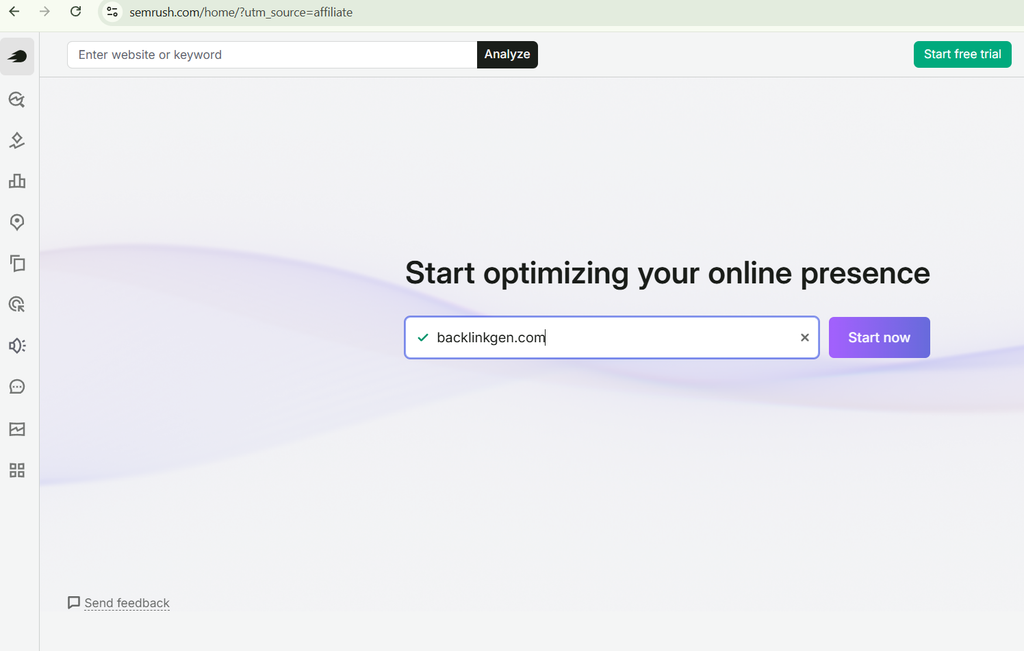
Semrush Get Started and put your domain and click start now.
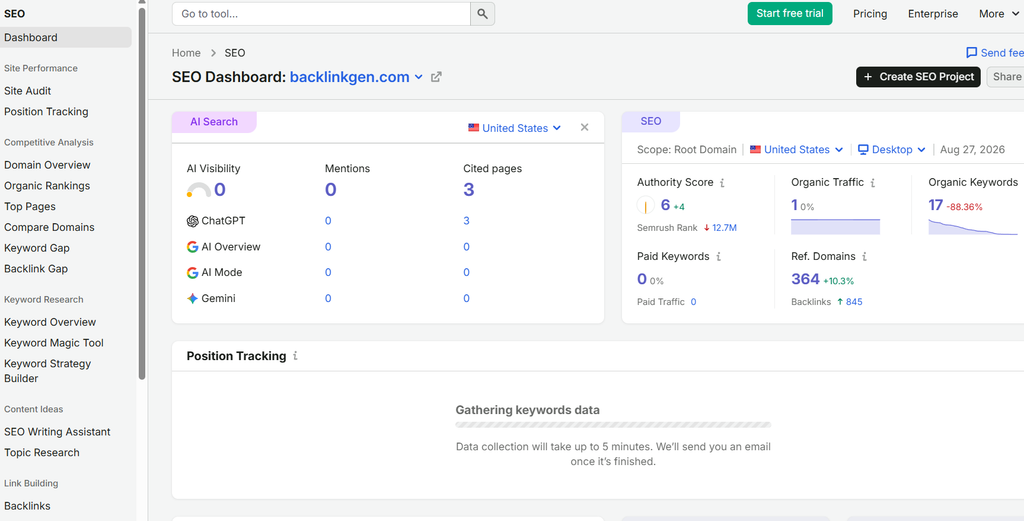
In Semrush Dashboard, you will see AI Visibility, SEO Performance and other Keywords Data Metrics.
Keyword research is one of the most useful starting points.
Instead of trying to guess what potential customers search for, use Semrush to discover the search landscape around your products and services.
Start with your primary product, service, or category.
For example, a cybersecurity company might begin with:
“cybersecurity services”
The objective is not simply to find the keyword with the highest search volume.
Instead, look for different groups of keywords.
Informational Keywords
These help potential customers understand a problem.
Examples:
- What is endpoint security?
- How does endpoint protection work?
- Cybersecurity risks for businesses
Commercial Keywords
These indicate that users are researching possible solutions.
Examples:
- Best endpoint security software
- Enterprise cybersecurity solutions
- Managed cybersecurity services
Transactional Keywords
These indicate stronger buying intent.
Examples:
- Buy endpoint security software
- Cybersecurity service provider
- Enterprise security software pricing
Problem-Based Keywords
These are particularly valuable for B2B content.
Examples:
- How to prevent ransomware attacks
- How to secure remote employees
- How to protect business data from phishing
A strong B2B SEO strategy normally needs all four categories.
The informational content builds visibility and authority.
Commercial and transactional content supports revenue.
Problem-focused content allows the business to enter the conversation before the prospect starts comparing vendors.
3. Analyze Keyword Intent Instead of Chasing Search Volume
This is where many businesses make a mistake.
Suppose Semrush shows:
Keyword A: 50,000 monthly searches
Keyword B: 2,000 monthly searches
It may appear obvious that Keyword A is better.
But suppose Keyword A is highly informational and unrelated to your product, while Keyword B is searched primarily by people looking for the exact service you provide.
The 2,000-search keyword could be much more valuable.
For B2B SEO, I recommend creating a keyword scoring framework.
For example:
| Factor | Question |
|---|---|
| Relevance | Is the keyword directly related to our business? |
| Intent | Does the search indicate research or buying intent? |
| Competition | Can our website realistically compete? |
| Value | Could the visitor become a customer? |
| Content fit | Can we create genuinely useful content around it? |
You can assign scores to each factor and prioritize keywords accordingly.
This converts keyword research from a list of search terms into a business decision-making process.
4. Use Semrush to Understand Your Competitors
Your competitors are not just other companies selling similar products.
In SEO, your competitors are also the websites appearing in the search results for your target keywords.
This distinction is extremely important.
A software company might consider three other SaaS companies its main competitors.
However, when searching for a topic such as “inventory forecasting,” the actual Google results may include:
- Industry publications
- Consultants
- Universities
- Software companies
- Research websites
- Review platforms
These websites compete for the user’s attention even if they are not direct commercial competitors.
Semrush can help you investigate competing domains and understand areas such as:
- Organic keywords
- Estimated organic traffic
- Top-performing pages
- Keyword overlap
- Competitor rankings
- Backlink profiles
- Content opportunities
The objective is not to copy competitors.
The objective is to understand why they are visible.
5. Find Content Gaps
One of my favorite uses of competitive SEO data is identifying content gaps.
Suppose your competitors rank for hundreds of relevant keywords, while your website does not appear for many of them.
That creates an opportunity.
A content gap analysis can reveal topics that competitors have already established visibility around but your business has not addressed effectively.
For example, imagine a CRM company.
Competitors may rank for:
- CRM implementation guide
- CRM migration checklist
- CRM for small businesses
- CRM integration
- CRM data migration
- CRM adoption strategy
- CRM implementation costs
The company may already have a product page for “CRM software” but lack supporting content around these related searches.
This creates a topic coverage problem, not necessarily a keyword problem.
The solution could be a structured content cluster:
CRM Software
→ CRM Implementation Guide
→ CRM Migration Guide
→ CRM Integration Guide
→ CRM Implementation Cost
→ CRM Adoption Strategy
→ CRM Data Management
Now the website has the opportunity to demonstrate deeper topical expertise.
6. Identify Low-Hanging SEO Opportunities
Not every SEO opportunity requires creating a new article.
Sometimes your best opportunity already exists on your website.
Look for pages ranking on the second page of Google, particularly positions around 11–30.
These pages can be excellent optimization candidates.
For example, suppose an existing article ranks:
- Position 18 for Keyword A
- Position 14 for Keyword B
- Position 22 for Keyword C
Instead of immediately creating three new articles, investigate the existing page.
Ask:
- Does it fully answer the search intent?
- Is the content outdated?
- Are important subtopics missing?
- Could the title be improved?
- Could internal links be added?
- Are relevant entities and terminology missing?
- Could the introduction answer the query more directly?
- Are there stronger competing pages?
Sometimes improving an existing URL is faster and more effective than starting from zero.
This is particularly useful for established B2B websites with hundreds or thousands of existing pages.
7. Use Semrush to Build a Topic Cluster
Modern SEO should not be approached as isolated blog posts.
If your business sells a particular product or service, build a topic ecosystem around it.
For example, a company selling enterprise data analytics software could create a central commercial page:
Enterprise Data Analytics Software
Supporting content could include:
- What is enterprise data analytics?
- Business intelligence vs data analytics
- How to build a data analytics strategy
- Data analytics KPIs
- Data visualization best practices
- Enterprise analytics implementation
- Data analytics challenges
- Data analytics ROI
- Data analytics case studies
Semrush keyword research can help identify the subtopics.
The next step is connecting them through internal links.
This creates a stronger information architecture and gives search engines more context about the website’s expertise.
8. Use Semrush for Technical SEO
Content alone cannot solve every SEO problem.
A technically weak website can struggle even when its content is excellent.
Use a technical SEO audit to identify issues such as:
- Broken links
- Crawlability problems
- Duplicate content
- Missing title tags
- Missing meta descriptions
- Redirect problems
- Canonical issues
- HTTPS problems
- Indexation issues
- Internal linking problems
- Slow or problematic pages
But don’t treat every technical warning as equally important.
This is another area where SEO professionals need judgment.
For example, a tool may identify hundreds of warnings.
That does not mean you need to fix all 100 immediately.
Prioritize problems according to:
Impact × scale × business importance.
A technical problem affecting your top 50 commercial pages deserves more attention than a minor warning affecting a handful of low-value URLs.
9. Analyze Your Backlink Profile
Backlinks remain an important part of SEO, particularly in competitive B2B industries.
Semrush can help you investigate your backlink profile and compare it with competitors.
Look at:
- Referring domains
- Backlink growth
- Authority of referring websites
- Anchor text
- Lost backlinks
- New backlinks
- Competitor backlink sources
The important question is not:
“How many backlinks do I have?”
The better question is:
“Which websites are linking to competitors but not to us?”
That question turns backlink analysis into an acquisition strategy.
For example, suppose three competitors have earned links from:
- Industry publications
- Technology directories
- Business associations
- Research websites
- Podcasts
- Professional communities
Those sources can become prospect lists for your own digital PR and link-building campaigns.
This is where SEO tools become much more powerful when combined with human outreach and relationship building.
10. Don’t Confuse Backlink Quantity With Backlink Quality
A large backlink number can look impressive in a report.
But 5,000 low-quality links do not necessarily provide more value than 50 genuinely relevant links.
For B2B businesses, I prefer evaluating backlinks through relevance and authority.
Consider two hypothetical links:
Link A: A highly relevant industry publication with a strong audience.
Link B: A generic website containing thousands of unrelated outbound links.
Link A may be significantly more valuable from a strategic perspective.
Therefore, backlink analysis should consider:
- Relevance
- Editorial context
- Website quality
- Audience relevance
- Link placement
- Authority
- Sustainability
This is also why businesses should avoid building links simply to increase a metric inside an SEO platform.
The goal is not to make the tool’s dashboard look better.
The goal is to improve organic visibility and business outcomes.
11. Track Your SEO Progress
Once your strategy is implemented, tracking becomes critical.
Semrush’s position tracking capabilities can help businesses monitor keyword performance over time.
Create a tracked keyword set around your most important topics.
I recommend separating keywords into groups such as:
- Brand
- Product
- Service
- Commercial
- Informational
- Competitor
- High-priority keywords
Then monitor changes over time.
For example:
Month 1: Position 34
Month 2: Position 21
Month 3: Position 14
Month 4: Position 9
This tells you that the page is moving in the right direction.
But rankings should not be your only KPI.
Also measure:
- Organic sessions
- Organic conversions
- Qualified leads
- Demo requests
- Revenue influenced by organic search
- Conversion rate
- Non-brand traffic
- Top landing pages
For B2B companies, this broader measurement framework is far more meaningful.
12. Connect SEO Data With Conversion Data
This is where SEO becomes a business function rather than just a marketing activity.
Suppose your website receives 100,000 organic visits.
That sounds impressive.
But if those visits generate only five qualified leads, the SEO strategy may need to be reconsidered.
Now imagine another website receiving 20,000 organic visits but generating 150 qualified enquiries.
Which strategy is better?
Obviously, traffic alone cannot answer the question.
Use Semrush for search intelligence, but combine it with analytics and CRM data to understand what happens after the visitor arrives.
Your reporting should ideally answer:
Which keywords → which pages → which visitors → which conversions → which revenue?
That is the connection between SEO and ROI.
13. Use Semrush Data to Build a 90-Day SEO Roadmap
Once you have completed keyword research, competitor analysis, technical auditing, content-gap research, and backlink analysis, convert the findings into an execution roadmap.
I generally recommend dividing the first 90 days into three phases.
Month 1: Foundation
Focus on:
- Technical SEO problems
- Keyword mapping
- Existing content analysis
- Competitor research
- Internal linking
- Priority landing pages
The objective is to establish a strong foundation.
Month 2: Content and Authority
Focus on:
- New commercial pages
- High-value informational content
- Content updates
- Topic clusters
- Digital PR
- Relevant backlink acquisition
The objective is to expand topical coverage and authority.
Month 3: Optimization
Focus on:
- Ranking improvements
- CTR optimization
- Content refreshes
- Internal-link improvements
- Conversion optimization
- Backlink opportunities
- Underperforming pages
The objective is to improve what is already working.
This creates a continuous SEO cycle rather than a one-time audit.
14. A Practical Example: B2B SaaS Company
Let’s take a hypothetical B2B SaaS company selling project management software.
Instead of simply targeting:
“project management software”
we could use Semrush to investigate the broader search ecosystem.
Potential keyword groups could include:
Commercial
- Best project management software
- Project management software for teams
- Enterprise project management software
Problem-based
- How to manage remote projects
- How to track project deadlines
- How to improve project collaboration
Comparison
- Project management software comparison
- Project management tools comparison
- Project management software alternatives
Implementation
- Project management software implementation
- Project management migration
- Project management software onboarding
The company could then build:
- A core product page
- Comparison pages
- Solution pages
- Educational articles
- Implementation resources
- Case studies
- Industry-specific pages
Semrush provides the research layer.
The business strategy determines what gets built.
15. How I Recommend Using Semrush as a B2B Marketer
After working across SEO, digital marketing, websites, analytics, and paid campaigns, I have found that the biggest value of an SEO platform comes from connecting different data points.
Don’t use Semrush once a year to produce an SEO audit PDF.
Use it as an ongoing decision-making system.
A practical workflow is:
Step 1: Understand business objectives.
Step 2: Research the market and keywords.
Step 3: Analyze competitors.
Step 4: Identify content and keyword gaps.
Step 5: Audit the technical foundation.
Step 6: Map keywords to existing and new pages.
Step 7: Build content clusters.
Step 8: Identify relevant backlink opportunities.
Step 9: Track rankings and organic performance.
Step 10: Connect SEO performance with conversions.
Step 11: Update pages based on actual performance.
Step 12: Repeat the process.
This turns SEO into a continuous optimization program.
16. Common Mistakes Businesses Make With Semrush
Mistake 1: Chasing High Search Volume
High volume does not automatically mean high business value.
Mistake 2: Copying Competitors
Competitor analysis should generate insights, not duplicate content.
Mistake 3: Treating Every Audit Error as Critical
Prioritize technical problems according to business impact.
Mistake 4: Measuring Only Rankings
Rankings are useful indicators, but leads and revenue are ultimately more important.
Mistake 5: Creating Content Without Search Intent
A keyword can have substantial search volume and still be the wrong target for your business.
Mistake 6: Ignoring Existing Content
Your biggest SEO opportunity may already be sitting on your website.
Mistake 7: Buying Links Based on Quantity
A large number of irrelevant links does not equal a strong SEO strategy.
Conclusion
Semrush can be an extremely useful platform for businesses that want to make SEO decisions using data rather than guesswork.
But the platform itself is not the strategy.
The real value comes from knowing what questions to ask of the data.
Which keywords matter to our customers?
Which competitors are winning organic visibility?
Which topics are we missing?
Which existing pages have growth potential?
What technical issues are holding the website back?
Where are competitors earning relevant backlinks?
Which keywords are improving?
And most importantly:
Is organic search contributing to business growth?
For B2B companies, SEO should ultimately connect visibility with commercial outcomes.
That means moving beyond vanity metrics such as total traffic or the number of ranking keywords.
A stronger approach is to identify commercially relevant search opportunities, create genuinely useful content, build topical authority, strengthen the technical foundation, earn relevant backlinks, and continuously measure what contributes to qualified leads and revenue.
Used this way, Semrush becomes much more than a keyword research tool.
It becomes a research and intelligence layer for your SEO strategy.
And that is how I recommend businesses use SEO platforms: not to generate more reports, but to make better marketing decisions.
If you want Digital Marketing Consulting for your business, Contact Us
Important Note: This article is for educational purposes. Semrush features, pricing, metrics, and interface options may change over time. Always validate SEO decisions against your own business data and objectives.
About Author:
BacklinkGen.com Editorial Team
The BacklinkGen.com Editorial Team is led by Amit Tyagi, Gaurav Saxena and Rachit Srivastava—professionals with expertise spanning enterprise technology, artificial intelligence, digital marketing, SEO, AI Search Optimization (AIO/GEO), content strategy, and business growth. Together, they bring decades of combined industry experience across global technology initiatives, performance marketing, and digital transformation.
Every article published on BacklinkGen.com is guided by practical experience, in-depth research, and a commitment to editorial accuracy. The team focuses on delivering trustworthy, actionable, and up-to-date insights that help businesses, marketers, and professionals stay ahead in the rapidly evolving world of search, AI, and digital marketing.