By Amit — Digital Marketing Consultant (E-E-A-T Author)
In today’s global marketplace, U.S. companies have an incredible opportunity to reach new audiences beyond borders. Yet many brands underestimate one of the most powerful growth levers — multilingual content.
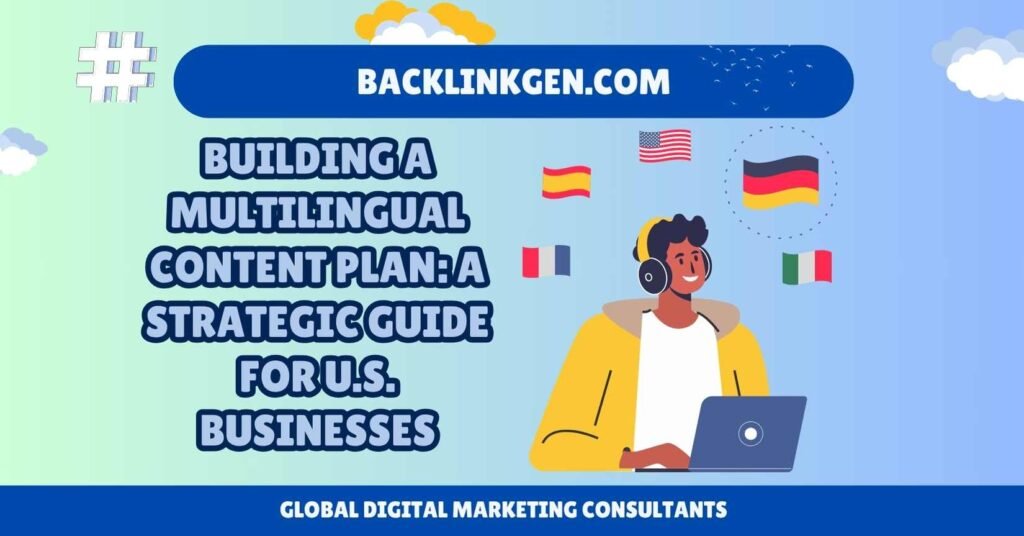
It’s no longer enough to translate a few web pages or social media posts. True global impact comes from creating a multilingual content plan that connects authentically with customers in their own language, culture, and context. Over the past decade helping American businesses expand internationally, I’ve seen firsthand how strategic multilingual planning turns “good” marketing into extraordinary global growth.
Let’s explore how your organization can build a multilingual content plan that drives real results — from brand awareness to conversions.
1️⃣ Why Multilingual Content Matters More Than Ever
The internet is global — but English isn’t universal. Over 70% of online consumers say they prefer to buy from websites in their native language. Even within the United States, cultural and linguistic diversity is expanding rapidly.
Think about it:
- The U.S. has over 42 million Spanish speakers, more than any country except Mexico.
- Asian and Middle Eastern communities represent a growing share of online consumers.
- Globally, markets like Latin America, Europe, and Southeast Asia are driving the next wave of digital commerce.
By creating multilingual content, you’re not just translating words — you’re showing respect for people’s identity, improving accessibility, and building trust.
2️⃣ Step One: Define Your Multilingual Strategy
Before you jump into translation, you need a clear strategy tied to business goals. Here’s how to begin:
a. Identify Target Markets
Start by pinpointing where you want to grow. Use analytics and sales data to identify regions with rising interest or existing demand. Are you targeting Spanish-speaking audiences in the U.S.? Or expanding into Europe or Asia?
b. Understand Market Potential
Research purchasing behavior, cultural nuances, and local competitors. A message that works in New York might not resonate in São Paulo or Paris.
c. Align Language Strategy With Business Goals
Every language you add requires investment — translation, SEO, design, support. Prioritize languages based on ROI potential.
3️⃣ Step Two: Conduct Cultural and Linguistic Research
A literal translation won’t cut it. What works linguistically or emotionally in English might miss the mark — or even offend — in another culture.
Here’s what we emphasize with our clients:
- Tone: Should your brand voice be formal, friendly, or aspirational? Tone perception differs widely by culture.
- Color and Imagery: Colors carry symbolic meanings. For example, white signifies purity in the U.S. but mourning in parts of Asia.
- Local Idioms: Avoid wordplay or humor that relies on English expressions. Instead, localize metaphors to resonate with native audiences.
A true multilingual content plan involves transcreation — rewriting content to convey the same meaning and emotion in another language, not just the same words.
4️⃣ Step Three: Build a Scalable Content Architecture
Once you know where you’re headed, you need the right foundation. Scalability matters. Many U.S. businesses start small — maybe one translated website — but soon find themselves juggling multiple versions, updates, and translations across regions.
Here’s what works:
a. Centralize Content Management
Use a content management system (CMS) that supports multilingual workflows, such as WordPress Multisite, HubSpot, or Adobe Experience Manager.
b. Create a Source Content Library
Keep all original (English) content organized with clear metadata, topics, and ownership. This makes translation, updates, and SEO tracking much easier.
c. Define Version Control
Track which pages exist in which languages and who’s responsible for updates. Outdated translations can damage brand credibility fast.
d. Automate Where Possible
Use translation management systems (TMS) like Lokalise or Smartling to streamline the process, manage translators, and integrate updates automatically.
5️⃣ Step Four: Combine Human and AI Translation
AI has transformed the translation landscape, but machines alone can’t ensure nuance or accuracy. For professional results, use a hybrid model:
- Machine Translation (MT): For bulk translation or low-risk content (like product specs, FAQs).
- Human Editing: For high-impact content — homepage, marketing campaigns, and storytelling.
- Cultural Review: Local experts review for tone, idioms, and relevance.
This approach gives you both efficiency and authenticity — and keeps your brand voice consistent across markets.
6️⃣ Step Five: Localize SEO
Even the best multilingual content won’t perform if it’s not discoverable. Localized SEO ensures your pages rank well in each region.
Here’s the process we follow:
- Keyword Research by Language: Don’t translate English keywords. Conduct keyword research natively — “car insurance” in English may not align with how Spanish speakers search.
- Use Hreflang Tags: Tell Google which language each version of a page targets.
- Optimize URLs: Use localized slugs (e.g.,
/es/for Spanish pages). - Localized Metadata: Translate meta titles, descriptions, and alt text.
- Backlink Strategy: Build links from local sites, directories, and media in each target country.
These steps ensure your multilingual content doesn’t just exist — it gets found by the right people.
7️⃣ Step Six: Adapt Content Formats
Your multilingual plan should go beyond text. Different cultures engage with content differently.
- Videos: Add subtitles or localized voiceovers.
- Infographics: Adapt visuals and data references to regional norms.
- Emails: Use local currencies, dates, and time zones.
- Social Media: Adapt posting schedules and hashtags by region.
For instance, short-form video performs incredibly well in Asian markets, while long-form educational posts are more effective in Europe. Match the medium to the audience.
8️⃣ Step Seven: Build a Multilingual Team
Successful multilingual content planning requires cross-functional collaboration.
Here’s the team structure we often recommend to U.S. firms expanding internationally:
- Global Content Strategist: Oversees the entire multilingual ecosystem.
- Regional Marketers: Bring cultural and linguistic insight.
- Translators and Editors: Certified native speakers.
- SEO Specialist: Manages localized keyword optimization.
- Project Manager: Coordinates workflows, deadlines, and updates.
Even if you outsource translation, maintain internal ownership of strategy and quality control. The goal is consistency across all languages.
9️⃣ Step Eight: Set KPIs and Measure Performance
What gets measured gets improved. Set clear KPIs to evaluate your multilingual content’s impact.
Track metrics like:
- Organic traffic by language
- Engagement (bounce rate, time on page)
- Conversion rates per region
- Local keyword rankings
- Social media reach in non-English channels
Use analytics tools like Google Analytics 4 (GA4) and Search Console to segment data by region and language.
If a particular market underperforms, analyze if it’s a translation issue, cultural misalignment, or technical problem (like hreflang errors).
🔟 Step Nine: Keep Testing and Updating
Multilingual content isn’t a one-time project — it’s a living system. As markets evolve, update your strategy regularly.
- Review translations every 6–12 months.
- Refresh keyword research annually.
- Stay aware of cultural shifts and trending topics in target regions.
- Conduct periodic content audits to ensure consistency and accuracy.
Digital maturity comes from iteration. Your first version won’t be perfect — but continuous refinement leads to long-term success.
💬 Real-World Example: U.S. Brand Going Global
One of our clients, a mid-sized SaaS company in Texas, wanted to expand into Latin America and Europe. Initially, they used direct translations of their English website. Traffic grew, but conversions lagged.
We built a multilingual content strategy that went far beyond translation:
- Rewrote core pages for cultural relevance (transcreation).
- Conducted Spanish and Portuguese keyword research.
- Localized video explainers with native voiceovers.
- Created regional landing pages with local testimonials and pricing.
Within six months, organic leads from Latin America grew by 230%, and bounce rates dropped by 42%.
That’s the power of doing multilingual content right — not as a checkbox, but as a strategic growth engine.
🌐 Common Mistakes U.S. Businesses Make
Even with the best intentions, many companies stumble when building multilingual content. Here are pitfalls to avoid:
- Using direct translation only — it strips emotion and meaning.
- Ignoring local SEO — your content won’t reach the right audience.
- Inconsistent tone across languages — damages brand trust.
- Underestimating cost and time — quality localization requires investment.
- Failing to measure ROI — without metrics, you can’t improve.
Remember: Multilingual content is an asset, not an expense. Treat it as a long-term investment in global brand equity.
🚀 The Future of Multilingual Marketing
The next decade will belong to brands that communicate across cultures seamlessly. With AI-driven translation, voice search, and localized digital experiences, consumers will expect businesses to “speak their language” — literally and emotionally.
U.S. companies that start building robust multilingual ecosystems today will dominate global digital landscapes tomorrow. Whether you’re a startup or an enterprise, this is your opportunity to lead.
🏁 Final Thoughts
As someone who’s helped dozens of American firms scale internationally, I’ve learned that successful multilingual content planning is not about translation — it’s about connection.
Every language you add to your digital ecosystem is a bridge to a new audience, a new market, and a new opportunity. But that bridge must be built strategically — with research, cultural empathy, and a scalable content framework.
If your company is ready to expand globally, start with one question:
“Are we truly speaking our audience’s language?”
If not, now’s the time to build that multilingual content plan — and open your brand to the world.
About the Author
Amit is a Senior Digital Marketing Consultant with over a decade of experience helping U.S. businesses transform their online presence, scale globally, and achieve measurable growth through data-driven, multilingual strategies.

BacklinkGen.com Editorial Team
The BacklinkGen.com Editorial Team is led by Amit Tyagi, Gaurav Saxena and Rachit Srivastava—professionals with expertise spanning enterprise technology, artificial intelligence, digital marketing, SEO, AI Search Optimization (AIO/GEO), content strategy, and business growth. Together, they bring decades of combined industry experience across global technology initiatives, performance marketing, and digital transformation.
Every article published on BacklinkGen.com is guided by practical experience, in-depth research, and a commitment to editorial accuracy. The team focuses on delivering trustworthy, actionable, and up-to-date insights that help businesses, marketers, and professionals stay ahead in the rapidly evolving world of search, AI, and digital marketing.