
By Amit, Senior Digital Marketing Specialist & Web Development Strategist
Executive Summary: The End of the Click-Through Era
The digital marketing landscape is undergoing its most profound transformation since the dawn of the search engine. Google’s recent global test on mobile—seamlessly connecting AI Overviews directly to AI Mode on the search results page—isn’t just another feature update. It is the definitive signal of a paradigm shift from a web of links to a world of self-contained, conversational answers.
As a strategist with over 15 years of experience navigating algorithm updates and platform shifts, I see this integration as a fundamental rewrite of the rules. Google’s stated vision, to let you “just ask whatever’s on your mind… and find exactly what you need” without thinking about how to ask, is now a technical reality. This move accelerates the trend of zero-click search, where user journeys begin and end within Google’s interface. For businesses, especially in competitive fields like IT consulting and specialized e-commerce, this demands an immediate and strategic response. The goal is no longer just to rank on the first page; it is to become the indispensable, citable source that powers the AI’s answer.
The Anatomy of the Shift: From Two Paths to One Seamless Journey
To understand the impact, we must first dissect the change. Previously, Google’s AI offerings were fragmented: an AI Overview provided a quick snapshot at the top of search results, while the more powerful, conversational AI Mode was a separate interface, requiring users to consciously switch tabs or navigate away. Google’s own product managers have admitted AI Mode felt like a “separate silo”.
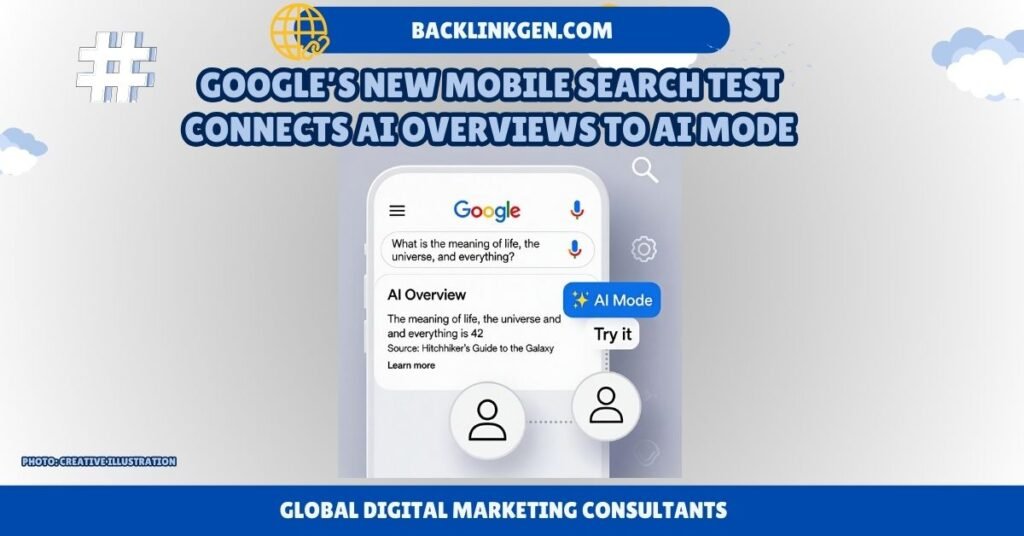
The new test obliterates this barrier. Now, after receiving an AI Overview, a user can simply tap a “Show more” button to be instantly transitioned into the AI Mode interface, right on the same page. An “Ask anything” bar appears, inviting follow-up questions, deeper research, and multi-turn conversations without ever loading a new URL.
The Old vs. New User Journey
| Aspect | Old, Fragmented Model | New, Seamless Integration |
|---|---|---|
| Starting Point | Standard Search Results Page (SERP) with AI Overview. | Same SERP with AI Overview. |
| Action for Deeper Query | User must notice and click a separate “AI Mode” tab or option. | User taps “Show more” in the AI Overview. |
| Result | Redirect to a different AI Mode interface. | Instant expansion into AI Mode on the same page. |
| User Cognitive Load | High. Must understand two different tools and choose a path. | Low. Natural progression from snapshot to conversation. |
| Likelihood of Leaving SERP | Higher, as the journey is discontinuous. | Much lower. The entire session is contained within Google. |
This frictionless flow is a masterstroke in user experience but a potential chokepoint for website traffic. As Search Engine Land notes, the large “Show more” button now leads to a deeper AI answer, not more source links, making a click to your site “less likely”.
Beyond the Button: The Powerful AI Engine Driving This Experience
This seamless interface is powered by Google’s most advanced AI infrastructure, designed to handle complexity that would stump traditional search.
- The “Query Fan-Out” Powerhouse: At the core of AI Mode is a technique called “query fan-out” or “query expansion”. When you ask a complex question like, “Plan a 3-day tech-focused itinerary for San Francisco for a solo traveler,” the AI doesn’t perform one search. It intelligently breaks your question into subtopics—neighborhoods, notable tech company HQs, museum hours, transit between them—and executes hundreds of simultaneous searches on your behalf. It then reasons across this vast information to synthesize a coherent, step-by-step plan.
- Multimodality as Standard: You are no longer limited to text. AI Mode is built for text, voice, and image input. You can snap a photo of a piece of hardware and ask how to integrate it with your existing system, or upload a screenshot of an error log and ask for troubleshooting steps. This is a game-changer for visual industries and technical support.
- The Frontier Model: Gemini 3 Pro: For subscribers to Google’s AI Premium plan, an even more powerful engine is available: Gemini 3 Pro. This model brings “advanced reasoning” and can even generate dynamic, interactive interfaces like custom simulations or visual tools tailored to your query. Imagine asking for a comparison of cloud server configurations and receiving an interactive cost-performance chart you can manipulate.
The Strategic Imperative: Thriving in the “Answer Engine” Ecosystem
Forget chasing clicks. The new imperative is to become the authoritative source the AI must cite. If your content is not synthesizable, citable, and deemed supremely authoritative, you risk invisibility in the most valuable, complex searches. Here is the new playbook, informed by this shift.
1. Content Strategy: From Keywords to Concepts & Context
The old keyword-stuffed page is dead. AI’s query fan-out seeks comprehensive, context-rich information.
- Master Topic Clusters: Don’t create isolated pages. Build comprehensive topic pillars surrounded by detailed, interlinked cluster content. For an IT consulting firm, a pillar on “Cloud Migration Strategy” should be surrounded by deep dives on cost analysis, security frameworks, employee training plans, and case studies for specific industries. This creates a knowledge graph the AI can mine.
- Anticipate Follow-Up Questions: Write with the conversation in mind. If your article explains “ERP Implementation,” proactively answer the next logical questions within the content: “How long does it typically take?” “What are the most common pitfalls?” “What is the typical ROI timeline?” This directly feeds the AI’s conversational flow.
- Structure for Machine & Human: Use clear hierarchical headers (
H1,H2,H3), bulleted lists, and definition tables. Publish in FAQPage schema markup to explicitly signal questions and answers to Google’s crawlers. Make your content effortlessly parsable.
2. Technical SEO & E-E-A-T: The Bedrock of Authority
Technical excellence and proven expertise are your tickets into the AI’s response.
- Fortify E-E-A-T Signals: Experience, Expertise, Authoritativeness, and Trustworthiness are more critical than ever. Showcase author credentials with bylines and bios. For a B2B e-commerce site, have product specifications authored and verified by certified engineers. Pursue backlinks from .edu, .gov, and recognized industry bodies.
- Structured Data is Non-Negotiable: Implement schema.org markup religiously—for products, local business info, articles, how-to guides, and events. This gives the AI clear, unambiguous signals about your content’s meaning and context.
- Site Performance as a Ranking Factor: A slow site signals poor user experience and technical neglect. Core Web Vitals are a baseline. In an AI-first world, a fast, secure (HTTPS), and mobile-optimized site is table stakes for being considered a reliable source.
3. Measuring Success in a Zero-Click World
Our KPIs must evolve. While overall traffic may fluctuate, quality becomes the north star.
- Track AI-Generated Traffic Separately: In Google Analytics, segment traffic coming from “AI Overviews” or “AI Generation.” Monitor behavior flow: do these users, who arrive perhaps deeper in your site via a specific citation, have higher engagement or conversion rates? Early Google data suggests that while clicks from AI Overviews may drop, dwell time and conversion quality can improve.
- Monitor Your “AI Share of Voice”: Use tools to track when and for which queries your brand or content is cited in AI Overviews. Are you the primary source or a footnote? This is your new share of voice.
- Prioritize Goal Completions Over Clicks: Shift focus to form submissions, demo requests, content downloads, and high-value page views. The goal is to attract the deeply researched user who arrives ready to engage, not the casual browser.
The Publisher’s Dilemma and the Path Forward
The industry concern is valid and stark. As The Keyword notes, this integration could lead to more queries being resolved entirely within Google’s interface, a scenario publishers have long feared. The initial traffic dip is a real threat.
However, this is not an extinction-level event for savvy businesses. It is a forced evolution. The future belongs to deep expertise, not shallow content. The AI cannot replace firsthand experience, proprietary data, authentic customer stories, or true thought leadership. Our task is to double down on creating that irreplaceable value and packaging it in a way that the intelligent machines of 2025 and beyond recognize, trust, and are compelled to reference.
The seamless bridge from AI Overview to AI Mode is more than a UX tweak; it is the closing of a loop. It finalizes Google’s transition from a search engine to an answer engine. For marketers and business owners, the message is clear: adapt your strategy to serve the AI’s need for supreme, structured, and authoritative truth, and you will win the audience that matters most.
The User Journey is Redefined: A Deeper Strategic Analysis
Google’s technical merging of AI Overviews with AI Mode is a masterclass in user experience design, but for businesses, it represents a fundamental rewrite of the digital user journey. The core principle is no longer “search, scan results, click,” but rather “ask, converse, resolve.” This has profound implications for how we attract potential customers.
The Shift in Searcher Intent and Your Strategic Posture
To adapt, you must first understand how searcher behavior is being reshaped. The new seamless flow encourages deeper exploration within Google’s interface, changing what a “visit” to your site means.
This table underscores the critical shift: the battleground for attention has moved upstream. The competition is no longer just the other websites on the SERP; it’s the completeness and persuasiveness of Google’s own AI-generated answer. If that answer satisfies the user, your click-through rate plummets. If, however, your expertise is woven into that answer as a critical source, you attract a user who is already informed and leaning toward a solution you provide.
The Publisher’s Reality: Navigating the “Traffic Paradox”
Let’s address the elephant in the room head-on. This integration poses a direct challenge to website traffic, and Google is well aware of publisher concerns. As Ben Kaufman, AI Mode Product Manager, stated, the old AI Mode felt like a “separate silo”. This update aims to make it a “natural part of the…page”, which by definition keeps users engaged within Google’s ecosystem longer.
The data is sobering: with AI Overviews already appearing in over 50% of searches, click-through rates for traditional top positions have declined significantly. This new, smoother path to deeper AI conversation threatens to accelerate that trend. The user taps “Show more” and is presented with an “Ask anything” bar, inviting a dialogue that can answer follow-up questions, perform comparisons, and generate visuals—all potentially without a single external click.
This is the “Traffic Paradox” of AI search: while overall referral clicks may decrease, the quality and intent of the clicks that remain can be dramatically higher. The key for businesses is to stop fighting this paradox and start leveraging it. The goal shifts from chasing maximum traffic to attracting maximum qualified intent.
The Practical Playbook: Earning Your Place in the AI Conversation
So, how do you become the indispensable source? Based on the mechanics of how AI Overviews and AI Mode work, here is your actionable playbook.
1. Architect Your Content for AI “Query Fan-Out”
Google’s AI uses a “query fan-out” technique, breaking complex questions into subtopics and searching them simultaneously. Your content must anticipate this.
- Build Topic Clusters, Not Isolated Pages: For a core topic (e.g., “cloud migration strategy”), create a pillar page and surround it with deep, interlinked cluster content on subtopics (cost analysis, security frameworks, industry-specific case studies). This creates a comprehensive knowledge graph the AI can mine.
- Structure for Scannability and Synthesis: Use clear, hierarchical headers (
H1,H2,H3), bulleted lists, and definition tables. Start articles with a direct, concise answer to the presumed query. This makes your content effortlessly parsable for synthesis into an AI Overview. - Implement Strategic Schema Markup: Go beyond basic Article schema. Implement FAQPage, HowTo, and QAPage schema to explicitly structure your questions and answers, giving the AI clear, unambiguous signals about your content’s purpose.
2. Master the New “E-E-A-T+” for the AI Era
Experience, Expertise, Authoritativeness, and Trustworthiness (E-E-A-T) are more critical than ever, but they must be demonstrable to an AI.
- Showcase First-Hand Expertise: Have product specs authored by certified engineers. Feature case studies with detailed data. Use author bios that highlight specific, relevant credentials. AI seeks content that demonstrates real-world application.
- Become a Cited Authority: Pursue backlinks from .edu, .gov, and recognized industry associations. When the AI is fanning out queries, it heavily weights these authority signals. A mention in a whitepaper or research study is now a top-tier SEO asset.
- Embrace Multimodality: The AI-powered future is multimodal. Ensure your key content includes relevant, high-quality images, charts, and videos with descriptive filenames and alt text. An AI responding to a visual query is more likely to cite a source that provides a strong visual component.
3. Target Conversational and Long-Tail Queries
The queries that trigger this seamless AI experience are naturally longer and more complex.
- Shift Keyword Research: Use tools to find question-based queries (“how to,” “what is the best way to,” “compare X vs Y for Z scenario”). Target these long-tail, high-intent phrases aggressively.
- Create “Iterative” Content: When you write a guide, anticipate and answer the next logical questions within the content. If your article is “How to Implement an ERP,” include sections on “Common ERP Implementation Pitfalls” and “Measuring ERP ROI.” This directly feeds the AI’s conversational follow-up flow.
4. Rethink Your Metrics and Goals
Your analytics dashboard needs a rethink.
- Track New Success Indicators: Monitor your visibility in AI-generated answers. While direct tracking is evolving, analyze traffic segments for keywords likely to trigger Overviews. Look for changes in user behavior: are sessions longer? Is bounce rate lower? Is conversion rate higher? This indicates you’re attracting that high-intent user.
- Prioritize Goal Completions Over Pageviews: Shift internal KPIs toward form submissions, demo requests, high-value content downloads, and purchases. Frame SEO success as driving business outcomes, not just search engine referrals.
Looking Ahead: The Inevitable Integration and Your Opportunity
This mobile test is not an experiment that will be rolled back. It is a decisive step toward Google’s stated vision: “just ask whatever’s on your mind… and find exactly what you need”. AI Mode is being baked into the core search experience.
For the savvy business, this isn’t a threat; it’s a filter. It will separate those who create shallow, generic content from those who invest in deep, authoritative expertise. The future belongs not to those who game an algorithm, but to those who become the definitive source of truth in their domain. By architecting your digital presence to serve the AI’s need for superior, structured, and trustworthy information, you will consistently earn the most valuable asset in the new search landscape: the citation that leads to a conversation-ending, high-converting click.