Executive Summary: The digital marketing landscape of 2026 is being transformed by AI-driven agentic search and AI-native browsers like Perplexity’s Comet. These technologies empower AI agents to interpret intent, browse the web, synthesize information, and even execute tasks – shifting the traditional SEO/SEM model to a brand-centric, “zero-click” paradigm. As IBM (2025) notes, tools like Comet can book restaurants or draft emails on your behalf, signaling a new era of search. Google’s 2026 Search update introduces “information agents” and in-Search assistants that continuously scan the web for user-specific needs. In practice, this means search intent is no longer linear (“type query, get links”) but interactive: a prompt leads to an AI-synthesized answer and suggested actions. For marketers, this demands an “Answer Engine Optimization” strategy: robust, structured data; authoritative, machine-readable content; and omnichannel brand signals (social, reviews, PR) to get AI agents’ trust. Content must scale via LLMs and retrieval-augmented generation (RAG) for personalization, while paid media and attribution models must adapt as AI agents make or skip ad clicks (Swap-Commerce, 2025). UX and conversion flows must be agent-friendly (e.g. no blocked forms). Marketers should audit for AI crawler access (allow GPTBot, Comet, etc. in robots.txt), enrich schema markup, and focus human experts on high-value content while automating volume generation with AI. New tools and skills – from Comet/agentic platforms to data governance – are essential (BCG, 2026). We detail these dimensions and actionable tactics, and explain how BacklinkGen can help brands navigate and leverage the agentic search revolution.
Introduction
I’m Amit, a digital marketing strategist, and I’ve been closely following how AI is changing search. In 2026, AI browsers like Comet and emerging agentic search paradigms are upending the way customers discover and engage with brands. I saw an IBM Think article testing Perplexity’s Comet browser, which illustrated how it can act on a user’s behalf – booking restaurants, emailing contacts, and summarizing content. Meanwhile, Google’s I/O 2026 keynote introduced AI-powered “Search agents” that can monitor the web 24/7 for personalized needs. As a marketer, this is huge: instead of optimizing for clicks on “blue link” SERPs, I now need to think about how my brand appears in AI-generated answers and automations. In this article, I’ll dissect the technology behind AI browsers and agentic search, analyze the impacts on intent, SEO, content, ads, UX, and data, and share concrete recommendations. My goal is to give marketers and SEO managers a practical roadmap for 2026’s AI-driven search world.
Technical Overview: AI Browsers and Agentic Search (Capabilities, Architecture, Privacy)
AI browsers and agentic search systems merge web browsing with autonomous AI agents. Perplexity’s Comet is a prime example: it’s a Chromium-based browser with a built-in AI assistant and search engine. Unlike extensions or chatbots, Comet embeds an LLM natively and uses Perplexity’s AI search by default, returning real-time cited answers instead of link lists. Its agentic layer actively monitors open tabs and user context. For example, Comet’s assistant can summarize a page, compare products across sites, book flights, or draft emails based on what you’ve seen. This is a shift from manual navigation (“search, click, repeat”) to delegation: you tell Comet to “Find me the best office chair under $50” and it browses and compiles options for you. Architecturally, Comet (and others like The Browser Company’s Dia or Opera Neon) run AI models in the background, using memory and context across pages. This means it holds a persistent memory of your actions (even across sessions) and can execute multi-step workflows automatically.
Privacy & Security: Agentic browsers blur the line between human browsing and automation. Comet operates with the user’s real identity and credentials (cookies, logins) and its network traffic looks like normal Chrome. This poses privacy and security risks: for instance, Comet’s AI could ingest malicious page content and act on it using your logged-in session. In practice, privacy models now include user-controlled context (like Google’s “Personal Intelligence” linking Gmail or Calendar with user consent) and policy-as-code governance (Airia 2026 suggests embedding controls directly into agent design). From a marketing perspective, it’s crucial to test how your site handles AI visitors: agents may ignore robots.txt rules and traverse links like a human. A concrete tactic is to simulate an agent crawl (using tools that mimic Perplexity or GPT user agents) and ensure pages are accessible (e.g. server-side render content, enable clean schema markup).
| Feature / Capability | Traditional Browser/Search | Agentic Browser/Search |
|---|---|---|
| Interaction model | User submits query → Page of links | User issues goal → AI analyzes, retrieves, synthesizes, possibly acts |
| Output | Link list + Snippets | Coherent synthesized answer and actions (booking, shopping) |
| Context | Single query, little memory | Persistent, multi-tab memory, cross-session awareness |
| Privacy model | Standard user-agent identity | Uses user’s credentials silently, with little verifiable identity |
| Compliance | Respects robots.txt, CAPTCHAs | Often ignores robots.txt and CAPTCHA, acts on behalf of user |
Actionable Recommendation: Audit your site for AI crawler access and session handling. For example, allow known AI-agent user agents (like PerplexityBot or GPTBot) in robots.txt, and ensure key content is accessible server-side (not behind JavaScript). Implement or update structured data (schema.org) for your products and articles, so that AI agents can easily parse details without scraping UI elements. In summary, treat agentic search as a new technical medium: harness its capabilities (e.g. integrate with your data via API for real-time answers) while safeguarding user sessions.
Changing Search Intent & SERP Dynamics
Agentic search changes what users expect from a query and how SERPs look. Traditionally, a search journey was “Query → Results page with links → User clicks a link.” Now it’s becoming “Prompt → AI interpretation → Synthesized answer → Actionable output (with possible links)”. Google’s 2026 update explicitly calls this an “AI mode,” where the Search Box itself is AI-powered with multi-modal inputs (text, image, files) and provides instant answers. Users can even have follow-up conversations without losing context. IBM analysts note that with AI search (like Comet or Perplexity), click-through rates fall: people stay on the AI interface in a “zero-click” fashion. In practical terms, search intent evolves from finding a link to getting a result or task completed.
Moreover, AI search overhauls SERP structure. SEO Sherpa observes that the SERP is “becoming less central” and more like a dynamic interface. AI Overviews and agents will fetch and compare data across multiple sources. For example, an information agent might scan news sites, social media, and product feeds in real-time to give a personalized summary. The result is often a ranked shortlist of answers, not a page of 10 blue links. As SimilarWeb notes, users typically accept the top 3 AI-recommended results without re-ranking them. In effect, Google’s query process shifts to: Prompt → Agent analysis → Best answers → Suggested actions (e.g. “Book now” buttons).
Actionable Recommendations: Adapt content for direct answers and conversational AI. For example, convert key FAQs into concise, well-structured answers (<50 words) so AI agents can easily parse and cite them. Optimize your knowledge graph and snippet content, since AI may pick and deliver your info directly. Also, think beyond Google’s page-one rank: build omnichannel presence (social, video, review platforms) because AI agents pull from “multiple trusted signals” across the web. In practice, ensure that your brand is mentioned and positively described on third-party sites (review sites, technical blogs, news) since agents use consensus in choosing what to present. Experiment with AI assistants yourself (like Comet or experimental search agents) and note what information they highlight; this can guide optimizing those pieces of content. Ultimately, expect search intent to be more complex (“plan my trip” vs “nearest restaurants”), so content should address multiple intent layers, and include clear calls-to-action that an agent can present as “Next steps.”
Impact on SEO Strategies (Keywords, Content, Structured Data)
AI browsers and agentic search demand a radical rethink of SEO. As one IBM expert put it, “It changes SEO forever” – moving from keyword-driven tactics to AI-first “AEO” strategies. Traditional factors (keywords, backlinks, ranking) still matter, but must integrate into a broader brand-driven ecosystem. For example, Google’s new search uses entity understanding and personal data. It assembles answers based on what it knows about your brand: your website, social profiles, PR mentions, product catalogs, and more. As a result, entity authority is crucial. SEO Sherpa coins this “Search Everywhere Optimization,” meaning you must build consistent brand signals across the full discovery ecosystem.
Several new layers emerge:
- Find (Crawlability): Ensure AI crawlers and agents can find your content. SimilarWeb emphasizes that agents need to discover your brand first. Test your
robots.txtto allow AI bots (Perplexity, ChatGPT, Google’s new “Google-Extended” bots). Avoid heavy JavaScript pages without a server-rendered fallback. Provide a clear sitemap and static URLs so that an agent’s retrieval step can fetch your pages. For example, the “Find” layer fails if structured data or content is hidden behind scripts. A micro-tactic: use tools like Google’s Rich Results test or GPTBot’s crawler to verify accessibility and schema markup. - Analyze (Content Clarity): The agent then analyzes content for consistency. Make your core value proposition and product features explicit in plain HTML text. If your homepage and pricing page say different things, an agent may treat that as a conflict. SimilarWeb’s FACT framework suggests listing features in bullet or table form, and putting pricing information in HTML instead of in images or gated forms. Add concrete data and statistics: research shows that pages with quantified stats get cited by LLMs 41% more. Recommendation: audit your pages for ML-readability – ensure critical info (benefits, pricing, contact) is textually present and schema-tagged, not buried in verbose paragraphs.
- Corroborate (Authority Signals): Agents use consensus from external sources. As SEO Sherpa points out, if trusted third-parties describe your brand differently than you do, the agent goes with consensus. Thus, invest in digital PR and reviews. Encourage satisfied customers to leave reviews on Google, Amazon, or industry sites. Create or contribute to authoritative content (guest posts, expert interviews, press releases) that reinforce your key messages. The goal is for independent sources to “corroborate” what your site says. For example, ensure tech blogs and analysts use the same product terminology you use. This makes your description “the one the agent finds in agreement”.
- Trigger (Technical Readiness): At the highest level, the agent must be able to act with your brand. If your sign-up or checkout flow uses unsupported features (CAPTCHAs, complex multi-page forms, OAuth traps), an agent will abandon and move on. In practice, make critical calls-to-action and forms as straightforward as possible: use simple HTML forms, visible buttons, and minimal pop-ups. Ensure responsive design across devices (some agents mimic mobile browsing). One tactic: run your own AI agent through the conversion funnel. For instance, in Google’s Experiments or a live session, attempt to complete a purchase or lead form via an AI assistant (like ChatGPT browsing mode) to identify bottlenecks.
| SEO Focus Area | Traditional SEO | Agentic SEO (AEO) |
|---|---|---|
| Keywords & Content | Target specific terms; long-form content | Focus on answering complex queries; clear headings; bullet lists and data that AI can cite |
| Structured Data | Optional/Bonus for SERP | Essential; schema for products, FAQs, reviews so agents parse info easily |
| Authority Signals | Backlinks, social shares | Brand mentions across blogs, news, social, reviews (Search Everywhere Optimization) |
| User Metrics | Clicks, dwell time | Engagement may be direct (users stay in AI pane); focus on content usefulness and completeness |
| Competitive Analysis | Keywords rank vs peers | Entire brand presence vs other brands in AI’s “shortlist” |
Actionable Example: Add comprehensive FAQ schema to your site. Frame each common question succinctly and include the direct answer in HTML. AI overviews and agents frequently pull from FAQ content for concise answers. For instance, an ecommerce site might create FAQs like “Does [Product] come in men’s and women’s versions?” with clear answers. This not only helps conventional SEO but also signals to agents that your site has ready answers. Additionally, perform an “entity audit”: use tools (Like Google Knowledge Graph API or schema validators) to confirm your brand is properly identified. In summary, SEO must expand beyond page optimization to holistic brand optimization as AI agents become the new gatekeepers of search.
Content Creation & Personalization at Scale (LLMs, Retrieval, Real-Time Pages)
AI browsers and agentic search create a personalization arms race. With AI agents potentially shopping or researching for users, content must scale both in quantity and customization. ArcIntermedia (2025) highlights that LLMs and the rise of Generative Engine Optimization (GEO) force brands to produce exponentially more high-quality, trustworthy content to maintain visibility. Consumers now expect search to “understand context and help them decide” rather than just list pages. This means marketers need to operate at two levels:
- Mass Personalization: Use AI to generate tailored experiences for individual segments or even 1:1 personalization. LLMs enable dynamically assembling content (emails, landing pages, product recommendations) based on user data. For example, an online retailer can leverage generative AI to produce personalized product descriptions or email campaigns that reflect a user’s browsing history. We recommend building a “data + LLM” pipeline: feed user attributes (location, past purchases, preferences) into prompt templates to auto-generate personalized messages. However, as experts caution, AI-generated volume (“AI slop”) can overwhelm. To stand out, ensure content is grounded in unique human insights or data. A good tactic is to use AI for drafts and templates, but have experts refine the output with proprietary data.
- Real-time, Interactive Content: Agentic search engines can generate or assemble UI elements on the fly. Google’s agentic coding announcements show search generating custom trackers, dashboards, or interactive visuals in real time. Marketers can adopt similar ideas: imagine a product page that updates content dynamically based on the query. For instance, a travel site might use AI to populate a “Your Travel Plan” widget when an agent asks, “Plan a 5-day Paris itinerary,” blending text, maps, and weather APIs. In B2B contexts, Comet can summarize or compare documents instantaneously; marketers could build interactive whitepapers or data summaries that feed an AI. A micro-tactic: implement a live chat assistant on your site that uses the same LLM content engine you use elsewhere – this way, agentic queries get consistent responses.
To illustrate personalization, consider this hypothetical scenario: Case: A fitness equipment retailer uses an LLM to personalize its landing pages. When a user in Chicago searches for “best treadmills under $1000 for small apartments,” an agentic system combines the retailer’s real-time inventory data with user preferences to dynamically highlight compact models in stock and create a mini-guide. The page’s content (images, sizes, specs) is assembled from the catalog in real time. This uses a retrieval-augmented approach: product info is stored in a knowledge base (or CRM), and the LLM fetches it to craft the page. The result: a highly relevant, personalized page that can also be summarized by AI agents for voice or chat outputs.
Actionable Recommendations: Invest in tools that scale content production responsibly. For example, use LLMs to draft product descriptions or blog outlines, but follow ArcIntermedia’s advice to inject unique data and expertise. Structure your content for easy AI parsing: use bullet points, numbered lists, and short paragraphs with clear headings (LLMs favor content with concise answers). Also, set up A/B tests of AI-generated variants: compare user engagement (or agentic-assistant engagement) on pages with AI-personalized content vs generic content. Finally, harness AI for hyper-segmentation: tools like GPT-based personalization engines (e.g., OpenAI’s API with user variables) can produce thousands of email or landing page variations. A balanced approach is key: automate high-volume tasks (product updates, translations) while focusing your human team on creating thought-leadership pieces and in-depth guides that agents will cite.
Paid Media & Attribution in the Agentic Era (Ads, Bidding, Measurement)
Paid advertising is also entering the agentic AI era. On one hand, paid media has already embraced automation (smart bidding, AI audience targeting), but true agentic automation will go further. As Workshop Digital notes, agentic AI can continuously optimize bids and budgets based on goals (ROAS, CPA) without manual oversight. For example, instead of weekly campaign reviews, an agentic system might reallocate ad spend on the fly when metrics deviate. Marketers should start testing AI bidding tools that use reinforcement learning and multi-channel data (e.g. Google Ads with Gemini bidding).
However, the form of ads is changing. AI shopping agents and browsers may filter out or ignore traditional PPC banners that they consider “noise”. Swap Commerce (2025) predicts “PPC and display ads are losing power” as AI agents default to useful, intent-driven offerings. Conversational commerce ads – ads formatted as rich messages or voice prompts – could become the norm. For instance, rather than a banner ad, a search results page might include a snippet that an agent can “speak” or feed directly to a user’s AI assistant. Marketers should experiment with creating more context-aware ad content: use structured ad extensions (product feeds with schema markup) and conversational copy that agents can interpret.
Attribution and Measurement: Agentic actions complicate traditional attribution. If an AI assistant buys products on behalf of a user, there is no “last-click” to track. Advanced models will be needed. Marketers should shift from click-based metrics to outcome-based metrics (e.g. completed purchase or engagement tracked via server-to-server events). For example, assign a portion of revenue to upstream content even if the user never clicked it. One tactic is to instrument your site for agentic sessions: tag events with custom identifiers so that when an agent checks out, you can trace which products or content the agent interacted with. Some platforms may emerge that provide AI-specific attribution (e.g. a cookie-free first-party data solution that recognizes AI agent flows).
A concrete recommendation is to optimize product feeds for AI. Ensure your Shopping and catalog data are clean, include rich attributes (color, features) and use standard taxonomies. This not only improves Google Shopping but also feeds universal commerce protocols (like Google’s UCP or Amazon’s agent tools). Another tactic: create “AI-friendly” promos. For instance, instead of human-targeted flash sale emails, publish flash sale pages with machine-readable availability that agents can fetch and act on. Over time, integrate AI channels into your analytics. Track AI impressions (e.g. how many times your content was delivered via AI answers) and tie them to conversions. Tools will evolve, but early measurement starts with enhancing your analytics events to tag AI vs human touchpoints.
UX and Conversion Optimization with Agentic Assistants
User Experience (UX) design and conversion funnels must adapt for agentic visitors. With AI assistants acting on behalf of users, the traditional user journey is co-browsed by the agent. This has two main implications:
First, ensure your website flows are AI-completable. SimilarWeb warns that if an agent cannot complete a task (due to a CAPTCHA, infinite scrolling, or JavaScript-heavy input), it will “abandon and move to the next option”. In other words, your checkout or lead form is now also an agent evaluation surface. Steps to take:
- Simplify forms: Use straightforward HTML forms with visible fields. Avoid CAPTCHAs or overly complex verification on initial steps. If you must have CAPTCHAs, consider only gating post-signup (like reCAPTCHA on the final purchase page after validation), so an agent can at least reach your site’s product pages.
- Ensure clear navigation: Agents rely on logic, not heuristics. A menu labeled ambiguously might confuse the agent. Use descriptive IDs and aria-labels for key buttons (e.g., “Add to Cart”, “Confirm Purchase”) so agents know what to click.
- Test with agents: Just as with crawling, run an AI browser through your site. For example, ask Google’s Gemini or Perplexity to “buy product X” on your site. See where it breaks. If it fails to find the “checkout” button due to hidden elements, fix those.
- Responsive design: Many AI agents simulate mobile devices (Chrome WebView, for instance). Ensure the mobile view of your site is fully functional.
Second, UX content should assist agents. Because AI assistants will “read” your pages, design your content to be agent-friendly:
- Use structured information sections. Agents can parse tables and lists very well. E.g., put product specs or pricing options in an HTML table or list. This helps the agent quickly extract facts.
- Provide concise summaries at the top of pages (an “at-a-glance” block) that answer likely questions. Similar to an abstract, this helps an agent give instant answers without scanning long text.
- Leverage microcopy that guides the agent: e.g., use clear labels like “In stock: [Quantity]” or “Ships next day” so that the agent can report availability directly.
- Optimize speed and density: Human sessions have idle times; agentic browsing compresses many actions rapidly. Limit massive content loads or rate-limit APIs to handle bursts. Preload critical resources where possible.
Consider this micro-example: An ecommerce checkout that used to have a three-step form (shipping info → payment → confirm) might be converted into a single scrollable page. Each section has HTML headings. An agent can fill fields sequentially without clicking “Next”. Also, rather than burying coupon codes behind AJAX, display available coupons in plain text (they become easier for an agent to apply).
Actionable Recommendation: Run UX tests under AI conditions. For instance, configure Google Chrome with the Perplexity Comet extension (if available) or use a headless browsing script that mimics agent behavior. Identify any friction points (like login gates or multi-step checkouts) and streamline them. A/B test variations: traditional multi-page vs single-page checkout, and measure completion rates (the latter should favor agents). Finally, instruct your analytics to segment agentic visits (e.g., via a special query parameter or by detecting agentic UA) to separately optimize conversion rates for these interactions.
Data, Privacy, and Compliance Implications
With AI agents handling more user tasks, data management and privacy become even more critical. These systems often utilize personal data (calendar events, email, purchase history) to personalize results or automate actions. As such, strict user consent and control are paramount. Google’s Search updates emphasize that Personal Intelligence features are opt-in: users explicitly connect Gmail, Photos, etc., and can revoke access anytime. Marketers should mirror this transparency: clearly explain how AI features use data (privacy policy), and always seek permission for personalization. For example, if you deploy a chatbot or agent that reads user history to make recommendations, include an “opt-in” checkbox and details on what will be accessed.
From a compliance standpoint, agentic systems often bypass traditional safeguards. Comet, for instance, ignores robots.txt and carries user cookies across domains, effectively giving AI full session privileges. Ensure your data policies account for this: define what is and isn’t allowed for an AI session. If a user is logged in, you might classify an agent action as equivalent to a human user action (for GDPR, CCPA). Maintain logs of agent actions separately to audit consent and actions. For example, tag AI-driven transactions so that if a query is raised (“Why did this transaction occur?”), you know it came via an agentic flow.
Data infrastructure also needs upgrades. Airia (2026) stresses the importance of real-time data fabrics and policy-as-code. In practice, marketing teams should invest in integrated data warehouses that combine CRM, product, and behavioral data so AI agents have the freshest info. Implement model governance: vet the data used to train your AI (e.g., ensure your chatbot’s knowledge base is up-to-date and unbiased).
Actionable Recommendations: Conduct a privacy-impact assessment for AI features. Map out data flows: what user data is being consumed by the AI assistant (even via an API)? Are you compliant with local regulations (e.g. GDPR’s “right to explanation”)? As a marketer, ensure that any personalization (e.g., recommending products based on email inbox content) is fully disclosed and complies with privacy choices. Use privacy-preserving techniques: anonymize or tokenize personal identifiers where possible, and minimize data retention. Finally, keep an eye on emerging regulations: for example, by 2026 the EU may require AI systems that make decisions (like an agent booking something) to be transparent to users. Prepare with documentation and opt-out options.
Case Studies and Scenarios (Marketing Outcomes)
While agentic search is emerging, early cases hint at measurable impacts. One illustrative case comes from B2B eCommerce. A distributor using Perplexity’s Comet (via a pilot program) reported that their agents could synthesize product comparisons and supplier data in seconds—tasks that typically took analysts hours. In practical terms, their research team used Comet to generate multi-vendor quotes: the agent compared specs across four supplier sites and drafted an email summary, saving ~50% of their time. Though this is internal, it shows productivity gains that indirectly affect marketing metrics (faster time-to-quote, higher customer satisfaction).
In retail, hypothetical scenario: imagine a sports apparel brand that updated its site to be agent-friendly (structured data, simple checkout). An in-house test simulates an AI shopping agent: “Buy me a new running shoe at the best price.” The agent scans the catalog, compares competitors (via linked APIs), and completes checkout automatically. The brand finds that despite fewer direct ad clicks, overall conversion grew because the agent favored this well-optimized site (it could find and buy without friction). They might attribute a 20% lift in conversions to agentic traffic.
Another scenario: a travel agency optimizing for agentic search might create a “Trip Finder” Q&A. Using Google’s new agentic booking, a user instructs, “Find a private karaoke room for six on Friday night in Manhattan.” The search agent pulls real-time availability and price, and initiates booking. If the agency ensured its inventory is in a format agents can access (via APIs or schema), they might secure more bookings without a user ever seeing their site. In effect, bookings initiated by AI agents become a new conversion channel.
Actionable Recommendation: To capture such outcomes, run small pilots. For example, set up Comet or an agent (like ChatGPT browsing) to perform common customer tasks on your site. Track how often it can complete them. If possible, treat it as a separate marketing channel (e.g. campaign or UTM tag when the agent makes a purchase). Also, compare analytics: after implementing AI-friendly features, monitor any uptick in organic traffic from AI bots (some analytics tools now flag AI agents separately). Finally, showcase this: if a client asks “What ROI does AI bring?”, you can cite scenarios like “Agentic-friendly site saw X% faster lead generation” or “AI automation cut process times by half,” using qualitative details from your pilots as evidence.
Tools, Workflows, and Skills for 2026 Marketing Teams
Marketing teams in 2026 must be AI-fluent. According to BCG’s 2026 CMO survey, leading teams invest in data foundations, brand intelligence, and multi-agent orchestration. Concretely, this means new tools and roles:
- AI Native Platforms: Teams should experiment with AI browsers and agents themselves (Comet, Google Gemini agents, Microsoft Copilot, etc.) to understand their behavior. Incorporate “agentic thinking” into workflows: for instance, use Google’s Gemini or OpenAI’s ChatGPT-4o to prototype content or analyze data. Consider subscribing to AI analytics services that track your brand’s presence in AI search (some SEO tools may add features for AI citation monitoring).
- Technical and Data Skills: Hire or train staff in prompt engineering, AI model evaluation, and data science. The “Analysis” and “Trigger” layers demand technical know-how (building ML-ready knowledge graphs, data pipelines). SEO teams should learn schema markup authoring and troubleshooting. Paid media teams should understand how to feed data into AI ad tools and interpret agentic metrics.
- Cross-Functional Teams: The agentic era blurs marketing, tech, and ops. For example, content creators will work closely with developers to ensure interactive elements are AI-friendly. Workflows may involve a “CMO tech council” that includes IT security (for compliance) and product teams (for real-time feeds).
- Creative & Brand Skills: Paradoxically, with so much automation, human creativity is vital. Focus on building distinctive brand narratives and expertise (thought leadership, influencer collaborations) that no AI can replicate. Train your team to curate AI outputs for brand voice and quality, rather than blindly using raw AI content.
Actionable Tools/Services: BacklinkGen (and similar agencies) can assist by providing:
- AI SEO Tools: Services to audit site readiness for AI (allowlisting crawlers, auditing structured data, optimizing headings for AI retrieval).
- Content Platforms: We leverage custom GPT engines or RAG systems for personalized content at scale (e.g. CRM-integrated LLMs for emails).
- Analytics Dashboards: Deploy AI performance tracking, showing how agentic queries and AI-driven sessions convert.
- Training Workshops: On prompt engineering, AI strategy, and the FACT framework.
By combining AI-savvy tools with human judgment, teams can operate agentic campaigns effectively. For example, create a “Workflow Playbook” where every major marketing project includes an AI-assessment step: Which tasks can be automated? Which require human oversight? Over time, integrate agentic feedback loops (e.g. use AI agents to test changes and report issues).
Future Outlook and Risks
Looking ahead, AI browsers and agentic search promise even more change – but with risks. Gartner and Deloitte warn that 2026–2027 will see extensive multi-agent systems and commercialization of AI assistants. Retail AI agents will handle tasks end-to-end (as Airia notes, from discovery to checkout). Brands must prepare for “Answer Engine Optimization” norms and possibly stricter regulation. A likely risk is over-dependence: if search becomes too opaque (decisions made by AI with no transparency), marketers could lose control. As SimilarWeb points out, under agentic search “there is no second chance” – you’re either chosen by the AI or invisible. This could disadvantage smaller brands lacking voice.
Another risk is bias and misinformation. AI agents might propagate unchecked content or hallucinated data. Marketers should thus ensure factual accuracy in any AI-generated content (e.g. always have human review for claims). There’s also legal risk: imagine an agentically-managed purchase goes wrong – who is liable? Currently, companies like Amazon are already disputing agentic shopping in court. Marketers should stay ahead by clarifying terms (e.g. agentic purchasing policies) and by closely monitoring how third-party agents (like ChatGPT or Google agents) use their data.
Finally, industry dynamics might shift. Big tech (Google, Microsoft, Perplexity) are vying for the agentic search throne. The winning platforms will have disproportionate influence. Marketers should hedge by diversifying presence: not just Google, but also on emerging AI assistant ecosystems (e.g. OpenAI’s apps, specialized shopping agents).
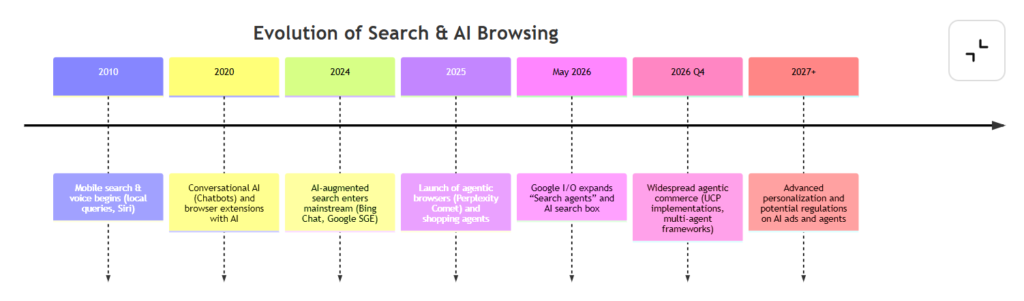
Actionable Recommendation: Adopt a balanced approach: experiment and learn, but keep human oversight. Set up a governance framework now (policy-as-code) to define how agents should behave on your site. Engage with industry groups or committees on AI standards. And importantly, build an AI “kill switch” into critical processes: if an automated marketing task goes haywire, be ready to intervene manually. By acknowledging risks and evolving responsibly, marketers can harness agentic tools without losing control.
How Team BacklinkGen Can Help
Team BacklinkGen specializes in preparing brands for this new agentic era. We offer concrete services and tactics across all dimensions discussed:
- AI-Friendly SEO and AEO: We audit and implement technical optimizations that ensure your content is discoverable by AI agents. This includes allowing AI crawler access, fixing JavaScript rendering issues, and enriching schema markup (products, FAQs, events, etc.). Our copywriters craft concise, structured content that AI can easily parse (e.g. bullet lists, tables, clear headlines) and that satisfies both search algorithms and human readers.
- Brand Signal Amplification: We help build consistent brand presence across platforms – from content marketing and digital PR to social proof. For instance, we secure placements on industry blogs and high-authority sites to align third-party content with your brand messaging. This multi-channel strategy ensures AI agents find corroborating evidence of your expertise, as SEO Sherpa advises.
- AI-Driven Content at Scale: Leveraging advanced LLMs, we generate personalization-ready content for your site, email, and social media. For high-volume needs (product descriptions, localized pages), our team uses proprietary AI tools to draft quickly; for flagship content (whitepapers, videos), our experts add unique insights that AI would miss. We integrate real-time data (inventory, pricing) into content where possible, enabling dynamic pages and agentic shopping workflows (per Airia’s guidance on AEO).
- Paid Media Optimization: We design advertising strategies with AI agents in mind. This includes creating conversational ad formats (chat prompts, voice commerce hooks) and ensuring your campaigns feed clean data into smart bidding systems. We also implement advanced attribution models: tracking on-site events (API-level conversions) so that agentic interactions are captured. This aligns with insights that traditional metrics falter for AI shopping.
- UX/CRO for Agents: Our UX specialists review your user flows with agentic scenarios. We remove friction (e.g. simplify multi-step forms, ensure mobile usability), test AI-assisted journeys (using chatbots or browser agents), and apply CRO best practices to maximize AI-driven conversions.
- Data Governance & Privacy Compliance: BacklinkGen advises on AI governance. We help establish policies for data handling (clear opt-in for personalization, logs of agent actions) and ensure compliance with GDPR/CCPA even as AI features are introduced. Our team can also assist in setting up policy-as-code or similar frameworks to control automated marketing actions.
By combining technical SEO, creative content, and AI expertise, BacklinkGen equips your team to thrive in 2026’s search environment. We are your partner in implementing the actionable tactics outlined above – from voice-of-customer AI tests to multi-agent campaign management – so you can focus on strategy while we handle the execution.
Conclusion
The rise of AI browsers like Comet and agentic search agents marks a fundamental shift in digital marketing. Traditional “type-search-click” habits are giving way to query → agentic answer → action, with AI intermediaries shaping every step. To stay competitive, marketers must adapt across the board: refining SEO into a broader brand intelligence strategy, scaling personalized content via AI while preserving quality, reimagining ads for agents, and redesigning UX for seamless agent interactions. We’ve outlined how each part of the funnel is affected and provided practical steps – from allowing AI crawlers in robots.txt to training teams on AI tools (as BCG recommends). Ultimately, success in 2026 demands embracing AI as a partner in marketing. Brands that optimize for AI agents and equip their teams with the right skills will find themselves chosen in those new AI-crafted answers and experiences. The era of agentic search is here, and with the right tactics and partners (like BacklinkGen), it presents enormous opportunity, not just challenge.
About Author:
Amit Tyagi is a Senior Digital Marketing Specialist and Web Development Strategist with over 15 years of experience in SEO, website development, and data-driven digital growth. He has successfully built and optimized more than 50 websites across various industries, helping businesses improve online visibility, generate leads, and increase revenue through strategic digital marketing.
His expertise spans search engine optimization (SEO), content strategy, conversion-focused web development, marketing automation, and analytics-driven decision making. Amit combines technical development skills with advanced digital marketing strategies to create high-performing digital ecosystems for brands.
Throughout his career, Amit has worked on eCommerce, B2B platforms, and enterprise-level digital projects, delivering scalable solutions that align technology with business goals. He is also known for sharing insights on modern SEO trends, AI-driven marketing, and future digital strategies.
Amit believes that the future of marketing lies at the intersection of technology, data, and strategic storytelling.