By Amit Tyagi | Senior Digital Marketing Specialist & Web Development Strategist
When I first read about OpenAI’s “No Pay-to-Cite” policy last year, I’ll be honest—I had to pause and think about what it really meant for the 2000+ USD in monthly ad spend I manage for my clients. After 18 years of building digital marketing strategies, optimizing ad campaigns, and working with everything from state government projects to USA-based tech firms, I thought I’d seen every shift in the digital landscape. But this one? This one requires a fundamental mindset reset for how we think about brands and AI.
Let me break down what’s actually happening here, why it matters, and what this means for your digital strategy moving forward.
The Traditional Marketing Playbook Doesn’t Apply Here
Here’s something I’ve learned after running countless campaigns through Google Ads (I’m Google Ads Certified, by the way) and managing PPC budgets: in traditional digital marketing, spend often translates to visibility. You pay for ad placement, you get impressions. You bid higher, you rank better. It’s a straightforward equation that’s worked for years.
But AI models operate in a completely different universe.
When someone asks ChatGPT, Claude, or any other large language model (LLM) for information, they’re not getting results based on a search algorithm that can be gamed with ad spend. They’re getting responses generated from patterns the model learned during training. The model doesn’t check your Google Ads account. It doesn’t see your PPC bids. It absolutely does not care about your advertising budget.
What’s fascinating—and honestly, a bit humbling—is that this is actually a feature, not a bug.
Understanding What Pay-to-Cite Really Means
The “No Pay-to-Cite” principle essentially states: purchasing advertisements does not increase the probability that an AI system will cite your brand or website as an authoritative source in its responses.
Think about that for a second. You can spend thousands of dollars a month on ads (and trust me, many of my clients do), but that investment won’t influence whether an AI thinks you’re credible enough to cite. An AI model trained on internet data doesn’t differentiate between a brand that spent millions on advertising and a brand that earned its authority organically.
This is radically different from traditional search engines. When I work on SEO strategies for my 40+ websites (which I’ve built and optimized through WordPress and WooCommerce), we’re essentially working within a system where quality links, topical authority, and backlinks matter. Google’s algorithm can be influenced through legitimate optimization. But an LLM? It’s already been trained. The knowledge cutoff date has passed. Your 2024 ad campaign won’t change what happened in the model’s training data.
Why This Shift Matters for Digital Marketing
I’ve spent nearly two decades helping brands build their digital presence, and I’ve watched the landscape transform from desktop-focused websites to mobile-first design, from traditional SEO to voice search optimization, and from basic analytics to GA4’s sophisticated attribution modeling. Each shift required us to rethink strategy.
The No Pay-to-Cite principle is another one of those pivotal moments.
For the longest time, we’ve operated under this assumption: if you have money to spend, you can buy visibility. It’s not always true (organic reach exists), but it’s been a significant part of the game. Now we’re entering an era where a substantial portion of information discovery happens through AI systems that are completely immune to advertising dollars.
I remember working on a project for a USA-based IT firm about three years ago. We had healthy budgets for both PPC and organic optimization. The PPC campaigns drove immediate traffic and conversions, which was fantastic for their bottom line. But when I explained the emerging importance of content quality and topical authority (not just for Google, but for the future of information retrieval), there was pushback. “Why spend time on content when we can just bid higher?” That mindset is becoming dangerously outdated.
What Actually Matters for AI Citations
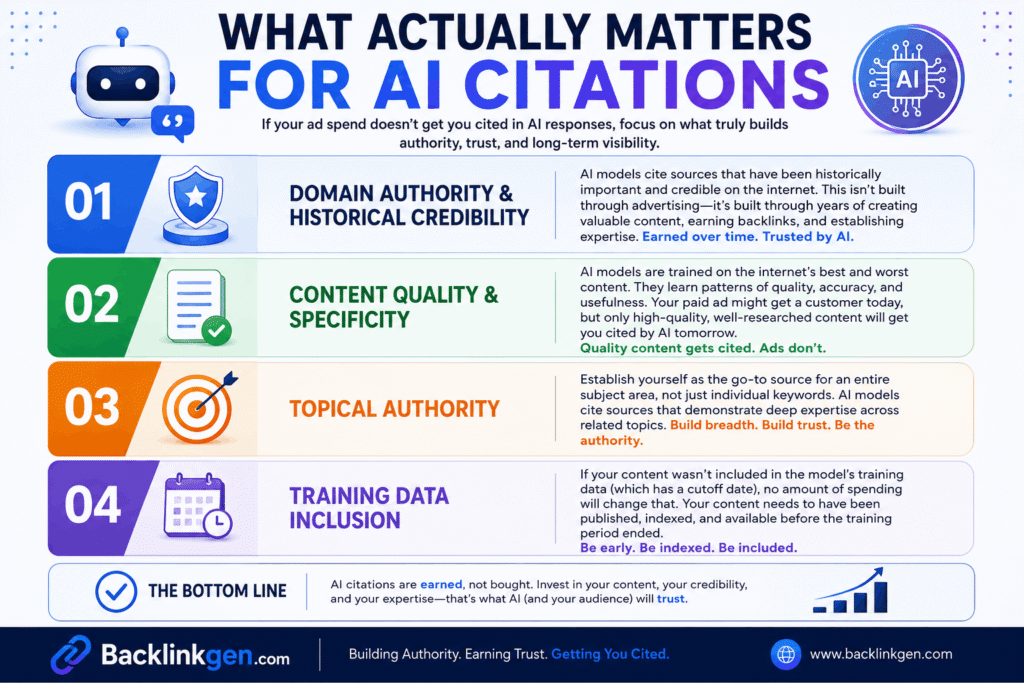
If your ad spend doesn’t get you cited in AI responses, what does? Let me share what I’ve observed from 18+ years in this space and what the evidence is already showing us:
1. Domain Authority and Historical Credibility AI models cite sources that have been historically important and credible on the internet. This isn’t built through advertising—it’s built through years of creating valuable content, earning backlinks, and establishing expertise. Your university website, your major news publication, your established industry resource—these get cited because they earned that position before the model was even trained.
2. Content Quality and Specificity When I optimize websites, I’m increasingly focusing on creating comprehensive, well-researched content that genuinely answers user questions. With AI, this becomes even more critical. An AI model has been trained on the internet’s best and worst content. It learned patterns about what constitutes quality, accuracy, and usefulness. Your paid ad might get a customer to convert today, but only quality content will get you cited by AI tomorrow.
3. Topical Authority One of the most important concepts I’ve integrated into my strategies (particularly when working with state government projects where accuracy is paramount) is topical authority—establishing yourself as the go-to source for an entire subject area, not just individual keywords. AI models learn and cite from sources that demonstrate deep expertise across related topics. This is built through organic content strategy, not ad spend.
4. Training Data Inclusion Here’s the hard truth: if your content wasn’t included in the model’s training data (which has a cutoff date), no amount of spending will change that. This is why newer, smaller brands face a disadvantage that money alone can’t overcome. Your content needs to have been published, indexed, and available before the training period ended.
The Uncomfortable Truth for the Advertising Industry
Let me be direct: this is uncomfortable for those of us in digital marketing. I manage approximately 2000 USD in monthly ad spend for my clients—that’s meaningful money. But I have to be honest about what it can and cannot do.
For AI-driven information discovery and citation, advertising is starting to become a less reliable lever than it has been for two decades. Your money is still valuable for driving immediate traffic, generating conversions, and building brand awareness. But for achieving authority in an AI-native internet? You need to invest in building something real.
I’ve seen this play out in my own work as an influencer sharing digital marketing expertise. When I create detailed, actionable content about SEO, web development strategy, or marketing analytics, it gets engaged with because it’s genuinely useful—not because I promoted it through ads. The citations and shares come from credibility, not budget.
What This Means for Your Strategy Going Forward
Here’s my practical advice after nearly two decades of building digital marketing strategies:
Don’t abandon paid advertising. It still works for its intended purposes. But do rebalance your portfolio.
Invest heavily in content strategy. This isn’t new advice, but it’s more critical than ever. Your content needs to be:
- Comprehensive and well-researched
- Topically authoritative
- Genuinely useful to your audience
- Properly indexed and discoverable
Build real expertise and authority. Whether through a blog, research, published studies, or thought leadership, create a body of work that demonstrates you actually know what you’re talking about.
Focus on the fundamentals. Strong information architecture (which I prioritize in my web development strategy work), proper implementation of GA4 analytics to understand what actually works, and consistent quality improvements—these are what build lasting authority.
Adapt your metrics. Stop measuring success solely by impressions and clicks. Start measuring how your brand appears as a trusted source in broader conversations, how often you’re cited or referenced, and how your organic reach is growing independent of paid promotion.
The Silver Lining
Here’s what I find genuinely exciting about this shift: it’s a leveling of the playing field for smart, scrappy brands.
If you’re a startup or a smaller player without massive advertising budgets, you’re no longer completely outgunned by brands that simply spend more. You can still win through better strategy, smarter content, and genuine expertise. This is how I’ve approached building my own brand and consulting work—through sharing real knowledge and insights, not just outspending competitors.
For my clients working on government projects or competing in technical fields, this has been liberating. The advantage now goes to those who genuinely understand their domain and can articulate it clearly, not necessarily those with the deepest pockets.
Looking Ahead
We’re in a transition period. Traditional digital marketing based on paid visibility is still dominant, but AI-driven information discovery is growing exponentially. The brands that will thrive are those that recognize this shift and invest accordingly.
Your budget isn’t going away as a useful tool. But if you’re hoping to be cited as an authoritative source in an AI response, your best investment is in becoming genuinely authoritative. Create better content than your competitors. Demonstrate deeper expertise. Build something that deserves to be cited, not just something with a larger ad budget.
That’s not a new philosophy—it’s actually the oldest marketing principle. But in the age of AI, it’s becoming the only one that matters.
About Author:
Amit Tyagi is a Senior Digital Marketing Specialist and Web Development Strategist with over 15 years of experience in SEO, website development, and data-driven digital growth. He has successfully built and optimized more than 50 websites across various industries, helping businesses improve online visibility, generate leads, and increase revenue through strategic digital marketing.
His expertise spans search engine optimization (SEO), content strategy, conversion-focused web development, marketing automation, and analytics-driven decision making. Amit combines technical development skills with advanced digital marketing strategies to create high-performing digital ecosystems for brands.
Throughout his career, Amit has worked on eCommerce, B2B platforms, and enterprise-level digital projects, delivering scalable solutions that align technology with business goals. He is also known for sharing insights on modern SEO trends, AI-driven marketing, and future digital strategies.
Amit believes that the future of marketing lies at the intersection of technology, data, and strategic storytelling.