
Good marketing starts with knowing your audience.
That sounds obvious, but in practice, many businesses define their audience using only basic information such as age, gender, location, profession, or income. While these details are useful, they do not tell you where your audience actually spends time online, what content they consume, which creators influence them, what publications they trust, or which websites they regularly visit.
For SEO professionals, content marketers, link builders, digital PR specialists, and agencies, this information can make a significant difference.
Imagine that you are trying to build links for a SaaS company. You could search Google for websites related to SaaS, productivity, business, or technology and start sending outreach emails. Or, you could first understand the audience of the SaaS product and discover the websites, publications, creators, podcasts, and social platforms that already attract those people.
The second approach gives you a much stronger starting point.
And you do not necessarily need an expensive enterprise research platform to begin.
There is a free tool that can help marketers explore exactly this kind of information.
The tool is SparkToro.
Important Note: We are not associated, affiliated, sponsored, or endorsed by SparkToro or any other tools mentioned in this article. We share these tools and ideas independently to help creators, marketers, and business owners discover useful resources. Please review each tool’s official website, terms, pricing, privacy policies, and limitations before using it. We are not responsible for decisions, outcomes, or losses resulting from their use.
Why Audience Research Matters for SEO and Link Building
Audience research is often associated with advertising and customer personas, but its value goes much further.
For a link-building campaign, knowing your target audience can help answer an important question:
Where does the audience we want to reach already spend its attention?
Suppose you are promoting an online accounting software product.
A traditional link-building approach might focus on finding websites with high Domain Rating, Domain Authority, or large traffic numbers.
Those metrics can be useful, but they don’t tell the entire story.
A smaller accounting publication that is regularly followed by your ideal customers may be more strategically valuable than a completely unrelated high-authority website.
The same principle applies to content marketing.
If you know which publications, YouTube channels, podcasts, social accounts, and websites your audience follows, you can create content that is more closely aligned with the information ecosystem surrounding that audience.
That can lead to better content ideas, stronger outreach lists, more relevant digital PR opportunities, and potentially more meaningful backlinks.
A Free Tool That Makes Audience Research Easier
This is where SparkToro becomes interesting.
SparkToro is an audience research platform that allows marketers to describe an audience and investigate the online sources, platforms, interests, creators, and publications associated with that audience.
The interesting part is that you don’t necessarily have to begin by knowing the exact websites you want to research.
You can begin with the people.
For example, imagine you want to research:
Marketing managers at small businesses interested in SEO, Google Ads, social media marketing, and AI tools.
Instead of guessing which websites these people use, you can enter a description of this audience and use the resulting research to identify potential sources of influence.
That makes the process particularly useful for SEO, digital PR, influencer marketing, content strategy, and link building.
Start by Creating a Free Account
To experiment with SparkToro, start by visiting its website and creating an account.
The registration process is straightforward.
After signing up, SparkToro asks some questions to understand how you intend to use the platform.
The onboarding screen includes a role selection and an organization selection. You can choose the options that best describe your professional situation.
It then asks:
What are you hoping to do with SparkToro?
There are several possible use cases, including media pitches and placement, partnership outreach, paid or performance marketing, market research, keyword research, link building for SEO, audience reports, social media reach, marketing strategy, influencer research, targeted advertising, and content marketing.
For someone working in SEO or link building, selecting options such as Keyword Research, Link Building for SEO, Build Personas/Audience Reports, and Marketing Strategy makes sense.
You can select the options relevant to your actual objectives.
Choose the Free Tier
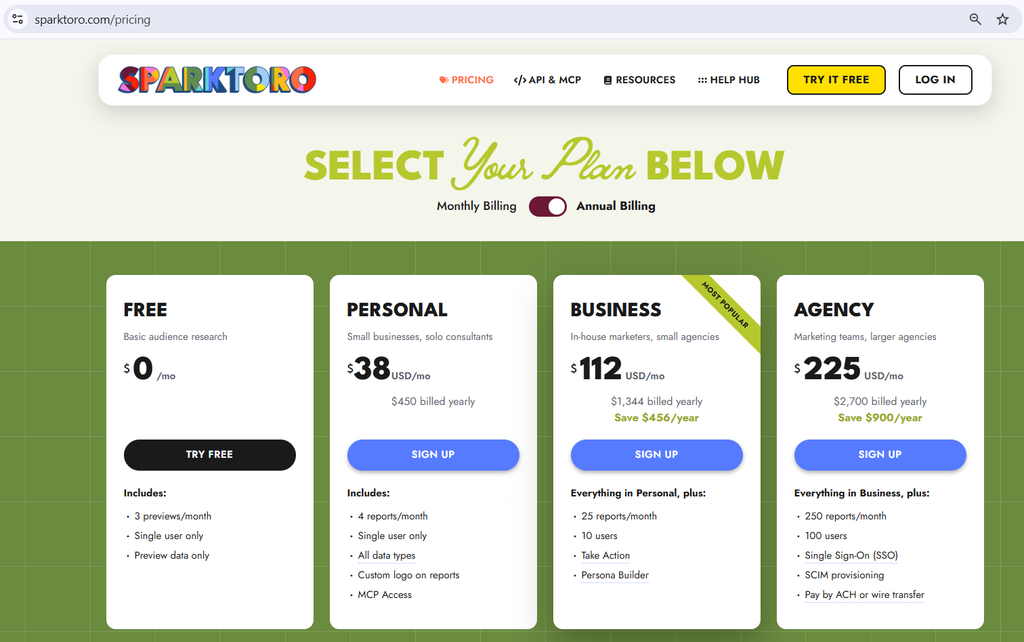
After completing the setup process, you can use SparkToro’s Free plan.
This is important for marketers who want to test the platform before committing to a paid subscription.
The free version provides limited research, but it is enough to understand how the platform works and experiment with different audience descriptions.
The goal at this stage isn’t to generate hundreds of reports.
Instead, think of your available searches as research opportunities.
Choose audiences that are strategically important to your business and use the available reports to discover useful patterns.
That alone can provide ideas for SEO, content, outreach, and marketing campaigns.
Creating Your First Audience Research Report
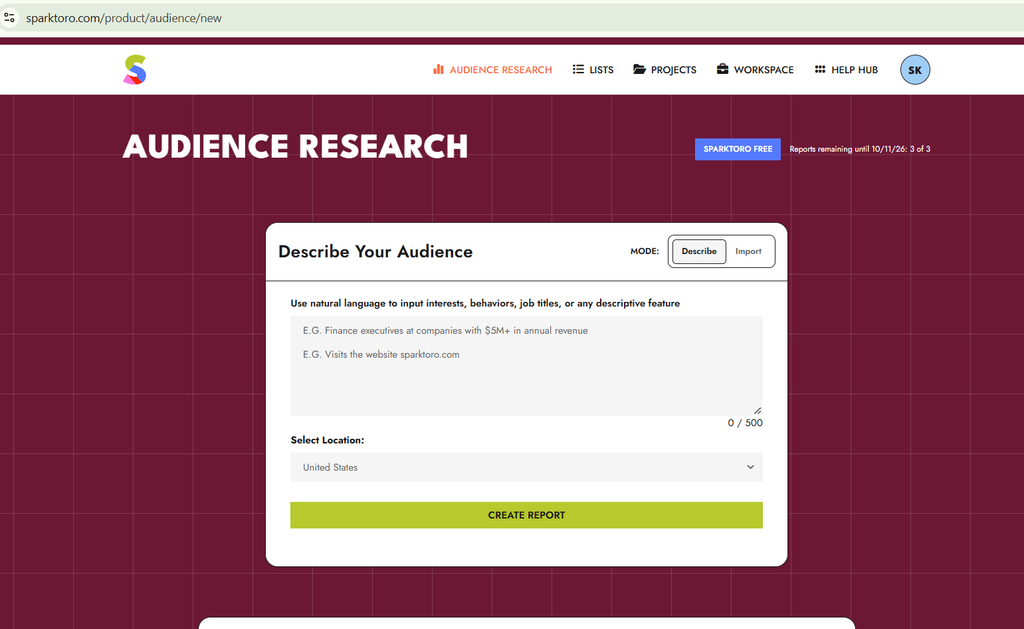
Once you enter the Audience Research section, SparkToro gives you an option to describe your audience.
This is where you should spend some time thinking about what you actually want to learn.
The interface allows you to use natural language to describe characteristics such as interests, behaviors, job titles, and other descriptive features.
For example, don’t simply enter:
“Business owners.”
That audience is far too broad.
Instead, try something like:
“Small business owners in the United States who are interested in digital marketing, SEO, online advertising, lead generation, and business growth.”
You can then select the appropriate location.
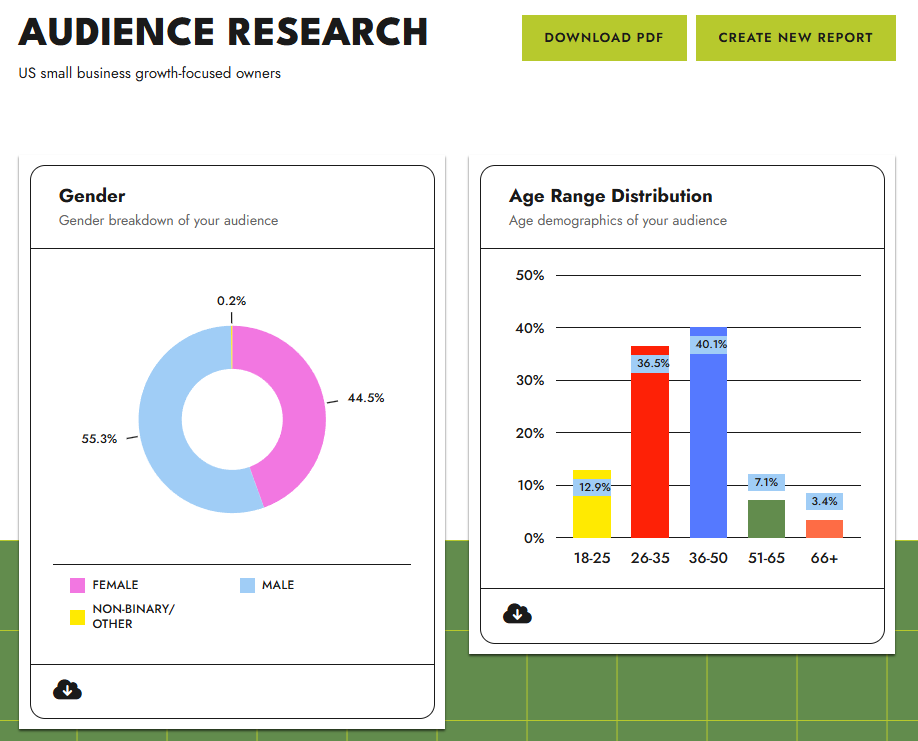
You can see in the screenshot above 2 Graphs from the report it created, which you can download for free.
The better your audience description reflects your actual target market, the more useful the resulting research can become.
Don’t Make Your Audience Description Too Broad
One of the biggest mistakes in audience research is trying to research everyone.
Consider an e-commerce fitness business.
Entering:
“Fitness enthusiasts”
doesn’t provide much strategic definition.
There could be beginners, professional athletes, gym owners, personal trainers, runners, bodybuilders, people interested in nutrition, and many other groups.
A more specific audience might be:
“Women aged 25–40 in the United States interested in home workouts, strength training, healthy nutrition, and fitness apps.”
Now the research has a much clearer direction.
The same principle applies to B2B audiences.
Instead of:
“IT professionals”
you could research:
“IT managers at small and medium-sized businesses interested in cybersecurity, cloud computing, data protection, and business technology.”
Specificity gives your research a purpose.
Example 1: Digital Marketing Agency
Let’s say you run a digital marketing agency and want to acquire more SEO clients.
You could create an audience description such as:
“Small and medium-sized business owners in the United States interested in SEO, Google Ads, content marketing, lead generation, and growing their online presence.”
The resulting research can help you discover the websites, publications, social networks, creators, and other sources that this audience follows.
Now imagine that several marketing publications appear repeatedly.
Those publications could become potential targets for:
- Guest contributions
- Expert commentary
- Digital PR
- Data-driven content
- Industry partnerships
- Link-building outreach
You can also examine the topics and creators associated with the audience to find ideas for your own content strategy.
Instead of producing another generic article titled “10 SEO Tips,” you may discover more specific subjects that are already relevant to the audience.
Example 2: SaaS Business
Suppose your company sells project management software.
Your audience description could be:
“Project managers and operations managers at small and medium-sized businesses who are interested in productivity, project management, team collaboration, and business software.”
Audience research can reveal the information sources followed by these professionals.
You might find business publications, productivity websites, software review platforms, podcasts, YouTube channels, and professional communities.
For a link-building campaign, these discoveries can become extremely useful.
Rather than creating a generic list of 500 websites, you can build a prospect list based on audience relevance.
For example, a publication regularly consumed by project managers could be considered for expert contributions or digital PR outreach.
This creates a much stronger connection between audience research and link acquisition.
Example 3: E-Commerce Fashion Brand
Now consider an online fashion store.
You could research:
“Women in the United States interested in affordable fashion, seasonal fashion trends, online shopping, beauty, and fashion influencers.”
The research could help identify fashion publications, creators, social accounts, websites, and other media sources.
This information can support influencer outreach as well as digital PR.
For example, if certain creators are strongly associated with the audience, you can investigate their content to understand what topics and formats attract attention.
If certain publications repeatedly appear, they could become targets for product launches, trend stories, expert commentary, or relevant editorial coverage.
Audience research therefore becomes useful beyond traditional SEO.
Example 4: Online Education Business
Imagine an education company offering data analytics training.
A useful audience description could be:
“Students and early-career professionals interested in data analytics, Excel, SQL, Python, Power BI, data careers, and professional development.”
This audience could have very different online behavior from experienced data scientists.
Research may reveal educational websites, technology publications, career platforms, YouTube creators, podcasts, and professional communities.
These insights can influence content planning.
Instead of guessing what students want to read, the company can investigate the information sources already attracting that audience.
Potential content could include:
- Data analyst career guides
- SQL interview preparation
- Power BI tutorials
- Excel career skills
- Data analytics projects
- Career transition guides
- Beginner-friendly programming content
The same research can also help identify potential websites for outreach.
Example 5: Cybersecurity Company
Consider a cybersecurity company selling services to small businesses.
You could research:
“IT managers and business technology decision-makers at small and medium-sized businesses concerned about cybersecurity, ransomware, data protection, and cloud security.”
The results could reveal technology publications, cybersecurity websites, podcasts, YouTube channels, industry creators, and professional platforms.
This information can support a digital PR strategy.
For example, the company could create original research around ransomware trends and pitch the findings to publications already followed by its target audience.
It could also develop expert commentary around emerging cybersecurity issues.
This is much more powerful than approaching random technology websites simply because they have strong SEO metrics.
Example 6: Travel Business
Let’s take one more example: a travel company.
Suppose it targets Australian travelers interested in international holidays.
The audience description could be:
“Australian travelers interested in international holidays, affordable flights, hotels, travel planning, travel experiences, and destination guides.”
Audience research can help reveal travel websites, publications, creators, YouTube channels, podcasts, and social platforms relevant to this group.
Now the travel company can use that information for:
Content marketing: Create destination content based on audience interests.
SEO: Identify subjects worth researching further through keyword tools and Search Console.
Digital PR: Pitch travel publications with original research and expert insights.
Influencer marketing: Find creators whose audiences overlap with the company’s target customers.
Link building: Identify relevant publications and websites for editorial outreach.
Again, the goal is not to copy every website found in the research.
The goal is to understand the ecosystem around the audience.
Turning Audience Research Into a Link-Building Strategy
This is where the process becomes particularly valuable for Backlinkgen’s audience.
Once you have completed audience research, don’t stop at the report.
Turn the findings into an outreach strategy.
Start by identifying websites that are both relevant to your audience and potentially relevant to your brand.
Then categorize them.
You might create groups such as:
Industry publications
Websites covering the specific industry your customer belongs to.
Niche blogs
Smaller but highly relevant websites with a focused audience.
Creators and influencers
People who already have the attention of your target market.
Podcasts
Shows where industry experts and customers spend time.
News and media
Publications that could potentially cover original research, company news, or expert commentary.
Communities
Relevant online communities where conversations around your subject already happen.
The next step is to determine what kind of value you can offer each category.
A publication might be interested in original research.
A journalist might need expert commentary.
A blog might accept a genuinely useful expert contribution.
A podcast may want an industry specialist as a guest.
A creator might be interested in collaboration.
This is where audience research can make outreach more intelligent.
Audience Research Should Come Before Outreach
One common mistake in link building is starting with a list of websites and asking:
“How can I get a link from this website?”
A better question is:
“Does this website matter to the audience I am trying to reach?”
If the answer is yes, the opportunity becomes more interesting.
A relevant editorial mention can potentially provide more than an SEO signal. It can introduce the brand to potential customers, strengthen credibility, generate referral traffic, and create opportunities for further relationships.
This is why audience research can complement traditional backlink metrics.
Metrics such as authority, traffic, relevance, topical alignment, and link quality still matter. But understanding audience overlap adds another dimension to the decision.
The Bigger Picture
Effective audience research isn’t about creating a perfect customer profile and putting it into a presentation.
It is about understanding the information environment surrounding your customers.
Who has their attention?
Where do they learn?
Which websites do they trust?
Which creators influence them?
What subjects interest them?
Which publications reach them?
Once you understand these things, several marketing activities become easier.
Your content strategy can become more focused.
Your SEO research can become more relevant.
Your link-building prospecting can become more strategic.
Your digital PR campaigns can become better targeted.
Your influencer outreach can become less dependent on guesswork.
And your marketing team can start making decisions based on evidence rather than assumptions.
SparkToro is useful here because it gives marketers a practical starting point for exploring these questions, and its Free plan provides an opportunity to experiment before deciding whether more extensive research capabilities are required.
The most important lesson, however, isn’t about the tool.
It is about changing the way you think about audience research.
Don’t begin with:
“Which websites can give me backlinks?”
Begin with:
“Where does my audience already spend its attention?”
Once you answer that question, the websites, publications, creators, communities, and content opportunities you should pursue become much easier to identify.
That is what makes audience research a valuable part of modern SEO and digital marketing—not simply knowing who your customers are, but understanding the digital world they already inhabit.
Disclaimer
This article is intended for educational and informational purposes only. Tool features, pricing, available data, interfaces, and functionality may change over time. Audience research results should be treated as directional insights rather than guaranteed facts. Always validate important findings using your own analytics, customer research, campaign data, and other reliable sources before making significant marketing or business decisions.
About Author:
Amit Tyagi is a Senior Digital Marketing Specialist and Web Development Strategist with over 15 years of experience in SEO, website development, and data-driven digital growth. He has successfully built and optimized more than 50 websites across various industries, helping businesses improve online visibility, generate leads, and increase revenue through strategic digital marketing.
His expertise spans search engine optimization (SEO), content strategy, conversion-focused web development, marketing automation, and analytics-driven decision making. Amit combines technical development skills with advanced digital marketing strategies to create high-performing digital ecosystems for brands.
Throughout his career, Amit has worked on eCommerce, B2B platforms, and enterprise-level digital projects, delivering scalable solutions that align technology with business goals. He is also known for sharing insights on modern SEO trends, AI-driven marketing, and future digital strategies.
Amit believes that the future of marketing lies at the intersection of technology, data, and strategic storytelling.