
Hi, I’m Amit, and one of the biggest mistakes businesses still make in digital marketing is treating SEO, PPC, and social media as separate departments instead of interconnected growth engines. In today’s competitive online environment, customers move across multiple platforms before making a decision. They may first discover your brand through Instagram, later search for your services on Google, click a paid ad, and finally convert after reading reviews or blog content. This entire customer journey highlights why cross-channel marketing has become essential for modern businesses.
Cross-channel marketing is the strategic integration of multiple digital channels to create a seamless and consistent customer experience. Instead of running isolated campaigns, businesses align their SEO efforts, paid advertising campaigns, social media content, email marketing, and analytics into one unified strategy. When executed correctly, this approach improves brand visibility, customer engagement, conversion rates, and return on investment.
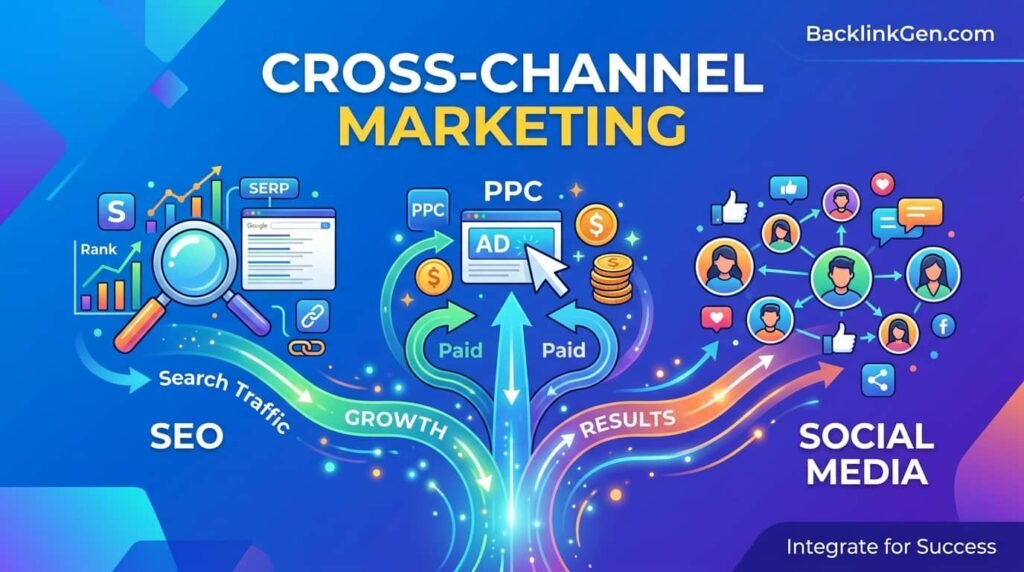
SEO helps businesses build long-term organic authority, PPC delivers instant visibility and targeted traffic, while social media strengthens audience engagement and brand loyalty. Together, these channels create a powerful ecosystem that continuously supports lead generation and customer retention.
In this article, I will explain how businesses can integrate SEO, PPC, and social media effectively, the benefits of cross-channel marketing, key strategies for implementation, common mistakes to avoid, and how companies can build a sustainable digital marketing framework that drives measurable business growth in 2026 and beyond.
Understanding the Foundation of Cross-Channel Marketing
Cross-channel marketing refers to the practice of creating coordinated marketing campaigns across multiple digital platforms while maintaining a unified brand message. Unlike traditional marketing approaches where each department works independently, cross-channel strategies ensure that every platform contributes toward common business objectives.
Modern consumers no longer interact with brands through a single touchpoint. A customer may discover a business through Facebook content, research products through Google search, compare options through YouTube videos, and finally make a purchase after clicking a Google Ads campaign. Because of this multi-platform behavior, businesses must create connected experiences that guide users smoothly across channels.
The foundation of cross-channel marketing lies in consistency. Businesses must maintain consistent branding, messaging, tone, visual identity, and promotional goals across SEO content, paid advertisements, and social media platforms. Consistency builds trust and improves brand recognition.
Data integration is another essential component. Analytics tools such as Google Analytics 4, Search Console, Meta Ads Manager, and CRM systems help marketers understand customer journeys across platforms. Businesses can then identify which channels contribute most to conversions and optimize accordingly.
Cross-channel marketing also improves marketing efficiency. Instead of creating isolated campaigns, businesses can repurpose content across platforms. A blog article optimized for SEO can become a LinkedIn post, Instagram carousel, YouTube short, or paid advertising creative.
Ultimately, cross-channel marketing allows businesses to create better customer experiences, improve engagement, increase conversion opportunities, and maximize the value of every marketing investment.
The Role of SEO in Cross-Channel Marketing
Search Engine Optimization remains one of the most valuable long-term digital marketing strategies because it helps businesses generate sustainable organic traffic. Within a cross-channel framework, SEO acts as the foundation that supports visibility, credibility, and content discoverability.
SEO enables businesses to rank for keywords that potential customers search for on Google and other search engines. When integrated with PPC and social media campaigns, SEO provides insights into audience behavior, trending topics, and high-performing content opportunities.
Keyword research plays a critical role in integration. The same keywords used in SEO campaigns can also guide PPC ad targeting and social media hashtag strategies. This creates consistency across all channels and improves audience targeting accuracy.
Content marketing is another major SEO contribution. Blog posts, landing pages, guides, videos, and educational resources optimized for search engines can be repurposed into social media content and used within paid campaigns. High-quality SEO content often improves PPC Quality Scores because it enhances landing page relevance and user experience.
SEO also supports remarketing strategies. Users who discover a website organically can later be retargeted through Google Display Ads or social media advertisements. This increases conversion probability by keeping the brand visible throughout the customer journey.
Technical SEO contributes indirectly to paid advertising success as well. Faster websites, mobile optimization, structured data, and strong user experience improve conversion rates for both organic and paid traffic.
Businesses that ignore SEO often become overly dependent on advertising budgets. By integrating SEO into cross-channel strategies, companies create long-term visibility while reducing customer acquisition costs over time.
How PPC Accelerates Multi-Channel Marketing Performance
Pay-Per-Click advertising provides immediate visibility and rapid traffic generation, making it an essential component of cross-channel marketing. While SEO takes time to build rankings, PPC allows businesses to appear instantly in front of targeted audiences through platforms such as Google Ads, Meta Ads, LinkedIn Ads, and YouTube Ads.
PPC campaigns are highly effective for supporting SEO and social media efforts. For example, businesses can use PPC to promote newly published blog articles, lead magnets, webinars, or product launches while waiting for organic rankings to improve. This creates immediate exposure and faster lead generation.
One major advantage of PPC is audience targeting. Businesses can target users based on demographics, interests, search intent, behavior, location, and purchasing patterns. These audience insights can later improve SEO content strategies and social media campaigns.
Remarketing is one of the strongest cross-channel PPC features. Businesses can show targeted ads to users who previously visited their website through organic search or social media platforms. This keeps the brand visible and increases conversion opportunities.
PPC also helps validate SEO strategies. Marketers can test keyword performance through paid campaigns before investing heavily in long-form organic content. High-converting PPC keywords often become valuable SEO targets.
Social proof integration is another advantage. Ads that include testimonials, ratings, or social engagement metrics often perform better because audiences trust brands with visible community interaction.
Additionally, PPC analytics provide valuable conversion data that helps businesses optimize landing pages, calls-to-action, and audience segmentation across all channels.
When integrated properly, PPC acts as a growth accelerator that amplifies the effectiveness of SEO and social media marketing strategies.
Social Media’s Role in Brand Visibility and Engagement
Social media has transformed from a simple networking platform into a major business growth channel. In cross-channel marketing, social media serves as the engagement and relationship-building component that strengthens customer trust and brand recognition.
Platforms like Facebook, Instagram, LinkedIn, X, TikTok, Pinterest, and YouTube allow businesses to interact directly with audiences, distribute content, and build online communities. Unlike SEO and PPC, social media enables real-time conversations and customer feedback.
One of the biggest benefits of social media integration is content amplification. SEO blog articles, videos, podcasts, case studies, and product updates can be distributed through social platforms to increase reach and traffic. This helps businesses attract audiences who may never discover the content through search engines alone.
Social media also enhances brand authority. Consistent posting, audience interaction, and thought leadership content help businesses establish credibility within their industry. Strong social engagement often improves customer trust and indirectly supports SEO performance through increased brand searches and backlinks.
Paid social advertising further strengthens cross-channel campaigns by targeting highly specific audience groups. Businesses can promote products, collect leads, retarget website visitors, and increase brand awareness efficiently.
User-generated content and influencer collaborations are additional advantages. Customers sharing reviews, testimonials, or product experiences create authentic marketing assets that improve campaign performance across all channels.
Social listening tools also provide valuable insights into customer preferences, trending discussions, and market sentiment. Businesses can use these insights to improve SEO content topics and PPC messaging.
When combined with SEO and PPC, social media becomes a powerful channel for nurturing customer relationships and supporting long-term business growth.
Creating Unified Customer Journeys Across Channels
Successful cross-channel marketing focuses heavily on customer journey mapping. Businesses must understand how users move between platforms before making purchasing decisions. A disconnected customer experience often leads to confusion, reduced trust, and lower conversion rates.
A unified customer journey begins with awareness. Social media campaigns, influencer marketing, or display ads may introduce users to a brand. From there, users often conduct Google searches to learn more about products or services. This is where SEO content becomes critical.
Once users visit the website, businesses should provide optimized landing pages, educational resources, testimonials, and strong calls-to-action. If visitors leave without converting, remarketing campaigns through Google Ads or Meta Ads can re-engage them.
Consistency across messaging is essential during every stage of the customer journey. Brand visuals, offers, tone, and value propositions should align across social media, paid ads, landing pages, and email campaigns.
Businesses should also personalize experiences wherever possible. Dynamic ads, segmented email marketing, and tailored content recommendations improve engagement and conversion rates significantly.
CRM integration further improves cross-channel journeys by tracking customer interactions across platforms. Businesses can analyze which channels contribute most to sales and optimize their marketing budgets accordingly.
Customer journeys should not end after conversions. Post-purchase engagement through email campaigns, loyalty programs, social media communities, and customer support strengthens retention and encourages repeat business.
Cross-channel marketing works best when businesses focus not only on traffic generation but also on building seamless experiences that guide users naturally from discovery to conversion.
Data Analytics and Attribution in Cross-Channel Campaigns
One of the most important aspects of cross-channel marketing is analytics and attribution. Without proper tracking systems, businesses cannot accurately measure performance or understand how channels contribute to conversions.
Modern customers interact with multiple touchpoints before making decisions. A user may click a social media ad, return through organic search, and finally convert after clicking a remarketing campaign. Traditional last-click attribution models fail to capture this complex behavior accurately.
Businesses should use tools such as Google Analytics 4, Google Tag Manager, CRM platforms, Meta Pixel, and marketing automation systems to track user behavior across channels. These tools help marketers analyze customer journeys, engagement patterns, and conversion paths.
Data integration allows businesses to identify high-performing channels and optimize budgets effectively. For example, social media may generate awareness while SEO drives qualified traffic and PPC closes conversions. Understanding these relationships helps businesses allocate resources strategically.
Cross-channel analytics also improve audience segmentation. Businesses can identify which content resonates most with specific demographics and tailor campaigns accordingly.
Another important benefit is campaign optimization. Marketers can analyze bounce rates, click-through rates, cost-per-conversion, and engagement metrics to refine messaging and targeting strategies.
Predictive analytics and AI-powered reporting tools are becoming increasingly important in 2026. These technologies help businesses forecast campaign performance, identify emerging trends, and automate optimization processes.
Ultimately, data-driven decision-making is essential for maximizing the effectiveness of cross-channel marketing campaigns and improving long-term return on investment.
Content Repurposing for Maximum Marketing Efficiency
Content creation requires significant time and resources, which is why content repurposing has become a major strategy within cross-channel marketing. Businesses can maximize reach and efficiency by transforming one piece of content into multiple formats for different platforms.
For example, a detailed SEO blog article can be converted into LinkedIn posts, Instagram carousels, YouTube videos, podcasts, infographics, email newsletters, and PPC ad creatives. This ensures consistent messaging while expanding audience reach across channels.
Repurposing also improves SEO performance. Social shares, backlinks, and increased engagement generated through other platforms can strengthen search visibility and drive additional organic traffic.
Video content is especially valuable in cross-channel campaigns. A webinar can become short-form video clips for Instagram Reels, TikTok, YouTube Shorts, and Facebook campaigns. These clips can direct audiences back to full-length content or optimized landing pages.
Content repurposing also improves brand consistency. Instead of creating disconnected campaigns, businesses reinforce the same core messages across platforms, increasing audience familiarity and trust.
Businesses should adapt content formats according to platform behavior. LinkedIn audiences may prefer professional insights, while Instagram users engage more with visual storytelling and short-form videos.
AI tools are also helping businesses automate content adaptation processes, generate social captions, optimize headlines, and personalize campaigns at scale.
When executed strategically, content repurposing reduces marketing costs, increases content lifespan, and enhances the effectiveness of integrated marketing campaigns.
Common Cross-Channel Marketing Mistakes Businesses Must Avoid
Despite its benefits, many businesses struggle with cross-channel marketing because of poor execution and lack of coordination. One of the most common mistakes is inconsistent branding. Different messaging, visuals, or offers across platforms can confuse audiences and reduce trust.
Another major issue is data silos. Marketing teams often operate independently, causing SEO specialists, PPC managers, and social media teams to work without shared insights. This limits campaign effectiveness and creates duplicate efforts.
Businesses also frequently ignore attribution modeling. Relying solely on last-click conversions prevents marketers from understanding the true impact of awareness and engagement channels.
Poor audience targeting is another challenge. Generic campaigns without segmentation often fail to connect with users effectively. Businesses should personalize campaigns based on audience interests, demographics, and customer behavior.
Many companies focus heavily on traffic generation while neglecting landing page optimization. Even high-performing campaigns fail if websites provide poor user experiences, slow loading speeds, or unclear calls-to-action.
Another mistake is overdependence on paid advertising. Businesses that ignore SEO and organic content often face rising acquisition costs and unstable long-term growth.
Lack of testing is equally problematic. Successful cross-channel campaigns require continuous experimentation with creatives, keywords, targeting, and content formats.
Finally, businesses often fail to align campaigns with customer intent. Awareness-stage users require educational content, while conversion-stage users respond better to offers, testimonials, and product demonstrations.
Avoiding these mistakes helps businesses create stronger, more effective, and sustainable integrated marketing strategies.
AI and Automation in Cross-Channel Marketing
Artificial Intelligence and marketing automation are rapidly transforming how businesses manage cross-channel campaigns. AI-powered tools now help marketers analyze data, personalize customer experiences, optimize advertising budgets, and automate repetitive tasks.
One major advantage of AI is predictive analytics. Machine learning algorithms can identify customer behavior patterns and predict which audiences are most likely to convert. This improves targeting accuracy across SEO, PPC, and social media campaigns.
AI also enhances content creation. Businesses use AI tools for keyword research, content ideation, ad copy generation, audience analysis, and personalization. This significantly improves campaign scalability and efficiency.
Marketing automation platforms streamline cross-channel communication by automating email sequences, lead nurturing workflows, social media scheduling, and remarketing campaigns. Automation ensures consistent customer engagement without excessive manual effort.
Chatbots and AI-driven customer support systems also improve user experiences by providing instant responses and guiding users through sales funnels.
Dynamic advertising is another growing trend. AI systems automatically adjust bids, creatives, and targeting parameters in real time to improve campaign performance.
SEO platforms powered by AI now analyze search trends, identify ranking opportunities, and suggest optimization improvements automatically. Similarly, social media algorithms help businesses deliver personalized content to relevant audiences.
However, businesses must balance automation with human creativity. Authentic storytelling, emotional branding, and strategic decision-making still require human expertise.
Companies that successfully combine AI capabilities with integrated marketing strategies will gain significant competitive advantages in the evolving digital landscape.
Building a Long-Term Cross-Channel Marketing Strategy
Cross-channel marketing is not a short-term tactic but a long-term business growth strategy. Businesses must focus on creating scalable systems, consistent branding, and customer-centered experiences to achieve sustainable success.
The first step is defining clear objectives. Businesses should establish measurable goals such as lead generation, website traffic growth, conversion improvements, or brand awareness expansion.
Audience research is equally important. Understanding customer behavior, preferences, pain points, and platform usage helps businesses create targeted campaigns that resonate with users effectively.
Content strategy should align with the entire customer journey. Educational SEO content supports awareness, PPC campaigns accelerate conversions, and social media nurtures engagement and loyalty.
Businesses should also invest in integrated technology systems. CRM platforms, analytics tools, automation software, and advertising platforms should work together seamlessly to provide unified performance insights.
Testing and optimization must become ongoing processes. Digital trends evolve rapidly, and businesses must continuously analyze campaign performance and adapt strategies accordingly.
Cross-functional collaboration is another critical factor. SEO teams, paid advertising specialists, content creators, designers, and social media managers must work together toward shared objectives.
Long-term success also requires trust-building. Brands that consistently provide valuable content, transparent communication, and excellent customer experiences gain stronger loyalty and competitive positioning.
In 2026 and beyond, businesses that adopt integrated marketing ecosystems rather than isolated channel strategies will be better positioned for sustainable digital growth.
How Team Backlinkgen Can Help
At Backlinkgen, we specialize in creating powerful cross-channel digital marketing strategies that integrate SEO, PPC, content marketing, and social media into one unified growth framework. Our goal is to help businesses increase visibility, generate qualified leads, and maximize return on investment through data-driven marketing solutions.
Our team provides advanced SEO optimization services including keyword research, technical SEO, on-page optimization, backlink strategies, and AI search optimization. We help businesses improve organic rankings and establish long-term digital authority.
We also design high-converting PPC campaigns across Google Ads, Meta Ads, LinkedIn Ads, and YouTube Ads. From audience targeting to remarketing strategies, we focus on generating measurable results while optimizing advertising budgets.
Our social media marketing services help brands build stronger audience engagement through strategic content creation, influencer collaborations, paid campaigns, and platform-specific growth strategies.
In addition, Team Backlinkgen helps businesses implement analytics systems, conversion tracking, marketing automation, and performance dashboards for better decision-making and campaign optimization.
Whether you are a startup, eCommerce business, educational institution, or enterprise brand, our integrated marketing approach ensures that every channel contributes effectively toward your business growth goals.
Conclusion
Cross-channel marketing has become essential in the modern digital ecosystem because customers interact with brands across multiple platforms before making decisions. Businesses that successfully integrate SEO, PPC, and social media create stronger customer experiences, improve brand visibility, and generate higher conversion rates.
SEO provides long-term organic authority, PPC accelerates traffic and conversions, while social media strengthens engagement and trust. Together, these channels form a comprehensive marketing ecosystem capable of driving sustainable business growth.
The future of digital marketing lies in integration, personalization, data-driven strategies, and AI-powered optimization. Businesses that continue operating isolated campaigns will struggle to compete in an increasingly connected digital environment.
By understanding customer journeys, leveraging analytics, repurposing content, and maintaining consistent messaging, companies can build highly effective cross-channel marketing systems that deliver measurable results over time.
Success in 2026 will belong to businesses that prioritize unified digital experiences and strategic collaboration across all marketing channels.
About Author:

BacklinkGen.com Editorial Team
The BacklinkGen.com Editorial Team is led by Amit Tyagi, Gaurav Saxena and Rachit Srivastava—professionals with expertise spanning enterprise technology, artificial intelligence, digital marketing, SEO, AI Search Optimization (AIO/GEO), content strategy, and business growth. Together, they bring decades of combined industry experience across global technology initiatives, performance marketing, and digital transformation.
Every article published on BacklinkGen.com is guided by practical experience, in-depth research, and a commitment to editorial accuracy. The team focuses on delivering trustworthy, actionable, and up-to-date insights that help businesses, marketers, and professionals stay ahead in the rapidly evolving world of search, AI, and digital marketing.