
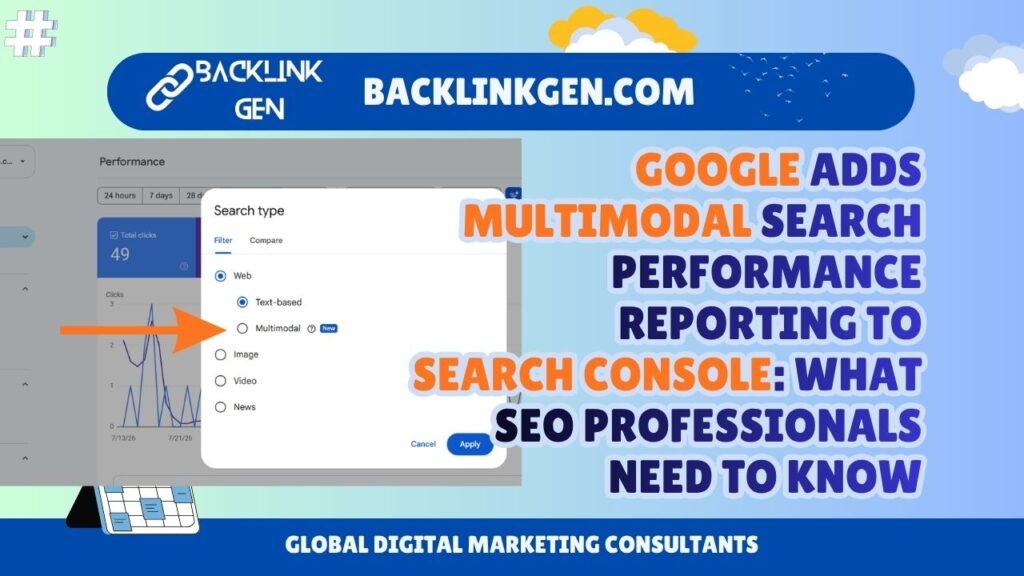
Google is expanding the way website owners measure organic search performance. In late September 2026, Google announced new multimodal search performance reporting in Google Search Console, giving publishers and website owners more visibility into how their content appears when people search using images rather than relying only on typed words.
The announcement is important because the way people discover information online is changing. Someone looking for a product can photograph it. A student can circle an object on a phone screen to learn more about it. A shopper can upload an image to Google Search instead of trying to describe the item in a search box.
These behaviours create opportunities for businesses to reach audiences through visual discovery. However, measuring that visibility has not always been straightforward.
Google’s new reporting introduces a dedicated multimodal search filter in its performance reporting. It covers image-led search experiences such as Google Lens, Circle to Search on Android, image uploads to Google Search, and Chrome’s right-click “Search this image” feature.
In my experience working across SEO, web development, analytics, and digital marketing campaigns, better reporting helps businesses make better decisions. When marketers can distinguish different ways users discover their content, they can investigate performance more intelligently and identify where optimization efforts may be needed.
This update does not mean Google has introduced a new ranking factor or algorithm update. Instead, it gives website owners additional information about an increasingly visual search experience.
For SEO professionals, the opportunity is to understand this data, incorporate it into reporting, and build a more informed strategy for visual search visibility.
1. What Did Google Announce in September 2026?
Google Search Central announced that multimodal search reporting was being introduced in the Search Console Performance reports for Search results and generative AI features.
The new reporting helps website owners understand how their content appears when users discover information through image-based searches. Google confirmed that the rollout was global, with metrics appearing for websites receiving traffic from these searches.
The announcement covers four important search experiences:
- Google Lens: Users search using images captured with a smartphone camera or selected from their devices.
- Circle to Search: Android users can select an object or area on their screen to find related information.
- Image uploads to Google Search: Users submit images to discover products, places, objects, and other relevant information.
- Chrome’s Search this image feature: Users can right-click an image and search for related information.
Previously, website owners had limited visibility into this category of search behaviour through a dedicated Search Console filter. The new reporting gives marketers a more specific way to investigate how image-led discovery contributes to website visibility.
For businesses with product catalogues, visual tutorials, travel content, informational websites, and image-rich landing pages, this is a useful development.
2. What Is Multimodal Search, and Why Does It Matter?
Traditional search generally begins with a text query. A user types something like “best running shoes for beginners” or “modern kitchen design ideas” and reviews the results.
Multimodal search expands this interaction by allowing users to combine visual information with search functionality. Instead of explaining an object in words, a person can use a photograph, screenshot, or selected area of a screen to find relevant information.
Imagine a shopper sees a pair of shoes while travelling. Rather than guessing the product name, the shopper can use Google Lens to identify similar products, explore available options, and visit relevant websites.
A traveller might photograph a landmark to discover its location. A homeowner might upload a picture of a furniture item to find alternatives. Someone reading an article might use Circle to Search to investigate a product shown in an image.
These examples demonstrate why visual discovery deserves attention in modern SEO strategies.
The important point is that users do not always express their needs through conventional keywords. Businesses should therefore think about how their products, services, and information can be discovered through images as well as text.
However, multimodal search is not a replacement for traditional SEO. It adds another dimension to the search experience, making accessible content, useful images, descriptive context, and sound technical foundations increasingly relevant.
3. Where Can You Find the New Reporting in Search Console?
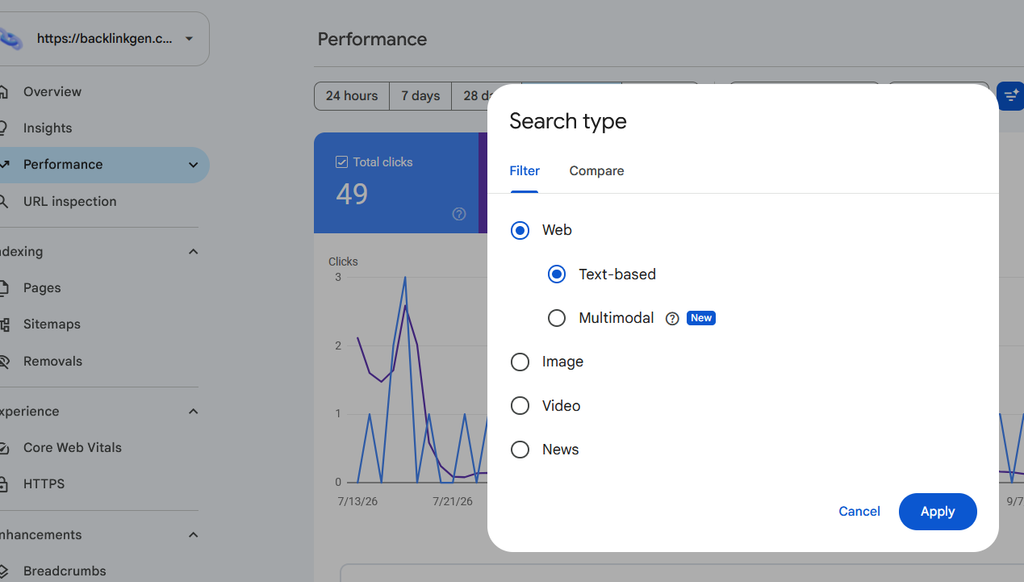
Google has introduced a new multimodal search type filter in its Performance reporting. Website owners can use this filter to examine relevant data separately from other search activity.
To explore it, follow these steps:
- Open Google Search Console and select your website property.
- Navigate to the Performance report for Search results.
- Open the Search type filter.
- Select the multimodal option under Web, where available.
- Review the available performance information and compare relevant reporting periods.
- Use the Export option to download the data for further analysis.
The reporting is also available in the Performance report for generative AI features, allowing website owners to investigate multimodal search performance within that reporting area.
Google’s rollout began globally in late September 2026. Availability and the volume of reported data depend on whether a website receives traffic from these search experiences.
If you do not see meaningful activity, that does not automatically indicate a technical SEO problem. Your website may simply receive little traffic through these search experiences, or the available reporting may not yet provide substantial data for your property.
4. What Metrics Should SEO Professionals Monitor?
The main value of the new reporting is the ability to investigate performance associated with image-led searches.
SEO professionals should examine the available impressions, clicks, click-through rate, and page-level performance data where reported. These metrics can help establish whether a website is appearing in multimodal search results and whether users are visiting its pages.
Start by identifying which landing pages receive visibility through this search type. Then compare their performance with the purpose of each page.
For example, a retailer may discover that product pages receive multimodal impressions. An educational website might find that illustrated tutorials attract visibility. A travel website may identify relevant performance for destination guides containing useful photographs.
The next step is to determine whether that visibility contributes to business objectives.
For lead-generation websites, evaluate whether relevant landing pages support enquiries. For e-commerce stores, investigate whether the pages receiving search traffic are useful for product discovery and purchases. For publishers, assess whether image-led discovery contributes to meaningful audience engagement.
Do not assume that more impressions automatically translate into more revenue. Performance data should be interpreted alongside conversion tracking, website analytics, and business objectives.
One important limitation also deserves attention: image-led searches do not always produce conventional text queries. Query-level reporting may therefore be unavailable for multimodal traffic. Page-level analysis and exported performance data become particularly useful when investigating this category.
5. How This Update Changes Visual SEO Strategy
The announcement gives marketers a stronger reason to treat image optimization as part of a broader organic search strategy.
However, visual SEO should not be reduced to adding keywords to image filenames or inserting alternative text everywhere. Effective optimization begins with making images useful, accessible, relevant, and understandable within the surrounding page.
For product websites, use clear product photographs and provide accurate product names, descriptions, specifications, and supporting information.
For publishers, ensure images genuinely support the article and add context to the subject being discussed.
For local businesses, use relevant photographs that accurately represent services, locations, products, or facilities.
For educational websites, use diagrams, screenshots, and illustrations that help users understand a concept rather than relying entirely on decorative imagery.
Technical implementation matters as well. Use descriptive filenames where practical, provide meaningful alternative text for informative images, and ensure important images can be accessed by search engines. Choose appropriate image formats and dimensions, and avoid unnecessarily large files that harm page performance.
The surrounding page should also explain the image’s relevance. A photograph of a product is more useful when accompanied by accurate information about that product.
These practices support accessibility, user experience, and image understanding. They do not guarantee visibility in multimodal search, but they provide a sensible foundation for visual content optimization.
6. How to Use the New Data for Content and Business Decisions
I recommend that SEO teams incorporate multimodal reporting into their regular performance reviews rather than treating it as an isolated metric.
Begin by identifying the pages that receive multimodal impressions and clicks. Group them by purpose, such as product pages, service pages, educational articles, destination guides, or visual resources.
Next, assess whether those pages meet users’ likely needs. A product page should provide useful product information, while an educational article should answer the underlying question clearly.
Look for patterns across pages. Are particular content categories receiving more visibility? Are important images associated with pages that perform well? Are there pages with visibility but relatively few clicks that deserve further investigation?
Use these observations to create a prioritized optimization plan.
For example, an online retailer might improve product photography and descriptions on important product pages. A publisher might reorganize a visual tutorial so that its screenshots are more useful and accessible. A digital marketing agency might add multimodal reporting to its monthly client dashboards.
Exporting data can also help teams combine Search Console insights with other reporting systems. However, avoid assuming that every dataset can be joined perfectly. Check date ranges, available dimensions, and reporting definitions before drawing conclusions.
The objective is not to make changes simply because a new filter exists. It is to use the additional information to make better decisions about content, user experience, and organic visibility.
7. What This Means for AI Search, GEO, and the Future of SEO
Google’s announcement also has implications for how marketers think about discovery across evolving search experiences.
As search interfaces become more visual and conversational, people can discover information in ways that do not begin with a traditional typed query. This makes it increasingly important to understand how different discovery experiences contribute to website performance.
For professionals working on Generative Engine Optimization (GEO) and AI search visibility, the new reporting provides another area to investigate within Google’s available reporting tools.
Nevertheless, it is important to distinguish measurable performance from assumptions. The existence of a multimodal filter does not prove that a website will be cited more frequently in AI-generated answers, nor does it guarantee higher rankings.
Marketers should continue focusing on clear information, helpful content, accessible pages, reliable technical implementation, and appropriate measurement.
The new reporting is useful because it expands visibility into an additional category of search behaviour. It does not eliminate the need for research, testing, or a broader understanding of the customer journey.
8. My Recommendations for Website Owners
For businesses looking to respond to this update, I recommend a practical approach.
First, check whether your Search Console property receives multimodal traffic. Establish a baseline before changing your strategy.
Second, identify the pages contributing to that visibility. Determine whether they represent valuable products, services, or informational resources.
Third, review image quality, alternative text, surrounding content, mobile usability, and technical accessibility. Prioritize improvements that benefit users rather than making changes solely to influence a reporting metric.
Fourth, connect performance insights to business outcomes wherever reliable data is available. Search visibility is useful, but qualified visits, enquiries, sales, and audience engagement provide additional context.
Finally, review the results consistently. Multimodal search should be considered alongside other acquisition channels, including conventional organic search, video, social platforms, and paid campaigns.
The best strategy is not to chase every new feature independently. It is to understand where customers discover your business and make that discovery experience as useful as possible.
Conclusion
Google’s September 2026 announcement introduces a valuable improvement to Search Console reporting by giving website owners dedicated visibility into multimodal search performance.
With reporting covering Google Lens, Circle to Search, image uploads to Google Search, and Chrome’s Search this image feature, marketers can investigate how users discover content through visual interactions.
For SEO professionals, the immediate priority is to explore the new filter, identify relevant landing pages, evaluate available performance data, and use those findings to guide practical optimization decisions.
I believe this update reinforces an important principle: effective SEO depends on understanding how people discover information, not simply tracking traditional keyword rankings.
Businesses that combine useful visual content, accessible website design, sound technical SEO, and meaningful performance measurement will be better equipped to respond to changing search behaviour.
The opportunity is not to abandon conventional SEO. It is to expand your understanding of search visibility and use the additional data to make more informed decisions.
Disclaimer
This article is intended for educational and informational purposes. Search Console features, reporting availability, and search behaviour may change over time. Performance varies by website, industry, content quality, and audience. Multimodal reporting does not guarantee improved rankings, traffic, or conversions. Website owners should review their own data, validate findings, and consult official Google documentation before making significant SEO decisions.
About Author:
BacklinkGen.com Editorial Team
The BacklinkGen.com Editorial Team is led by Amit Tyagi, Gaurav Saxena and Rachit Srivastava—professionals with expertise spanning enterprise technology, artificial intelligence, digital marketing, SEO, AI Search Optimization (AIO/GEO), content strategy, and business growth. Together, they bring decades of combined industry experience across global technology initiatives, performance marketing, and digital transformation.
Every article published on BacklinkGen.com is guided by practical experience, in-depth research, and a commitment to editorial accuracy. The team focuses on delivering trustworthy, actionable, and up-to-date insights that help businesses, marketers, and professionals stay ahead in the rapidly evolving world of search, AI, and digital marketing.