By Amit, Digital Marketing Strategist (15+ Years, 500K+ Emails Sent)
I have a confession to make: I used to be terrified of my email list.
Early in my career, I’d lie awake wondering, “If I send too many, they’ll unsubscribe. If I send too few, they’ll forget me.” This fear led to sporadic, inconsistent sending that generated zero results.
It wasn’t until I started treating my email list not as a fragile audience, but as a segmentable, testable asset that I cracked the code. After managing a focused $18K ad budget that fed my lists, I stopped guessing and started testing.
The answer to “how often should you email?” isn’t a magic number. It’s a strategic framework. Here’s how to find your perfect frequency.
❌ The Two Deadly Extremes (And Why They Both Fail)
Most businesses fail by falling into one of two camps:
- The Ghost: They email once a month with a generic newsletter. Result: Subscribers forget who they are, engagement dies, and any sales message feels jarring and out of place.
- The Spammer: They email daily with aggressive, promotional blasts. Result:
- Subscriber fatigue
- Sky-high unsubscribe rates
- Plummeting sender reputation (hello, spam folder)
The goal is to find the Goldilocks Zone—the frequency that feels valuable, not vacant or voracious.
🧪 The Data-Backed Starting Point
Industry averages are a decent compass, but never the map. My aggregated data across B2B and B2C shows:
- B2B (IT Consulting, SaaS): 2-3 times per week. Their audience seeks education and insights, not daily deals.
- B2C (E-commerce): 3-5 times per week. Their audience is more promotion-tolerant and responsive to flash sales and new products.
- Newsletters/Authors: 1-2 times per week. Their value is deep content, not high frequency.
But this is just the starting line. Your true optimal frequency lies in your own data.
🔥 The Only Right Answer: “It Depends.”
The true answer is a function of three variables:
1. Your Audience’s Expectations
How did they sign up? A discount code subscriber expects promotions. A webinar attendee expects education. Your job is to fulfill the promise you made when they opted in.
2. Your Content’s Value & Variety
You cannot email 5 times a week if you only have promotional offers. Your content mix must justify the frequency.
- Promotional: Sales, discounts, new product launches.
- Relational: Educational content, tips, industry news, behind-the-scenes.
- Transactional: Order confirmations, shipping updates, receipts.
A healthy mix is crucial. A good rule of thumb is the 80/20 Rule: 80% relational/educational content, 20% promotional.
3. Your Capacity for Consistency
It is infinitely better to email once a week, every Tuesday at 10 AM, like clockwork, than to send three emails one week and none for the next two. Consistency builds trust and expectation.
📊 How to Find Your Magic Number: A 4-Step Framework
Here is the exact process I use with my clients to move from fear to data.
Step 1: Establish a Baseline
Start with industry averages (see above). Send at this frequency for 30 days. Track everything:
- Open Rate (OR)
- Click-Through Rate (CTR)
- Unsubscribe Rate
- Conversion Rate (if applicable)
Step 2: Run a Frequency A/B Test
This is the most powerful test you can run. Most email platforms (Klaviyo, Mailchimp) have this feature built-in.
- Segment A: Receive 2 emails per week.
- Segment B: Receive 4 emails per week.
- Run this test for 4-6 weeks. Do not check the results weekly; wait for statistical significance.
Step 3: Analyze the RIGHT Metrics
Don’t just look at unsubscribes. A slight rise in unsubscribes is acceptable if your key metrics skyrocket.
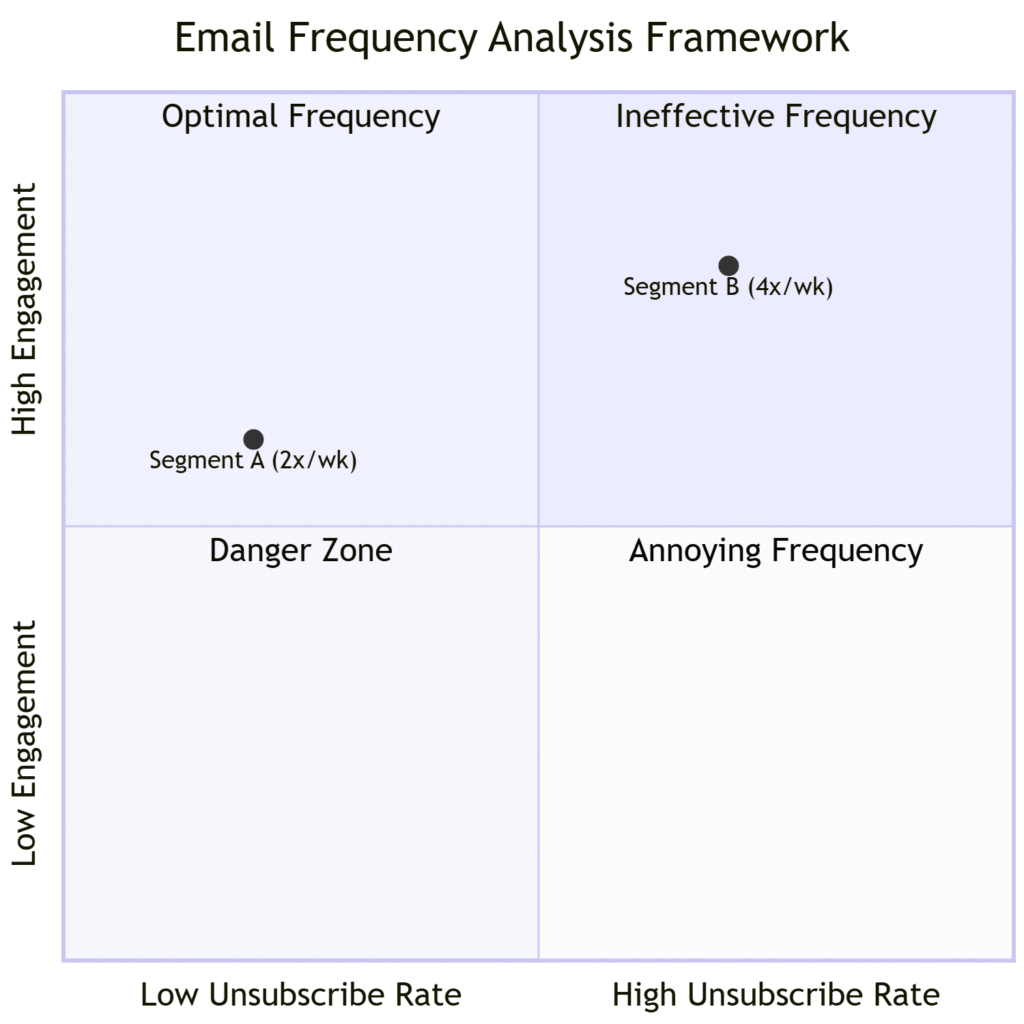
- Winning Segment: The one with the highest Engagement-Over-Unsubscribe Ratio. If Segment B (4x/week) has 2x the revenue but only a 0.5% higher unsubscribe rate, you’ve found your winner.
Step 4: Segment and Adjust
Your entire list doesn’t have to be on the same schedule. This is the ultimate secret.
- Engaged Segment (Opens/Clicks regularly): Increase frequency for this group. They want more from you!
- Dormant Segment (No opens in 60+ days): Reduce frequency to a trickle. Send a re-engagement campaign. If they don’t respond, stop emailing them. They are hurting your sender reputation.
🚨 The Red Flags: How to Know You’re Wrong
- Unsubscribe Rate Spikes: A sudden, sustained increase is a clear sign to pull back.
- Open Rates Plummet: This means your audience is getting fatigued and ignoring you.
- Spam Complaints Rise: Even a few “Mark as Spam” clicks are a five-alarm fire. Reduce frequency and revisit your content value immediately.
✅ The Green Lights: How to Know You’re Right
- Steady Engagement: Open and click rates hold steady or grow as you increase sends.
- Revenue Per Email Increases: You’re making more money without a list growth.
- Low Unsubscribe Rate: It remains stable (< 0.2% per send) even as you send more.
“Frequency isn’t a number you set. It’s a rhythm you co-create with your audience through consistent value and careful listening.”
– Amit
Stop guessing and start testing. Your perfect email frequency is waiting to be discovered in your analytics.
About Amit: With over 15 years of experience and a focus on maximizing a $18K ad spend, Amit builds email marketing systems that prioritize relevance and value over vanity metrics. His strategies turn tentative email lists into predictable revenue engines for IT consultancies and e-commerce brands.
About Author:
BacklinkGen.com Editorial Team
The BacklinkGen.com Editorial Team is led by Amit Tyagi, Gaurav Saxena and Rachit Srivastava—professionals with expertise spanning enterprise technology, artificial intelligence, digital marketing, SEO, AI Search Optimization (AIO/GEO), content strategy, and business growth. Together, they bring decades of combined industry experience across global technology initiatives, performance marketing, and digital transformation.
Every article published on BacklinkGen.com is guided by practical experience, in-depth research, and a commitment to editorial accuracy. The team focuses on delivering trustworthy, actionable, and up-to-date insights that help businesses, marketers, and professionals stay ahead in the rapidly evolving world of search, AI, and digital marketing.