When businesses talk about backlinks, the conversation usually focuses on one question:
“How many backlinks does my website have?”
That is useful, but it is not enough.
For a sustainable SEO strategy, I want to know something more important:
Are we continuously earning valuable links, or are we losing them?
A website can have thousands of backlinks and still have a weak link-building strategy if it is consistently losing valuable referring domains. Similarly, a website with a relatively small backlink profile can be moving in the right direction if it is steadily acquiring links from relevant, authoritative websites.
This is why the New and Lost Referring Domains and New and Lost Backlinks sections in Semrush are particularly useful.
In this article, I will show you how I analyze these two charts for a business domain and, more importantly, how to convert the data into SEO actions.
First, Understand the Difference Between Referring Domains and Backlinks
Before analyzing the charts, you need to understand the difference between these two metrics.
A backlink is an individual link pointing from another website to your website.
A referring domain is a unique website/domain that provides one or more backlinks to your website.
For example, imagine:
- example.com links to your website 5 times
- anotherwebsite.com links to your website 3 times
- newsportal.com links to your website once
You have:
9 backlinks from 3 referring domains.
This distinction is extremely important.
If your backlink count increases from 100 to 150, but most of those 50 new links come from websites that already link to you, your referring-domain growth may be much smaller.
For SEO analysis, I generally want to look at both volume and diversity rather than celebrating backlink numbers alone.
Semrush’s Referring Domains report specifically tracks the domains linking to a website and allows analysis based on metrics such as Authority Score, backlink count, country, category and other filters.
Where to Find This Data in Semrush
For this analysis, open Backlink Analytics in Semrush and enter your business domain.
For example, you can analyze:
backlinkgen.com
The Backlink Analytics Overview contains several backlink-related insights, including the charts for:
- New and Lost Referring Domains
- New and Lost Backlinks
Semrush describes these charts as a way to monitor the growth and loss of referring domains and backlinks over time.
Screenshot Placeholder
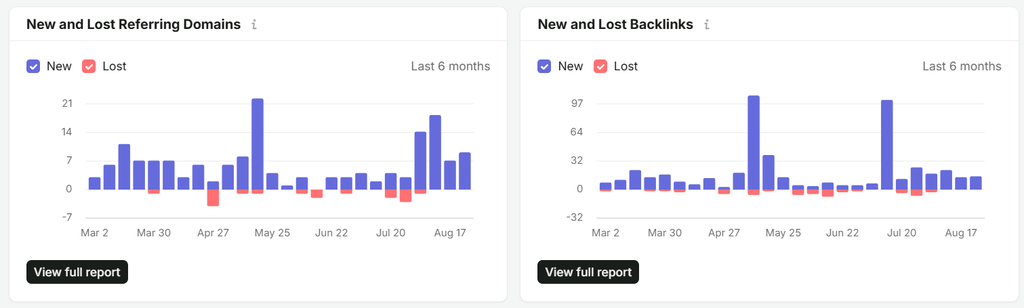
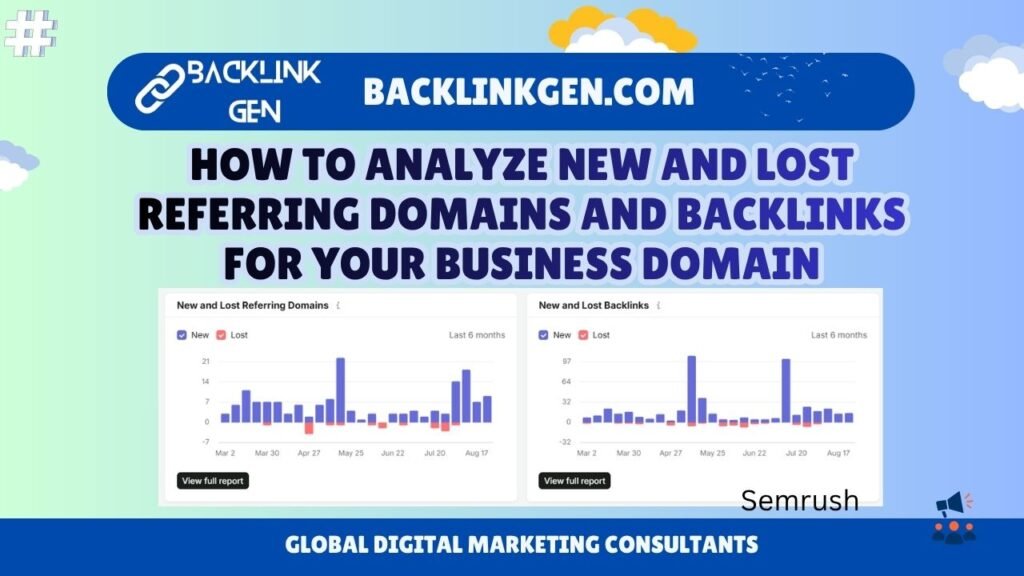
Suggested image caption: Semrush New and Lost Referring Domains and Backlinks analysis showing six months of link acquisition and loss.
1. Start With New and Lost Referring Domains
This is the first chart I would examine.
The chart shows how many new referring domains have appeared and how many referring domains have been lost during the selected period.
In the example above, the graph covers approximately six months.
The blue bars represent new referring domains, while the red bars represent lost referring domains.
The first question I ask is:
“Is the overall direction positive?”
You don’t necessarily need every week or month to be positive.
SEO doesn’t work that neatly.
There will be periods when you acquire fewer links and periods when you lose some links. What matters is the overall trend and the quality of the domains being gained or lost.
What I Look For
I typically evaluate four things:
- Consistency of new referring domains
- Size and frequency of losses
- Large spikes
- Net growth over time
For example, if a website gains 10 new referring domains in one month and loses 2, that is generally a positive signal.
But if it gains 15 and loses 14, the headline number of “15 new domains” doesn’t tell the complete story.
The business is effectively adding only one net referring domain.
2. Don’t Panic When You See Lost Referring Domains
One of the most common mistakes I see in backlink analysis is treating every lost link as an SEO emergency.
That’s not how I would approach it.
A backlink can disappear for perfectly normal reasons.
For example:
- A website removes an old article.
- A page is redesigned.
- A website shuts down.
- A resource is replaced.
- A URL changes.
- An article is updated and the external link is removed.
- A temporary technical issue prevents Semrush from seeing the link.
Therefore, a red bar in the chart is not automatically bad news.
The important question is:
Which referring domains did we lose?
This is where you move from dashboard monitoring to actual SEO analysis.
Semrush’s detailed backlink reports allow you to filter for lost backlinks and investigate the specific links that are no longer being detected. (Semrush)
3. Analyze the Quality of Lost Referring Domains
Suppose your website lost 8 referring domains last month.
That number alone doesn’t tell me much.
I would open the lost referring-domain data and investigate:
Authority
Was the lost domain authoritative?
A lost link from a respected industry publication may deserve immediate attention.
A lost link from a low-quality directory may not deserve any attention at all.
Relevance
Was the website related to your industry?
For example, if you operate a B2B SaaS company, losing a backlink from an established SaaS publication is more strategically important than losing one from an unrelated general directory.
Traffic Potential
Did the referring website actually send visitors?
A backlink isn’t valuable only because of its potential SEO contribution.
A relevant website that sends qualified referral traffic can be extremely valuable.
Target Page
Which page on your website was receiving the backlink?
This is another important question.
Losing a backlink to your homepage is different from losing a backlink to a high-performing commercial landing page or a major research article.
4. Look for Patterns Instead of Individual Links
I rarely recommend analyzing backlinks one by one without looking for patterns.
Imagine a company notices that it lost 20 referring domains.
That sounds concerning.
But after investigation, it discovers that:
- 15 were low-quality directories
- 3 were expired websites
- 2 were relevant industry websites
The situation is very different from losing 20 authoritative editorial domains.
Similarly, suppose a company acquires 30 new referring domains.
That sounds excellent.
But if 25 come from unrelated websites with very little authority, the number should not be treated as a major SEO success.
The pattern matters more than the headline number.
5. Now Analyze New Referring Domains
The next question is:
Where are our new links coming from?
This is one of my favorite ways to evaluate whether an SEO or digital PR campaign is actually working.
Suppose you recently launched:
- A research report
- A digital PR campaign
- An industry survey
- A guest-contribution campaign
- A new tool
- An original study
- A link-building campaign
You should expect the activity in your referring-domain chart to reflect that work.
If the campaign started in May and your new referring domains suddenly increase in May and June, that’s worth investigating.
Semrush’s backlink database and reports are designed to help monitor new and lost links over time, including recent backlink activity. (Semrush)
6. A Spike in New Referring Domains Needs Investigation
Look at the example chart.
There are periods where the number of new referring domains increases sharply.
A spike can be good.
But I never automatically assume that a spike means success.
I ask:
“Why did this happen?”
There are several possible explanations.
Scenario 1: Successful Digital PR
You published original research and several publications referenced it.
Excellent.
Scenario 2: Content Became Popular
An article started receiving organic visibility and other websites naturally linked to it.
Also excellent.
Scenario 3: A Campaign Generated Links
Your outreach team secured several editorial placements.
Potentially positive.
Scenario 4: Automated or Low-Quality Links
Thousands of automatically generated pages started linking to your website.
Now the analysis needs to be much more careful.
This is why backlink analysis should never be reduced to:
More links = better SEO.
7. Analyze New and Lost Backlinks Separately
Now move to the second chart:
New and Lost Backlinks.
This chart works at the individual-link level.
One referring domain can generate multiple backlinks.
For example:
A website may publish a resource article that links to your homepage, service page and research article.
That’s potentially:
1 new referring domain + 3 new backlinks.
This explains why the number of new backlinks can be significantly higher than the number of new referring domains.
Semrush’s Backlinks report provides additional information for individual links, including source URL, target URL, anchor text, Authority Score, first-seen and last-seen dates and link attributes.
8. Don’t Compare Backlink Volume Without Context
Suppose your competitor has:
50,000 backlinks
and your website has:
8,000 backlinks.
Should you automatically try to build 42,000 more?
Absolutely not.
I would first investigate:
- How many referring domains do they have?
- Which domains are linking to them?
- What is the quality of those domains?
- Which pages receive the most links?
- What types of content attract those links?
- Are the links editorial?
- Are they relevant to the industry?
- What anchor text is being used?
- How many links are sitewide?
- How many are new versus historical?
Backlink volume without context can lead businesses to spend money on the wrong type of link acquisition.
9. Use New Backlinks to Discover What Is Working
One of the most valuable uses of this report is identifying content that naturally attracts links.
Suppose your company has 100 blog posts.
You discover that three articles are responsible for a large percentage of your new backlinks.
That’s important.
Those articles may have characteristics such as:
- Original data
- Strong research
- Useful statistics
- Unique tools
- Templates
- Industry insights
- Detailed guides
- Original opinions
- Visual assets
Instead of simply creating more content, you can study why those pages attract links.
Then build additional content around the same successful format.
That’s how backlink analysis becomes a content strategy tool.
10. Compare New Links Against Lost Links
Now combine both charts.
This is where the analysis becomes much more meaningful.
Consider three hypothetical businesses.
Business A
New referring domains: 20
Lost referring domains: 5
This suggests strong positive growth.
Business B
New referring domains: 20
Lost referring domains: 18
The business is acquiring domains, but retention is weak.
Business C
New referring domains: 8
Lost referring domains: 2
The acquisition volume is lower, but the profile is still growing steadily.
Which business has the best SEO strategy?
You cannot answer that from these numbers alone.
You need to examine the quality, relevance and strategic importance of the domains.
This is why I prefer looking at backlink acquisition as a portfolio rather than a simple counting exercise.
11. Use Lost Links as Link-Building Opportunities
A lost backlink isn’t always just a loss.
It can become an outreach opportunity.
Suppose an industry website previously linked to your article, but the link disappeared.
You investigate and discover that:
- The article still exists.
- Your resource is still relevant.
- The link was removed during a content update.
You can contact the publisher and ask whether the resource can be restored.
Semrush specifically recommends investigating lost backlinks and, where appropriate, reaching out to the referring website to restore a link.
This is often easier than acquiring a completely new relationship.
The website already knew your content was valuable enough to link to once.
12. Watch for Multiple Lost Links From One Domain
Here’s another analysis technique I recommend.
Suppose you notice:
1 lost backlink
from a particular website.
That may not be significant.
But suppose you discover:
15 lost backlinks from the same domain.
Now I want to investigate.
Possibilities include:
- The website redesigned its architecture.
- A section was removed.
- URLs changed.
- A major article was deleted.
- The website migrated to a new CMS.
- Links were intentionally removed.
Semrush’s backlink filtering capabilities allow you to combine filters such as lost status and referring domain to investigate these situations more deeply. (Semrush)
13. Don’t Ignore Link Attributes
When analyzing new backlinks, also look at their attributes.
Depending on the link, you may encounter:
- Follow
- Nofollow
- Sponsored
- UGC
You should not evaluate a link exclusively based on whether it is “follow” or “nofollow.”
A nofollow link from a major publication can still generate brand exposure, referral traffic and potential secondary links.
For example, a publication may mention your company and link to your research using a nofollow attribute. Thousands of readers could still see that mention.
So my recommendation is:
Evaluate SEO value, referral value and brand value separately.
14. Create a Monthly Backlink Review Process
For businesses, I recommend turning this into a recurring SEO process rather than checking Semrush only when rankings fall.
Once a month, review:
Referring Domains
- New domains
- Lost domains
- Net change
- Authority of new domains
- Authority of lost domains
- Industry relevance
- Geographic distribution
Backlinks
- New backlinks
- Lost backlinks
- Important lost links
- New links to important commercial pages
- New links to content assets
- Anchor-text patterns
- Link attributes
Business Impact
Finally ask:
Did these links help the business?
Look at:
- Organic rankings
- Organic traffic
- Referral traffic
- Leads
- Brand mentions
- Commercial page visibility
- Content performance
That final step is what separates SEO reporting from SEO strategy.
15. How I Would Interpret the Example Chart
Looking at the six-month example, I would not simply say:
“The blue bars are higher, therefore the backlink profile is healthy.”
I would investigate the peaks and drops.
The large spikes in new referring domains and backlinks deserve investigation because they may correspond to specific campaigns, content publications, PR activity or other events.
Likewise, periods with noticeable losses should be investigated to determine whether important domains disappeared or whether the losses were mostly insignificant.
Then I would compare the findings with the website’s SEO timeline.
For example:
Was a new content campaign launched in May?
Did a PR campaign run in July?
Was the website redesigned in June?
Were URLs changed?
Did a major resource get removed?
Connecting backlink activity with actual business activity gives you a much more useful interpretation of the chart.
Final Thoughts: Don’t Measure Backlinks—Measure Backlink Momentum
The New and Lost Referring Domains and New and Lost Backlinks sections in Semrush are not just reporting widgets.
Used properly, they can tell you:
- Whether your link-building strategy is gaining momentum
- Whether valuable referring domains are being retained
- Which campaigns are earning attention
- Which content attracts links
- Where link losses need recovery
- Whether competitors may be accelerating their link acquisition
- Where new outreach opportunities exist
Most importantly, don’t become obsessed with a single number.
A healthy backlink profile is not necessarily the one with the largest number of backlinks.
It is the one that is relevant, diverse, sustainable and continuously improving.
In my previous article, How to Use Semrush to Build a Data-Driven SEO Strategy for Your Business, I explained how to use the Semrush dashboard to build a broader, data-driven SEO strategy.
This backlink analysis should be viewed as the next step: use the dashboard to understand what is happening, then use New and Lost Referring Domains and Backlinks to understand why your link profile is changing.
That’s where Semrush becomes much more than an SEO reporting tool—it becomes a decision-making tool for your SEO strategy.
Disclaimer
This article reflects my practical approach to SEO and backlink analysis based on professional digital marketing experience. Semrush interface elements, metrics, databases and features may change over time. Always evaluate backlinks in the context of your website, industry, content strategy and overall SEO performance rather than relying on a single metric.
About Author:
Amit Tyagi is a Senior Digital Marketing Specialist and Web Development Strategist with over 15 years of experience in SEO, website development, and data-driven digital growth. He has successfully built and optimized more than 50 websites across various industries, helping businesses improve online visibility, generate leads, and increase revenue through strategic digital marketing.
His expertise spans search engine optimization (SEO), content strategy, conversion-focused web development, marketing automation, and analytics-driven decision making. Amit combines technical development skills with advanced digital marketing strategies to create high-performing digital ecosystems for brands.
Throughout his career, Amit has worked on eCommerce, B2B platforms, and enterprise-level digital projects, delivering scalable solutions that align technology with business goals. He is also known for sharing insights on modern SEO trends, AI-driven marketing, and future digital strategies.
Amit believes that the future of marketing lies at the intersection of technology, data, and strategic storytelling.