
By Amit, Digital Marketing Strategist
I have a secret. You don’t need a team of developers or a six-figure budget to build a powerful, automated marketing engine. The revolution is here, and it’s called no-code.
After building and optimizing marketing systems for dozens of brands, I’ve seen a massive shift. The tools that were once reserved for Fortune 500 companies are now accessible to everyone. A no-code stack isn’t a “cheap alternative”—it’s a strategic advantage that lets you move faster, test smarter, and adapt instantly.
Whether you’re a solo founder, a small agency, or a growing e-commerce brand, here’s how to build a marketing stack that works as hard as you do, without writing a single line of code.
❌ The 3 No-Code Myths That Hold You Back
Before we build, let’s debunk the myths:
- “No-code is less powerful.” False. You can build complex workflows that handle lead scoring, multi-channel nurturing, and personalized customer journeys.
- “It will get expensive.” Not necessarily. Starting with free and affordable tools can get you 90% of the way. You scale your spending as you scale your results.
- “It’s just for simple tasks.” Outdated. No-code tools now power multi-million dollar businesses. The limit is your strategy, not the technology.
🧱 The 4 Pillars of Your No-Code Marketing Stack
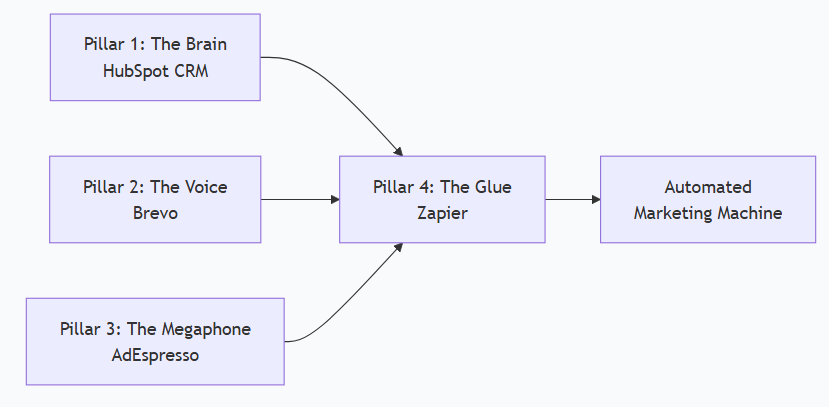
Every effective stack, regardless of budget, is built on these four pillars. For each, I’ll recommend my top no-code tools.
Pillar 1: The Brain (CRM & Data Hub)
This is the single source of truth for all your customer and prospect data. It’s the foundation everything else connects to.
- The Champion: HubSpot CRM
- Why it’s essential: Its free tier is incredibly robust. You can manage an unlimited number of contacts and deals, track every email interaction, and see a complete history of every lead—all without spending a dollar. It’s the central hub that keeps your data from getting siloed.
- Use Case: Every business, regardless of model, should start here.
- The E-commerce Specialist: Klaviyo
- Why it’s essential: If you sell products online, Klaviyo is more than an email tool; it’s a CRM that understands customer purchase data. Its deep integration with platforms like Shopify makes it the natural brain for an e-commerce operation.
Pillar 2: The Voice (Communication & Automation)
This is how you talk to your audience. It includes email marketing, SMS, and the automated workflows that deliver the right message at the right time.
- The All-Rounder: Mailchimp
- Why it’s essential: It’s the classic for a reason. Its free plan is a perfect launchpad for email marketing, and its visual customer journey builder allows you to create sophisticated automations with a drag-and-drop interface.
- The Powerhouse: Brevo (formerly Sendinblue)
- Why it’s essential: Brevo offers incredible value. Its free plan includes unlimited contacts (with a daily send limit) and its paid plans are affordable, offering not just email but SMS, live chat, and marketing automation in one place.
Pillar 3: The Megaphone (Advertising & Social Media)
This is how you find new customers and amplify your message.
- The Ad Optimizer: AdEspresso
- Why it’s essential: Instead of juggling Meta Ads Manager and Google Ads interfaces, AdEspresso provides a single, simplified dashboard. It makes A/B testing different audiences, creatives, and copy incredibly easy, turning a complex process into a visual, no-code experiment.
- The Social Scheduler: Buffer
- Why it’s essential: Consistency on social media is key. Buffer lets you schedule posts across all major platforms from one clean calendar. Its analytics help you understand what’s working without the overwhelm.
Pillar 4: The Nervous System (Workflow & Productivity)
This is the most important pillar—the glue that connects your other tools and automates your internal processes.
- The King of Glue: Zapier
- Why it’s essential: This is the engine of your no-code stack. Zapier creates “Zaps”—automated workflows that connect your apps. For example: When a deal is marked “Closed-Won” in HubSpot, a Zap can automatically add that customer to a “VIP” email segment in Mailchimp and create a new project task in Trello. It eliminates manual data entry forever.
- The Project Hub: Trello
- Why it’s essential: Marketing runs on campaigns and projects. Trello’s card-and-board system is a intuitive way to manage everything from your content calendar to your campaign launches. With power-ups, it can connect to your entire stack.
🛠️ Building Your Stack: Two Real-World Scenarios
Let’s see how these pillars come together for different business models.
Scenario 1: The B2B Service Provider (e.g., an IT Consultancy)
Goal: Generate and nurture qualified leads.
- The Stack:
- Brain: HubSpot CRM (Free)
- Voice: Brevo (Starter Plan)
- Megaphone: Native Google Ads + LinkedIn Ads
- Nervous System: Zapier + Trello
The Automated Workflow:
- A visitor downloads your “Cloud Migration Checklist” lead magnet from your website.
- Zapier automatically creates a new contact in HubSpot CRM.
- Simultaneously, Zapier adds this contact to a nurturing email sequence in Brevo.
- After three educational emails, if the contact visits your “Pricing” page (tracked in HubSpot), their “Lead Score” increases.
- A Zapier automation detects this high score and notifies your sales lead in Slack to make a personal follow-up.
Scenario 2: The E-commerce Brand (e.g., an appliance store)
Goal: Drive sales and increase customer lifetime value.
- The Stack:
- Brain: Klaviyo (Free/Starter)
- Voice: Klaviyo (for email/SMS)
- Megaphone: AdEspresso (for Meta/Google Ads)
- Nervous System: Zapier + Trello
The Automated Workflow:
- A customer abandons their cart with a specific air fryer.
- Klaviyo automatically triggers a 3-part email sequence: a reminder after 1 hour, a social proof email after 6 hours, and a limited-time discount offer after 24 hours.
- If they don’t purchase, Klaviyo can add them to a custom audience for a AdEspresso retargeting campaign.
- When they finally purchase, a Zap in Zapier marks the order as fulfilled in a Trello board for the operations team.
🚀 Your 30-Day No-Code Implementation Plan
Week 1: Lay the Foundation
- Action: Set up your HubSpot CRM or Klaviyo account. Import your existing contacts.
- Goal: Have a clean, central database.
Week 2: Establish Your Primary Voice
- Action: Choose Brevo or Mailchimp. Build your welcome email series for new subscribers. Connect it to your CRM with a simple Zapier zap.
- Goal: Automate your first customer touchpoint.
Week 3: Build One Core Automation
- Action: Identify your most repetitive task. Is it lead qualification? Cart abandonment? Build a single, powerful automation to handle it.
- Goal: Prove the value of automation by saving real time.
Week 4: Analyze & Optimize
- Action: Review the performance of your new automation. What’s working? Where are people dropping off? Tweak and improve.
- Goal: Move from a static setup to a learning, evolving system.
🚨 The #1 Rule of a No-Code Stack
Strategy first, tools second.
Do not buy a tool because it’s trendy. Identify a bottleneck in your marketing process first, and then find the no-code solution that solves it. Start with one problem, solve it completely, and then move to the next. This prevents “tool overload” and ensures every element in your stack has a clear, profitable job to do.
“A no-code stack isn’t about avoiding code; it’s about accelerating growth. It shifts your team’s energy from building systems to optimizing results.”
– Amit
About Author:

BacklinkGen.com Editorial Team
The BacklinkGen.com Editorial Team is led by Amit Tyagi, Gaurav Saxena and Rachit Srivastava—professionals with expertise spanning enterprise technology, artificial intelligence, digital marketing, SEO, AI Search Optimization (AIO/GEO), content strategy, and business growth. Together, they bring decades of combined industry experience across global technology initiatives, performance marketing, and digital transformation.
Every article published on BacklinkGen.com is guided by practical experience, in-depth research, and a commitment to editorial accuracy. The team focuses on delivering trustworthy, actionable, and up-to-date insights that help businesses, marketers, and professionals stay ahead in the rapidly evolving world of search, AI, and digital marketing.