Introduction by Amit
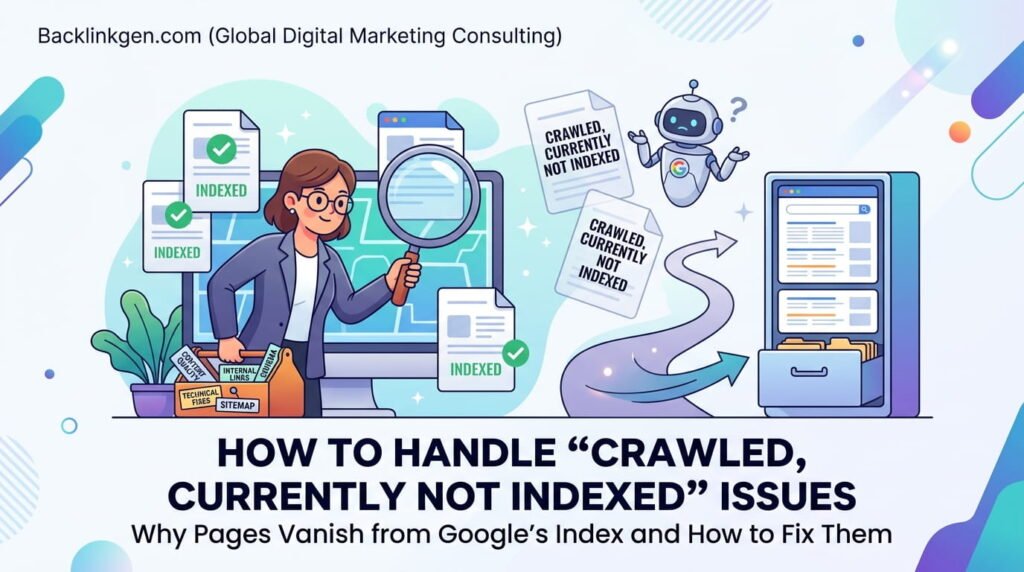
If you have been managing a website for any length of time, you have probably experienced the frustration of publishing content, seeing Google crawl it, and then discovering that the page never appears in search results. Even worse, pages that were previously indexed can suddenly disappear without warning. One of the most common messages website owners encounter in Google Search Console is “Crawled – Currently Not Indexed.”
This status has become increasingly common as Google continues refining its indexing systems. Many businesses invest significant time and money into content creation, SEO optimization, and link building only to find that valuable pages remain excluded from Google’s index. The result is lost traffic, reduced visibility, and missed business opportunities.
The reality is that Google is becoming more selective about what it indexes. Simply creating a page no longer guarantees inclusion in search results. Google’s algorithms now evaluate content quality, uniqueness, authority, user value, crawl efficiency, and overall website health before deciding whether a page deserves a place in the index.
Understanding why pages receive the “Crawled – Currently Not Indexed” status is the first step toward solving the problem. More importantly, businesses need a systematic approach to identify affected pages, diagnose underlying causes, and implement corrective actions that increase indexing rates.
In this guide, we will explore the real reasons pages vanish from Google’s index, explain how Google’s indexing process works, and provide actionable SEO strategies that can help your content get indexed and stay indexed.
1. Understanding What “Crawled, Currently Not Indexed” Actually Means
Many website owners mistakenly believe that “Crawled, Currently Not Indexed” is a technical error. In reality, it is a decision made by Google.
When Google discovers a URL, it first crawls the page. During crawling, Google’s bots analyze the content, internal links, metadata, structured data, page speed, and numerous other signals. After this analysis, Google decides whether the page deserves inclusion in its search index.
The “Crawled, Currently Not Indexed” status indicates that Google successfully visited the page but chose not to add it to the index at that time.
This distinction is important because the issue is usually not related to crawlability. Google can access the page. The challenge lies in convincing Google that the page offers sufficient value to users.
Google’s index is not an archive of every page on the internet. Instead, it is a curated collection of pages Google believes can satisfy search intent. Pages that appear thin, duplicate, outdated, low quality, or lacking authority may be excluded.
The status can also be temporary. Some pages eventually get indexed after Google reassesses them. Others remain excluded indefinitely unless improvements are made.
Website owners should avoid panicking when they see this status. Instead, they should view it as feedback from Google’s quality evaluation systems. The key question is not “Why can’t Google crawl my page?” but rather “Why doesn’t Google think this page deserves indexing?”
Understanding this mindset shift is critical because most successful solutions focus on content quality, website authority, and overall user value rather than purely technical SEO fixes.
2. Why Google Is Becoming More Selective About Indexing
Over the past several years, Google has significantly tightened its indexing standards.
The internet now contains billions of pages, and AI-generated content has dramatically accelerated content production. As a result, Google must prioritize resources and maintain search quality by indexing only the most valuable pages.
Google’s indexing systems increasingly focus on:
- Originality
- Expertise
- User value
- Trustworthiness
- Content depth
- Freshness
- Authority signals
Pages that fail to demonstrate these qualities may be crawled but excluded.
This trend has affected websites across industries. Even reputable websites occasionally see pages disappear from the index. Google’s algorithms continuously reevaluate indexed content, and pages that no longer meet quality expectations can be removed.
Many SEO professionals refer to this phenomenon as index pruning, where Google removes pages that contribute little value compared to competing content.
For website owners, this means quantity-based SEO strategies are becoming less effective. Publishing hundreds of mediocre pages often produces worse results than publishing a smaller number of exceptional resources.
Businesses must shift from creating content solely for keywords to creating content that genuinely solves user problems. Google’s systems increasingly reward comprehensive, authoritative, and engaging content while filtering out pages that appear redundant or unhelpful.
Understanding Google’s evolving indexing philosophy helps explain why many pages vanish without warning and why traditional SEO tactics alone may no longer guarantee visibility.
3. Thin Content: The Biggest Indexing Killer
One of the leading causes of “Crawled, Currently Not Indexed” status is thin content.
Thin content refers to pages that provide minimal value beyond what already exists elsewhere online. These pages often contain:
- Very little text
- Generic information
- Repetitive content
- Shallow explanations
- Low originality
Google wants to serve the best answer for every search query. If a page adds nothing unique, Google may decide not to index it.
Common examples include:
- Product pages with only manufacturer descriptions
- Location pages with nearly identical content
- Tag archives
- Empty category pages
- AI-generated articles without editing
- Doorway pages targeting slight keyword variations
Many businesses unknowingly create large volumes of thin content while attempting to expand keyword coverage.
Instead of creating numerous weak pages, focus on developing comprehensive resources that thoroughly address user questions. Include:
- Original insights
- Case studies
- Examples
- Data
- Expert opinions
- Unique visuals
The goal is to make your content significantly more useful than competing pages.
Before publishing, ask yourself whether a user would genuinely benefit from the page. If the answer is uncertain, Google may reach the same conclusion.
Investing in content quality improvements often leads to better indexing rates than any technical SEO adjustment.
4. Duplicate Content and Content Similarity Problems
Duplicate content remains one of the most misunderstood indexing challenges.
Google does not necessarily penalize duplicate content, but it frequently chooses not to index pages that appear substantially similar to existing pages.
Examples include:
- Near-identical service pages
- Duplicate product descriptions
- Parameter-generated URLs
- Session-based URLs
- Similar location pages
- Printer-friendly versions
When Google encounters multiple versions of essentially the same content, it typically selects one canonical version and ignores the rest.
The issue becomes particularly severe for large websites. Hundreds of pages may look unique to website owners but appear nearly identical to Google’s algorithms.
To address duplication issues:
- Use canonical tags properly
- Consolidate overlapping pages
- Create genuinely unique content
- Remove unnecessary URL variations
- Improve page differentiation
Every indexed page should have a clear purpose and offer distinct value.
Conduct regular content audits to identify duplication patterns. Tools such as Google Search Console, Screaming Frog, and SEO auditing platforms can help uncover content overlap.
The more unique and differentiated your pages become, the more likely Google is to index them successfully.
5. Internal Linking Issues That Prevent Indexing
Internal linking plays a critical role in Google’s indexing decisions.
Pages with weak internal links often struggle to gain visibility within a website’s structure. If Google rarely encounters a page through internal navigation, it may perceive the page as less important.
Common problems include:
- Orphan pages
- Deep click depth
- Weak contextual linking
- Poor navigation architecture
- Broken internal links
Google uses internal links to understand:
- Content relationships
- Site hierarchy
- Page importance
- Topic clusters
Strong internal linking distributes authority throughout the website and increases the likelihood that Google will revisit and index important pages.
Best practices include:
- Linking from authoritative pages
- Using descriptive anchor text
- Creating topic clusters
- Building logical navigation paths
- Updating older content with new links
A page linked prominently from multiple relevant pages sends stronger importance signals than a page buried several levels deep.
Improving internal linking often produces surprisingly fast indexing improvements because it helps Google better understand content significance.
6. Low Website Authority and Trust Signals
Even excellent content may struggle to get indexed if the website lacks authority.
Google evaluates websites using numerous trust-related signals, including:
- Backlink quality
- Brand mentions
- Content expertise
- User engagement
- Historical performance
New websites frequently experience indexing delays because Google has limited confidence in their overall quality.
Authority acts as a trust multiplier. High-authority websites often see pages indexed quickly, while low-authority sites may experience prolonged exclusion.
To improve authority:
- Earn quality backlinks
- Publish expert content
- Demonstrate experience
- Build topical authority
- Increase brand visibility
Topical authority is particularly important. Websites that consistently publish valuable content within a specific niche tend to gain greater indexing success over time.
Google wants evidence that a website is a reliable source of information. Building that trust requires consistent effort rather than quick SEO tactics.
The stronger your website’s authority profile becomes, the more efficiently Google may process and index new content.
7. Technical SEO Factors That Influence Indexing
Although content quality is often the primary issue, technical SEO problems can still contribute to indexing challenges.
Important areas to review include:
- Noindex tags
- Robots.txt restrictions
- Canonical implementation
- Server errors
- Redirect chains
- Slow loading speeds
- JavaScript rendering issues
Google may crawl a page but struggle to process its content effectively if technical obstacles exist.
Conduct regular technical audits using tools such as:
- Google Search Console
- Screaming Frog
- Sitebulb
- PageSpeed Insights
Pay special attention to rendering issues. Modern websites often rely heavily on JavaScript, and improperly rendered content may not be fully understood by Google.
Additionally, monitor server performance. Frequent downtime, slow response times, or crawl errors can reduce Google’s confidence in your website.
Technical SEO should support content quality rather than replace it. A technically perfect page with poor content may still remain unindexed, while strong content supported by sound technical foundations often performs much better.
8. Content Freshness and Updating Existing Pages
Google continuously reassesses content quality.
A page that was indexed last year may disappear if competitors publish more comprehensive or updated resources.
Content freshness matters particularly in industries involving:
- Technology
- Marketing
- Healthcare
- Finance
- Regulations
Updating content signals continued relevance.
Effective updates include:
- Adding new information
- Refreshing statistics
- Improving examples
- Expanding explanations
- Updating screenshots
- Enhancing readability
Many website owners focus exclusively on publishing new content while neglecting existing assets. In reality, updating existing pages often generates better SEO returns.
Google wants users to receive accurate and current information. Outdated content may lose indexing priority over time.
Establish a content maintenance schedule and regularly review high-value pages. Consistent updates help maintain visibility and strengthen overall site quality signals.
Fresh, comprehensive content remains one of the strongest factors supporting long-term indexing success.
9. How to Diagnose Indexing Problems Using Google Search Console
Google Search Console is the most valuable tool for investigating indexing issues.
Start by reviewing the Pages report and identifying URLs marked as:
- Crawled – Currently Not Indexed
- Discovered – Currently Not Indexed
- Duplicate Without User-Selected Canonical
- Alternate Page With Proper Canonical
Analyze affected pages for patterns.
Questions to ask:
- Are affected pages thin?
- Are they poorly linked internally?
- Do they target highly competitive topics?
- Are they duplicates?
- Do they receive backlinks?
Use the URL Inspection Tool to evaluate individual pages.
Compare indexed and non-indexed pages to identify differences in:
- Content depth
- Internal links
- Authority
- User value
Document findings systematically rather than making random changes.
Successful SEO requires identifying root causes rather than guessing. Search Console provides direct insights into Google’s perspective and should guide every indexing optimization strategy.
Data-driven diagnosis significantly improves the likelihood of resolving indexing problems effectively.
10. A Proven Recovery Strategy for “Crawled, Currently Not Indexed” Pages
Recovering excluded pages requires a structured process.
Step 1: Audit affected URLs.
Step 2: Identify quality weaknesses.
Step 3: Improve content depth and uniqueness.
Step 4: Strengthen internal links.
Step 5: Remove duplication issues.
Step 6: Enhance authority signals.
Step 7: Ensure technical SEO compliance.
Step 8: Request reindexing through Search Console.
Avoid repeatedly requesting indexing without making meaningful improvements. Google typically reassesses pages based on quality signals rather than submission frequency.
Prioritize high-value pages first. Not every URL deserves indexing. Focus on pages that contribute real business value and satisfy genuine user needs.
Many websites recover significant portions of excluded pages after implementing content improvements and stronger site architecture.
The most successful recovery efforts combine technical SEO, content optimization, authority building, and ongoing quality management.
Indexing is no longer automatic. It must be earned through consistent value creation and strategic SEO execution.
How Team Backlinkgen Can Help
At Backlinkgen, we help businesses diagnose and resolve indexing issues that prevent valuable content from appearing in Google search results. Our team performs comprehensive indexing audits, identifies content quality gaps, analyzes internal linking structures, evaluates technical SEO factors, and develops authority-building strategies tailored to your website. We also conduct content consolidation, topical authority planning, backlink acquisition campaigns, and Search Console analysis to improve index coverage. Whether your site has a handful of excluded pages or thousands of URLs affected by “Crawled, Currently Not Indexed” issues, our SEO specialists create actionable recovery plans designed to improve visibility, organic traffic, and long-term search performance.
Conclusion
“Crawled, Currently Not Indexed” is not merely a technical warning—it is Google’s way of indicating that a page has not yet earned a place in its index. As Google’s indexing systems become increasingly selective, website owners must focus on creating genuinely valuable content supported by strong technical SEO, effective internal linking, and authoritative signals.
The solution is rarely a single fix. Successful indexing requires a combination of content quality improvements, site architecture optimization, duplication reduction, authority building, and ongoing maintenance. Businesses that prioritize user value over content volume are far more likely to achieve sustainable indexing success.
By understanding why pages disappear from Google’s index and implementing a systematic recovery strategy, website owners can significantly improve visibility, increase organic traffic, and ensure that important content remains accessible to searchers.
About Author:

Amit Tyagi is a Senior Digital Marketing Specialist and Web Development Strategist with over 15 years of experience in SEO, website development, and data-driven digital growth. He has successfully built and optimized more than 50 websites across various industries, helping businesses improve online visibility, generate leads, and increase revenue through strategic digital marketing.
His expertise spans search engine optimization (SEO), content strategy, conversion-focused web development, marketing automation, and analytics-driven decision making. Amit combines technical development skills with advanced digital marketing strategies to create high-performing digital ecosystems for brands.
Throughout his career, Amit has worked on eCommerce, B2B platforms, and enterprise-level digital projects, delivering scalable solutions that align technology with business goals. He is also known for sharing insights on modern SEO trends, AI-driven marketing, and future digital strategies.
Amit believes that the future of marketing lies at the intersection of technology, data, and strategic storytelling.