
In today’s hyper-connected digital ecosystem, technical SEO is no longer just a backend discipline—it’s the backbone of global digital success. Over the years, while working with enterprise clients across multiple regions and industries, I’ve realized that even the most creative marketing strategies fail without a strong technical foundation. When your website spans multiple countries, languages, and user behaviors, the complexity multiplies—and so does the opportunity.
From managing crawl budgets across thousands of pages to ensuring lightning-fast load times in different geographies, technical SEO becomes a strategic advantage rather than a checklist task. Enterprise platforms must balance scalability, performance, and search engine accessibility while delivering seamless user experiences worldwide. The challenge is not just ranking higher—it’s about creating a unified, efficient digital infrastructure that performs consistently across borders.
In this article, I’ll walk you through the core principles of technical SEO for global enterprises, focusing on site architecture, performance optimization, and scalable strategies that drive long-term growth. Whether you’re managing a multinational eCommerce platform or a global SaaS product, mastering these fundamentals can dramatically improve visibility, engagement, and conversions.
1. Understanding the Role of Technical SEO in Global Expansion
Technical SEO is the foundation upon which global digital visibility is built. When businesses expand beyond domestic markets, search engines must understand how content is structured, targeted, and delivered across regions. Without a strong technical framework, even high-quality content can fail to rank or reach the intended audience.
One of the key aspects of global technical SEO is ensuring that search engines can efficiently crawl and index your website. Enterprise platforms often have thousands—or even millions—of pages, making crawl efficiency a critical concern. Poorly structured websites can lead to wasted crawl budgets, resulting in important pages being overlooked.
Another critical factor is international targeting. Search engines rely on signals such as hreflang tags, domain structure, and server location to determine which version of a page to show users. Misconfigurations here can cause duplicate content issues or incorrect regional rankings.
From my experience working with enterprise-level platforms, the biggest mistake organizations make is treating technical SEO as a one-time setup. In reality, it requires continuous monitoring and optimization. As your business grows, your technical infrastructure must evolve to support new markets, languages, and user demands.
Here is an Example Website Performance that we are optimizing recently
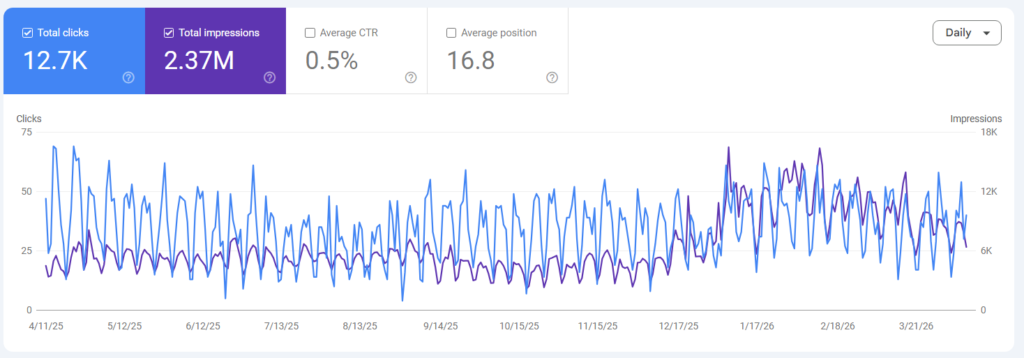
Over the last 12 months, the Google Search Console performance data clearly reflects the impact of consistent technical SEO and content optimization efforts at scale. With 2.37 million impressions and 12.7K clicks, the dataset demonstrates strong visibility growth, especially for an enterprise-level website targeting broad and competitive keyword segments. However, what stands out most is not just the volume—but the trend evolution over time.
In the earlier months, impressions and clicks appear relatively stable with moderate fluctuations, indicating baseline visibility and consistent indexing. This phase typically reflects foundational SEO work—proper site architecture, crawlability, and initial keyword positioning. As the timeline progresses, especially moving into late Q4 and early Q1, there is a noticeable surge in impressions. This suggests improved keyword rankings, expanded content reach, and possibly successful international or multi-page indexing strategies.
Despite the growth in impressions, the average CTR of 0.5% indicates a critical optimization opportunity. This is common in enterprise SEO, where pages rank across a wide range of queries but may not yet be fully optimized for click intent. It signals the need for stronger meta titles, compelling descriptions, structured data enhancements, and better alignment with search intent—especially for high-impression, low-click queries.
The average position of 16.8 provides deeper insight. This means the majority of keywords are ranking on page 2 or the lower half of page 1. From an SEO strategy perspective, this is a high-potential zone. Even slight improvements in ranking—moving from position 16 to top 10—can significantly boost CTR and traffic without requiring entirely new content creation. This is where technical SEO, internal linking, and content refresh strategies become highly impactful.
Another important observation is the consistency in daily click patterns, even with impression growth. This suggests that while visibility is expanding, user engagement hasn’t scaled proportionally. This often happens when content is technically sound but lacks strong SERP appeal or when it targets informational queries without clear conversion intent.
From my experience managing enterprise SEO campaigns, this type of performance graph represents a transition phase—from foundational SEO maturity to growth optimization. The next step is not just increasing impressions, but converting that visibility into meaningful traffic. This involves refining keyword targeting, improving SERP presentation, optimizing Core Web Vitals, and strengthening topical authority.
Overall, this 12-month performance snapshot is a strong indicator of scalable SEO success in progress. With the right optimization focus, this data has the potential to translate into exponential traffic growth in the coming months.
2. Designing Scalable Site Architecture for Enterprise Platforms
A well-planned site architecture is essential for both users and search engines. For global enterprises, this means creating a structure that is scalable, intuitive, and easy to navigate across different regions and languages.
At the core of effective site architecture is hierarchy. Your website should follow a logical structure where categories, subcategories, and pages are clearly organized. This not only improves user experience but also helps search engines understand the relationship between different pages.
For global websites, choosing the right URL structure is crucial. Options include country-code top-level domains (ccTLDs), subdomains, or subdirectories. Each has its advantages, but consistency is key. In most enterprise scenarios, subdirectories are preferred due to easier management and consolidated authority.
Internal linking also plays a vital role. A strong internal linking strategy ensures that link equity flows efficiently across your site, boosting the visibility of important pages. It also helps search engines discover new content faster.
In large-scale projects I’ve handled, implementing a modular architecture—where new regions or categories can be added without restructuring the entire site—has proven invaluable for long-term scalability.
3. Optimizing Crawl Budget for Large Websites
Crawl budget optimization is one of the most overlooked aspects of technical SEO, especially for enterprise websites. Search engines allocate a limited number of resources to crawl each site, so it’s essential to ensure that these resources are used efficiently.
One of the first steps is eliminating low-value pages. Duplicate content, thin pages, and outdated URLs can consume valuable crawl budget without contributing to rankings. Using tools like robots.txt and noindex tags can help control what gets crawled and indexed.
Another important factor is URL parameter management. E-commerce and dynamic websites often generate multiple URLs for the same content, leading to crawl inefficiencies. Proper canonicalization ensures that search engines focus on the most relevant version of each page.
Server performance also impacts crawl rate. Slow servers can limit how frequently search engines crawl your site, reducing the speed at which new content gets indexed.
In enterprise environments, I always recommend regular log file analysis. This provides insights into how search engine bots interact with your site, helping identify bottlenecks and opportunities for optimization.
4. Implementing International SEO Signals Correctly
International SEO goes beyond translating content—it involves providing clear signals to search engines about the intended audience for each page. One of the most important elements here is the implementation of hreflang tags.
Hreflang tags help search engines understand language and regional targeting. When implemented correctly, they ensure that users see the most relevant version of your content based on their location and language preferences.
Another critical aspect is choosing the right domain strategy. Whether you use ccTLDs, subdomains, or subdirectories, consistency and proper configuration are essential. Each approach has implications for SEO, branding, and technical management.
Localization also plays a role in technical SEO. This includes adapting currency, units, and cultural nuances to match local expectations. Search engines increasingly prioritize user experience, making localization a key ranking factor.
In my experience, even minor errors in international SEO setup can lead to significant traffic loss. Regular audits and validation tools are essential to ensure that all signals are correctly implemented and maintained.
5. Enhancing Website Speed Across Global Regions
Website speed is a critical ranking factor and a key component of user experience. For global websites, ensuring fast load times across different regions can be challenging due to varying network conditions and server locations.
Content Delivery Networks (CDNs) play a vital role in improving global performance. By distributing content across multiple servers worldwide, CDNs reduce latency and ensure faster load times for users in different locations.
Image optimization is another crucial factor. Large, uncompressed images can significantly slow down page speed. Using modern formats like WebP and implementing lazy loading can greatly enhance performance.
Minifying CSS, JavaScript, and HTML files also helps reduce load times. Removing unnecessary code and optimizing scripts ensures that pages load quickly and efficiently.
In enterprise projects, I’ve found that even small improvements in page speed can lead to significant increases in conversion rates. Speed is not just a technical metric—it directly impacts user satisfaction and business outcomes.
6. Core Web Vitals and Their Impact on Rankings
Core Web Vitals have become a key component of Google’s ranking algorithm. These metrics focus on user experience, measuring aspects such as loading performance, interactivity, and visual stability.
The three main metrics are Largest Contentful Paint (LCP), First Input Delay (FID), and Cumulative Layout Shift (CLS). Each of these plays a role in determining how users perceive your website’s performance.
Improving these metrics requires a combination of technical optimizations. This includes optimizing server response times, reducing render-blocking resources, and ensuring stable layouts during page load.
For enterprise platforms, monitoring Core Web Vitals at scale can be challenging. However, tools like Google Search Console and real user monitoring (RUM) solutions provide valuable insights into performance issues.
From my experience, prioritizing Core Web Vitals not only improves rankings but also enhances overall user engagement, making it a win-win strategy for global businesses.
7. Mobile-First Optimization for Global Audiences
With the majority of global traffic coming from mobile devices, mobile-first optimization is no longer optional—it’s essential. Search engines now primarily use the mobile version of a website for indexing and ranking.
Responsive design is the foundation of mobile optimization. Websites must adapt seamlessly to different screen sizes and devices, providing a consistent user experience.
Page speed is even more critical on mobile. Users expect fast-loading pages, and delays can lead to high bounce rates. Optimizing images, reducing scripts, and leveraging browser caching are key strategies.
Touch-friendly navigation and readable content also play a role in mobile usability. Buttons should be easily clickable, and text should be legible without zooming.
In global markets, mobile usage patterns can vary significantly. Understanding these differences and tailoring your mobile experience accordingly can provide a competitive advantage.
8. Structured Data and Schema for Enterprise SEO
Structured data helps search engines understand the content of your website more effectively. By using schema markup, you can enhance your search listings with rich results, improving visibility and click-through rates.
For enterprise websites, implementing structured data at scale requires careful planning. This includes defining templates and ensuring consistency across different pages and regions.
Common types of schema include product, organization, breadcrumb, and FAQ markup. Each serves a specific purpose and can significantly enhance how your content appears in search results.
Automation is key in large-scale implementations. Using CMS integrations or custom scripts can help apply structured data consistently across thousands of pages.
In my projects, leveraging structured data has often resulted in noticeable improvements in organic performance, especially in competitive markets.
9. Managing Technical SEO with Automation and Tools
Managing technical SEO for enterprise platforms requires the right tools and automation strategies. Manual processes are not scalable when dealing with large websites.
SEO tools can help monitor site health, identify issues, and track performance metrics. Automation can be used to generate sitemaps, monitor broken links, and implement redirects.
Continuous integration and deployment (CI/CD) pipelines can also play a role in technical SEO. By integrating SEO checks into development workflows, issues can be identified and resolved before they impact performance.
Collaboration between SEO teams, developers, and content creators is essential. Technical SEO is not a standalone function—it requires cross-functional alignment.
From my experience, organizations that invest in automation and collaboration are better equipped to handle the complexities of global SEO.
10. Continuous Monitoring and Technical SEO Audits
Technical SEO is not a one-time effort—it requires continuous monitoring and регуляр audits. As websites evolve, new issues can arise that impact performance and rankings.
Regular audits help identify problems such as broken links, duplicate content, and crawl errors. These issues can negatively affect both user experience and search visibility.
Monitoring tools provide real-time insights into website performance, allowing teams to respond quickly to changes. This includes tracking page speed, indexing status, and Core Web Vitals.
In enterprise environments, setting up dashboards and alerts can streamline monitoring प्रक्रियाओं. This ensures that issues are addressed promptly, minimizing their impact.
In my journey working with global clients, I’ve seen that consistent monitoring and proactive optimization are the keys to long-term SEO success.
Conclusion
Technical SEO is the engine that powers global digital success. From designing scalable site architecture to optimizing speed and performance, every aspect plays a crucial role in ensuring visibility across international markets. In my experience, businesses that prioritize technical excellence are better positioned to scale, adapt, and outperform competitors.
As search engines continue to evolve, the importance of technical SEO will only grow. By investing in robust infrastructure, continuous optimization, and cross-functional collaboration, enterprises can create a strong foundation for sustainable growth in the global digital landscape.
About Author:

BacklinkGen.com Editorial Team
The BacklinkGen.com Editorial Team is led by Amit Tyagi, Gaurav Saxena and Rachit Srivastava—professionals with expertise spanning enterprise technology, artificial intelligence, digital marketing, SEO, AI Search Optimization (AIO/GEO), content strategy, and business growth. Together, they bring decades of combined industry experience across global technology initiatives, performance marketing, and digital transformation.
Every article published on BacklinkGen.com is guided by practical experience, in-depth research, and a commitment to editorial accuracy. The team focuses on delivering trustworthy, actionable, and up-to-date insights that help businesses, marketers, and professionals stay ahead in the rapidly evolving world of search, AI, and digital marketing.