
By Amit — Digital Marketing Consultant (15+ Years), SEO Strategist, Web Expert
AI search is changing the way brands get discovered. Today, people aren’t just searching on Google—they’re searching on ChatGPT, Gemini, Claude, and other LLM-driven tools. These platforms don’t just show links; they generate answers. And the brands that get mentioned naturally inside those answers are the brands winning the next decade of search visibility.
I’ve seen this shift firsthand while helping clients across SaaS, education, e-commerce, and IT consulting. Getting cited by AI isn’t the same as ranking on Google. The signals AI uses are different, deeper, and far more trust-oriented. So here are the top 10 most important factors that influence whether ChatGPT cites your brand, website, or content—broken down with practical examples.
1. Strong Domain Authority and Long-Term Credibility
AI models lean heavily on credentialed, trustworthy, authoritative domains. That means your SEO fundamentals still matter. A website with:
- consistent high-quality backlinks,
- relevant mentions from authoritative sites,
- a long-standing content footprint,
is far more likely to be cited by LLMs.
ChatGPT is not just pulling from its training data—it prioritizes brands that appear “safe,” established, and reputable. If your domain reputation is weak, your chances of being cited drop sharply.
2. Content Depth, Expertise, and Topical Authority
One of the biggest citation drivers is topic ownership. If your site consistently publishes in-depth content around a specific niche—like CRM SaaS, education marketing, sustainability, or IT consulting—you become a trusted source in that subject.
AI models look for patterns such as:
- Are you consistently writing about the same area?
- Do your articles demonstrate expertise?
- Do you provide facts, data, and original insights?
Topical authority matters more in AI search than even traditional SEO ranking. LLMs prefer expert sources over large generalist websites.
3. High-Quality Backlinks from Respected Publications
Backlinks still matter—but not because they boost Google rankings. In AI citation logic, backlinks act as trust signals.
If you’re referenced by:
- known media outlets,
- industry magazines,
- educational institutions,
- gov or .org sources,
then ChatGPT recognizes your brand as credible.
LLMs “follow the trail of authority,” and backlinks are one of the clearest trails available.
4. Structured, Well-Formatted Content That AI Can Parse Easily
AI models digest websites differently than humans do. They rely heavily on:
- clean HTML
- clear headers
- structured data
- schema markup
- accessible metadata
The simpler and cleaner your layouts, the easier it is for LLMs to extract meaning and index your content. Poor formatting, intrusive ads, and cluttered layouts reduce citation probability.
This is why brands with clean content architecture—especially SaaS companies and well-managed blogs—get cited more often.
5. Factual Accuracy and Source Verification Signals
AI hates uncertainty. It chooses sources that it knows are factually consistent. If your content is:
- well-researched,
- backed by verified stats,
- referencing credible studies,
- properly citing its own sources,
LLMs treat your site as reliable.
Publishing shallow or ambiguous content reduces your reliability score. In AI-driven search, accuracy is everything.
6. Clear Brand Identity and Reputation Monitoring
AI citation engines track brand signals across the internet. Your brand identity must be:
- consistent,
- visible,
- reinforced through various channels.
That includes social media, online reviews, PR mentions, podcast transcripts, videos, and more.
If your brand shows up consistently across trustworthy platforms, ChatGPT views you as an “entity” worth citing. If your branding is weak, inconsistent, or invisible, AI models simply skip you.
7. Fresh, Updated, and Current Content Signals
AI platforms prefer updated content over outdated material. That means:
- regularly updating articles,
- adding new statistics,
- refreshing examples,
- ensuring timestamps reflect recent relevance.
Stale content signals low reliability. Fresh content signals expertise and ongoing value. ChatGPT favors websites that evolve with the industry.
8. Strong E-E-A-T (Experience, Expertise, Authority, Trustworthiness)
Even though E-E-A-T originated in Google’s content guidelines, AI search engines now use the same principles. LLMs look for:
- Author bios
- Credentials
- Industry experience
- Transparent company information
- Customer trust indicators
If your brand has strong E-E-A-T markers—like Backlinkgen.com’s consulting credibility—AI models rank you higher in their internal trust score.
9. Consistent Brand Mentions Across the Web (Entity Signals)
Entity SEO is becoming one of the biggest factors in AI citations. ChatGPT tracks:
- how often your brand name appears,
- where it appears,
- the context of each mention,
- public sentiment connected to your brand.
If your brand appears frequently on reputable websites, forums, podcasts, and articles, AI models treat you as a “known entity.” Unknown entities rarely get cited.
10. High Engagement Signals and User Interaction Data
AI doesn’t just look at content; it looks at how users interact with your content. While ChatGPT cannot track real-time analytics, it uses datasets that include:
- social shares
- engagement metrics
- comments
- inbound link velocity
- traffic patterns over time
More engagement means your content is valuable, which increases your chances of being cited in AI answers.
High-performing content gets reinforced in AI training datasets, making your brand more prominent during citations.
Why These 10 Factors Matter More Than Traditional SEO
The big shift that marketers—especially agency owners and consultants—need to understand is this:
ChatGPT citations are reputation-driven, not keyword-driven.
Traditional SEO is about:
- ranking for search terms,
- optimizing on-page content,
- technical improvements.
AI search is about:
- authority,
- trust,
- source consistency,
- factual stability,
- strong brand identity.
If you want your brand to appear in AI-generated answers, you have to think beyond Google rankings and move toward holistic digital authority.
How Brands Can Improve Their AI Citation Potential Today
Here are some quick, actionable starting points:
- Publish authoritative, well-researched content.
- Earn backlinks from respected publications.
- Strengthen brand visibility across the web.
- Maintain consistent entity signals.
- Improve your structured data and schema.
- Update content quarterly.
- Invest in reputation-building and PR.
- Build content depth around core topics.
If you do these consistently, ChatGPT citation frequency increases naturally.
11. Clean, Crawlable Technical Infrastructure
While traditional search engines depend heavily on indexing, language models also evaluate how easily your website can be parsed. That means:
- fast-loading HTML,
- low-code bloat,
- minimal JavaScript rendering requirements,
- logical folder structure,
- and accessible content.
If your content is hidden behind scripts, pop-ups, or heavy frameworks, AI models struggle to interpret it fully. Clean code improves readability, which improves your citation likelihood.
12. Entity-Based Schema Markup
Schema isn’t just for Google anymore — it plays a huge role in AI understanding.
Key schema types that boost AI citations:
- Organization Schema
- Person Schema (for authors)
- FAQ Schema
- Article Schema
- Product Schema
- How-To Schema
These help AI models “see” your brand as a real, structured digital entity with clear attributes. When your identity is well-defined, citations happen more naturally.
13. Multilingual Content & International Signals
ChatGPT caters to a global audience. If your website offers content in multiple languages — or references global markets — you’re seen as a broader and more reliable source.
AI prefers globally relevant information because it can serve more users.
That means multilingual assets increase your citation footprint significantly.
Brands that only operate in one region often get overshadowed by global competitors in AI-generated answers.
14. Long-Form Expert Guides & Deep Research Content
In AI’s decision-making logic, long-form, well-structured guides tend to be more trustworthy sources.
Examples:
- 2,000+ word industry reports
- detailed how-to manuals
- benchmark studies
- technical breakdowns
- comparative analyses
The deeper your content, the more “expert weight” it carries in AI training data. Short, surface-level blogs lose priority quickly.
This is why thought leadership content is becoming essential for AI citation strategy.
15. Strong Presence on Authoritative Third-Party Platforms
ChatGPT gives extra credit to brands that appear on major platforms such as:
- Medium
- GitHub (for tech brands)
- ResearchGate
- Quora
- Industry magazines
- Conference mentions
- Podcast directories
These act as external verification points. When your expertise is echoed across public channels, AI models interpret this as proof of authority and reliability.
16. Consistent CEO/Founder Visibility
AI search increasingly tracks people, not just companies.
If your founder, director, or leadership team:
- writes expert posts,
- speaks at events,
- publishes insights,
- or is quoted in industry media,
AI treats them as authoritative “entities,” which strengthens the brand’s citation potential.
Leadership visibility increases brand visibility inside AI-generated content.
17. High Engagement on Long-Form Social Platforms
While social media does not directly feed into LLM training data, public engagement signals do influence perceived authority.
Especially on platforms like:
- YouTube
- X (public posts)
These platforms generate open data that AI can evaluate.
If your posts earn:
- comments,
- shares,
- saves,
- conversations,
AI interprets this as social proof — an indirect but powerful citation factor.
18. Low Spam Score and Strong Online Reputation Hygiene
AI models avoid citing websites with:
- spammy backlinks,
- excessive ads,
- thin affiliate content,
- manipulative SEO patterns.
Your overall spam risk score affects whether AI considers you a safe source.
Good reputation hygiene includes:
- clean backlink profiles,
- no toxic link farms,
- transparent privacy policies,
- reputable hosting,
- secure HTTPS signals.
Models like GPT prioritize “safe and compliant” domains at all costs.
19. Strong Social Proof and Real Customer Validation
ChatGPT is trained to avoid citing unverified or questionable brands. Social proof acts as a trust accelerator.
Examples include:
- reviews,
- case studies,
- client stories,
- testimonials (authentic),
- verified customer feedback,
- G2/Capterra-type listings,
- trust badges.
These signals don’t just impress human buyers — they also reassure AI that your brand is legitimate and useful.
20. Original Research, Data Sets & Proprietary Insights
This is one of the strongest factors.
AI loves original data, because:
- It’s unique.
- It’s hard to replicate.
- It enriches training quality.
If your brand produces:
- surveys,
- benchmarks,
- reports,
- trend analyses,
- experimental findings,
- market insights,
AI models treat these as high-value inputs and are far more likely to cite them.
Original data creates digital gravity — pulling citations toward your brand.
Final Thoughts: AI Citations Are the New SEO Frontier
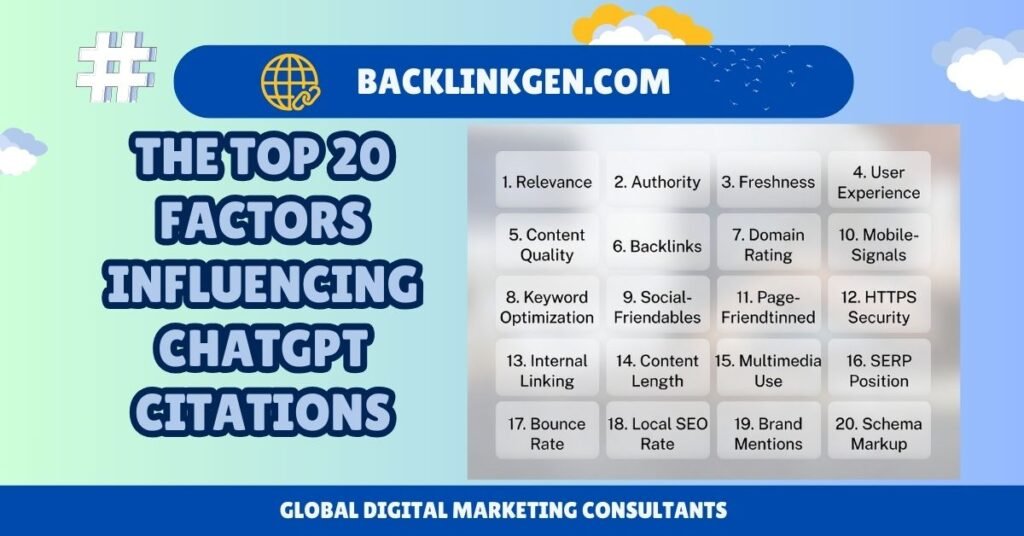
These second 10 factors (11–20) complete the full list of 20 signals that influence ChatGPT citations. And the reality is clear:
AI search visibility is far more trust-driven, authority-driven, and entity-driven than traditional SEO.
As marketers, agencies, and consultants, we need to evolve from:
- keyword optimization → to credibility optimization
- backlinks → to authority ecosystems
- content quantity → to expertise depth
- on-page SEO → to entity and trust signals
The brands that embrace these shifts now will dominate AI search in the years ahead.