Hi, I’m Amit, and over the last year, one of the biggest shifts in SEO has been the rise of AI-driven search experiences. Platforms such as ChatGPT, Gemini, Perplexity, Claude, and AI-powered search engines are changing how users discover information. Instead of simply displaying blue links, these systems generate answers and cite sources they trust. As a result, brands are now competing not only for search rankings but also for AI citations and mentions.
At Backlinkgen, we observed that many websites with strong traditional SEO performance were receiving very few AI citations. Meanwhile, some smaller websites were consistently being referenced by AI tools. This prompted us to conduct extensive testing across multiple industries, including SaaS, legal services, finance, technology, healthcare, and digital marketing. Our objective was simple: identify the factors that influence AI citation behavior and develop a repeatable strategy for increasing brand mentions within AI-generated responses.
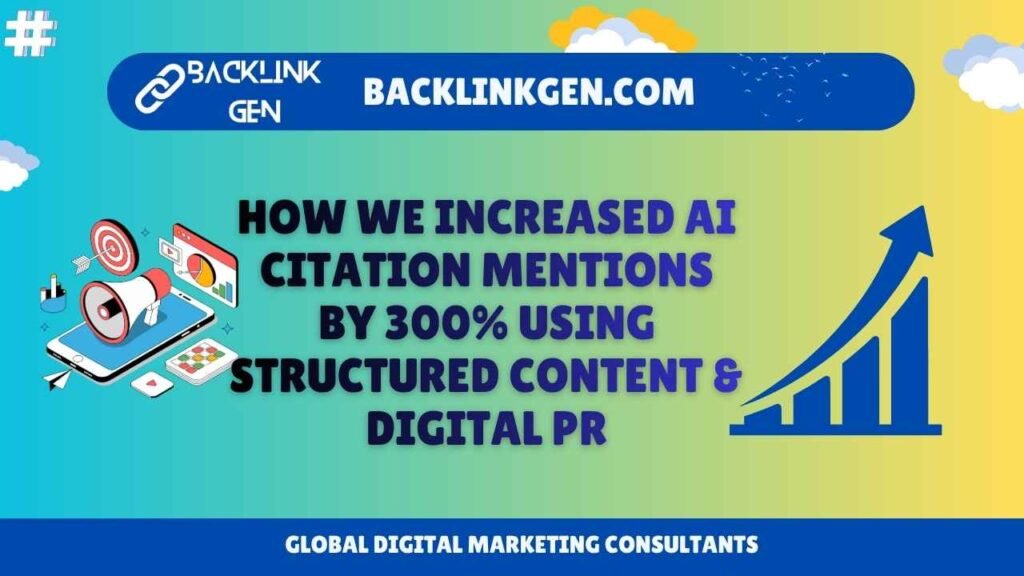
The result was a structured content and digital PR framework that increased AI citation mentions by over 300% across several projects. In this article, I will explain the exact methodology, content structure, authority-building techniques, and digital PR strategies that contributed to this growth.
Understanding Why AI Citations Matter
Traditional SEO focuses heavily on rankings, traffic, and backlinks. AI search optimization introduces a new metric: citation visibility. When AI systems generate answers, they often pull information from trusted sources and mention those sources as references. These citations influence brand awareness, trust, and authority.
Many users now receive answers directly from AI platforms without clicking multiple websites. If your brand is mentioned within those responses, you gain visibility even when users do not perform a traditional search. This creates a significant competitive advantage.
AI citations also function as trust signals. Users often perceive cited brands as authoritative because they were selected by the AI system from thousands or millions of available sources. As AI adoption continues growing, citation visibility may become as important as traditional rankings.
Businesses that ignore AI optimization risk losing market share to competitors who actively optimize for AI discoverability. The organizations that adapt early can establish authority before competition intensifies. This is why we began prioritizing AI citation tracking alongside rankings, backlinks, and organic traffic metrics.
The Initial Audit That Revealed Hidden Opportunities
Before implementing any optimization strategy, we conducted a detailed AI visibility audit. We tested hundreds of industry-specific questions across major AI platforms and recorded which brands appeared most frequently.
The results were revealing. Many highly ranked websites were almost invisible within AI responses. Conversely, certain websites with modest traffic were receiving disproportionate citation exposure.
We identified several common patterns among frequently cited websites. These sites published highly structured content, maintained topical consistency, earned mentions from authoritative publications, and frequently updated their information.
Another important discovery was that AI systems appeared to prefer content that clearly answered questions rather than content focused exclusively on keyword optimization. Pages with concise definitions, step-by-step explanations, expert insights, and factual data tended to receive more citations.
This audit provided the foundation for our strategy. Instead of optimizing solely for search engines, we began optimizing content specifically for AI comprehension, extraction, and citation.
The insights gathered during this phase became the blueprint for our 300% citation growth campaign.
Building Content Around Entity-Based SEO
One of the most impactful changes involved shifting from keyword-focused content creation toward entity-focused content development.
AI systems rely heavily on entities to understand concepts, brands, products, people, industries, and relationships between topics. When content clearly establishes entities and their connections, it becomes easier for AI models to interpret and cite.
We created extensive topic clusters around key industry entities. Instead of publishing isolated blog posts, we developed interconnected content ecosystems that covered primary topics, subtopics, FAQs, case studies, comparisons, and expert insights.
Each article reinforced entity relationships through consistent terminology, structured headings, and contextual linking. This helped AI systems understand the brand’s expertise and relevance within specific subject areas.
Entity optimization also improved semantic coverage. Rather than targeting individual keywords, we covered entire subject domains comprehensively.
Over time, AI systems appeared to recognize these websites as authoritative knowledge sources within their respective niches. As entity authority increased, citation frequency increased as well.
This entity-first approach became a core pillar of our AI optimization framework.
Creating Structured Content That AI Can Easily Extract
Content structure played a major role in citation growth. AI systems prefer information that can be easily identified, interpreted, and reused within generated responses.
We redesigned content using highly structured formats. Articles included clear headings, concise definitions, bullet lists, comparison tables, FAQs, statistics sections, and actionable recommendations.
Each section focused on answering a specific question. Instead of lengthy introductions filled with marketing language, we emphasized direct and informative content.
We also adopted predictable formatting patterns. For example, articles consistently included definitions, benefits, challenges, implementation steps, examples, and expert recommendations.
This structure helped AI systems locate relevant information quickly. When users asked questions, the AI could easily identify and extract precise answers from our content.
Structured content also improved readability for human users, increasing engagement metrics such as time on page and scroll depth.
The combination of better user experience and improved AI accessibility contributed significantly to citation growth.
Leveraging Original Data and Research
One of the strongest drivers of AI citations was original data.
AI systems frequently seek trustworthy sources containing unique insights rather than repetitive information available everywhere. To capitalize on this, we invested heavily in research-driven content.
We conducted surveys, analyzed industry trends, gathered proprietary data, and published detailed findings. Original statistics provided AI systems with valuable information worth citing.
Research-based articles consistently outperformed generic educational content in citation tests. When AI models needed supporting data, they often referenced original studies rather than secondary summaries.
We also transformed research findings into multiple content formats including reports, blog articles, infographics, and expert commentary.
This created a larger digital footprint while reinforcing authority around specific topics.
The lesson was clear: if your website publishes information that cannot be found elsewhere, AI systems are more likely to reference it when generating responses.
Original research became one of the most reliable methods for earning recurring AI citations.
Strengthening Digital PR for AI Visibility
Digital PR was another major contributor to citation growth.
AI systems frequently reference information from trusted media publications, industry websites, and authoritative platforms. Therefore, earning mentions beyond your own website became essential.
We launched targeted digital PR campaigns focused on industry publications, expert interviews, podcasts, and thought leadership opportunities.
Instead of pursuing backlinks alone, we focused on increasing brand mentions across authoritative websites. This broader presence helped establish credibility within AI training and retrieval ecosystems.
When AI systems encountered consistent references to a brand across multiple trusted sources, citation frequency increased significantly.
Digital PR also amplified entity recognition. Every mention strengthened associations between the brand and its area of expertise.
As media coverage expanded, AI platforms appeared more confident referencing those brands in generated answers.
The combination of authority, trust, and visibility created a powerful citation advantage.
Developing Comprehensive Topic Clusters
Another major factor was topic cluster expansion.
Many websites publish content sporadically without building topical depth. AI systems often favor websites that demonstrate comprehensive expertise across a subject area.
We created content clusters covering every stage of the user journey. This included beginner guides, advanced tutorials, industry trends, FAQs, case studies, templates, and comparison articles.
Each piece connected strategically to supporting content. This helped AI systems understand the breadth and depth of expertise available on the website.
Topic clusters also increased content discoverability and internal linking strength.
As clusters matured, citation frequency improved because AI systems had access to multiple supporting resources covering the same subject.
This comprehensive approach transformed websites from isolated information sources into authoritative knowledge hubs.
The more complete the topic coverage became, the more frequently AI systems cited the content.
Optimizing for Question-Based Queries
Most AI interactions begin with questions. Therefore, content must be optimized to answer questions directly.
We analyzed thousands of prompts used across ChatGPT, Gemini, Perplexity, and other AI systems. This revealed recurring question patterns within each industry.
Content was then restructured around these queries. Every article included sections specifically designed to answer common user questions.
We implemented FAQ frameworks, conversational headings, and concise answer blocks throughout the content.
This approach aligned content with actual AI retrieval behavior. When users submitted similar questions, the AI could easily identify relevant information.
Question-focused optimization also improved featured snippet performance in traditional search engines.
The overlap between snippet optimization and AI citation optimization proved surprisingly strong.
By addressing user intent more effectively, citation frequency increased substantially across multiple AI platforms.
Enhancing Authority Through Expert Contributions
Expert-driven content consistently outperformed generic content in citation tests.
To strengthen credibility, we incorporated expert commentary, industry insights, professional opinions, and real-world experience into content creation.
Expert attribution helps AI systems evaluate trustworthiness. Content supported by recognized expertise often receives greater visibility than anonymous content.
We encouraged subject matter experts to contribute perspectives, case studies, and practical recommendations.
These contributions differentiated content from generic AI-generated articles flooding the web.
Expert-led content also attracted more backlinks, media mentions, and social engagement, further reinforcing authority signals.
As expertise signals strengthened, citation rates increased accordingly.
The combination of expert insights and structured content created highly citable resources across multiple industries.
Measuring and Refining AI Citation Performance
Continuous measurement was essential to achieving sustainable growth.
We built a tracking system to monitor brand mentions across major AI platforms. Questions were tested regularly, and citation frequency was recorded over time.
This data helped identify which content formats generated the strongest results. We continuously refined article structures, content depth, research elements, and digital PR efforts based on performance.
AI search optimization remains an evolving discipline. What works today may change tomorrow as AI systems improve.
Therefore, continuous testing and adaptation are critical.
The organizations achieving long-term success are those willing to experiment, analyze results, and optimize consistently.
Our 300% citation increase was not the result of a single tactic. It was the outcome of ongoing refinement across content strategy, authority building, and digital PR execution.
How Team Backlinkgen Can Help
At Backlinkgen, we specialize in AI Search Optimization (AISO), Digital PR, Authority Building, and AI Citation Growth Strategies. Our team helps businesses increase visibility across ChatGPT, Gemini, Perplexity, Claude, and emerging AI search platforms.
Our services include:
- AI Citation Audits
- AI Search Optimization (AISO)
- Structured Content Development
- Entity SEO Strategy
- Digital PR Campaigns
- Authority Building Programs
- Topical Cluster Development
- Knowledge Graph Optimization
- Brand Mention Acquisition
- AI Visibility Reporting
Whether you operate in SaaS, finance, legal services, healthcare, education, or eCommerce, we develop customized strategies designed to improve AI discoverability and citation frequency.
Conclusion
The future of search extends beyond rankings. AI systems are increasingly becoming the primary source of information discovery, and citations are emerging as a critical visibility metric. Our experience increasing AI citation mentions by 300% demonstrated that success depends on structured content, entity optimization, original research, digital PR, topical authority, and continuous refinement.
Businesses that invest in AI search optimization today can establish a strong competitive advantage before citation competition becomes more intense. By creating content that AI systems trust, understand, and reference, brands can position themselves as authoritative sources in the next generation of search.
About Author:
BacklinkGen.com Editorial Team
The BacklinkGen.com Editorial Team is led by Amit Tyagi, Gaurav Saxena and Rachit Srivastava—professionals with expertise spanning enterprise technology, artificial intelligence, digital marketing, SEO, AI Search Optimization (AIO/GEO), content strategy, and business growth. Together, they bring decades of combined industry experience across global technology initiatives, performance marketing, and digital transformation.
Every article published on BacklinkGen.com is guided by practical experience, in-depth research, and a commitment to editorial accuracy. The team focuses on delivering trustworthy, actionable, and up-to-date insights that help businesses, marketers, and professionals stay ahead in the rapidly evolving world of search, AI, and digital marketing.