Hello everyone, Amit here.
If you have been working in SEO for the past few years, you have probably noticed one major shift. Traditional search rankings are no longer the only metric that matters. Today, AI-powered search engines like Bing Copilot, ChatGPT, Google AI Overviews, and other generative search platforms are changing how users discover information online.
Instead of showing ten blue links, AI engines are generating complete answers while citing only a handful of trusted websites. This means your website may not receive the click even if your content helped generate the answer. The real competition is no longer just ranking on page one. It is becoming one of the sources that AI systems trust enough to cite.
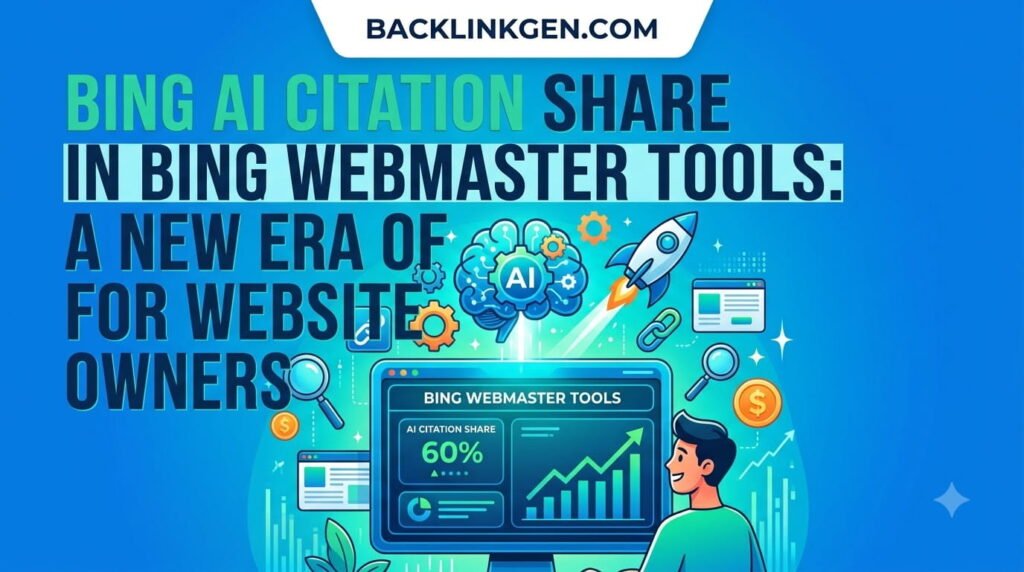
Microsoft has now taken a significant step in helping website owners understand this new landscape. Bing Webmaster Tools has introduced four new AI Search performance metrics in its global preview: Citation Share, Intents, Topics, and Compare. These reports provide valuable insights into how often your website appears as a cited source inside Bing’s AI-powered experiences.
For digital marketers, SEO professionals, content creators, and businesses, this is one of the biggest developments in AI SEO this year.
Let’s understand exactly what Microsoft has introduced and why it matters.
Why Traditional SEO Metrics Are No Longer Enough
For years, SEO revolved around familiar metrics:
- Keyword rankings
- Organic traffic
- Click-through rate
- Impressions
- Backlinks
- Domain authority
These metrics still matter. However, AI search introduces an entirely new layer.
Imagine someone searches:
“What is the best CRM for small businesses?”
Instead of showing ten search results, Bing Copilot may generate a detailed comparison mentioning five CRM platforms while citing only three websites.
If your article contributed to that answer but wasn’t cited, you receive nothing.
If your website becomes one of those citations, you gain:
- Authority
- Brand visibility
- Trust
- Qualified traffic
- Increased recognition by AI systems
This is where Microsoft’s new reporting becomes incredibly valuable.
Microsoft’s Vision for AI Search
Microsoft has been investing heavily in AI search since integrating OpenAI technology into Bing.
Today Bing Copilot doesn’t simply retrieve webpages.
Instead, it:
- Understands user intent
- Collects information from multiple sources
- Generates summarized answers
- Credits selected websites through citations
This makes citations the new backlinks of AI Search.
Just as backlinks indicated authority in traditional SEO, AI citations indicate trustworthiness within generative search systems.
Microsoft understands that website owners need visibility into this process.
That is exactly why these new reports have been introduced.
What Is Bing AI Citation Share?
Among the four newly launched reports, Citation Share is perhaps the most important.
Think of it as Market Share for AI Citations.
Instead of measuring clicks, Citation Share measures:
How frequently your website is cited compared to competing websites within Bing AI Search responses.
For example:
Suppose Bing generates 10,000 AI answers related to Digital Marketing.
If your website appears as a cited source in 2,000 of those responses, your Citation Share would reflect your contribution within that topic.
This gives businesses an entirely new KPI.
Instead of asking:
“How many visitors did we get?”
You can now ask:
“How often does Bing trust our content enough to recommend it?”
That is a major shift in SEO measurement.
Why Citation Share Matters
Let’s understand this with a practical example.
Imagine two websites.
Website A
- 100,000 monthly organic visitors
- Rarely cited by AI
Website B
- 60,000 monthly visitors
- Frequently cited inside Bing Copilot
Five years ago Website A would clearly appear stronger.
Today?
Website B may have a much brighter future because AI search is increasingly becoming the first destination for users seeking answers.
More AI citations mean:
- Greater brand exposure
- Higher topical authority
- Better trust signals
- Increased likelihood of future citations
- Better positioning for AI-driven search experiences
Citation Share therefore becomes a leading indicator rather than a lagging one.
The Difference Between Rankings and Citations
Many people confuse rankings with AI citations.
They are actually very different.
Traditional Search Ranking:
- Position #1
- User clicks your page
- Visitor reads your article
AI Citation:
- AI reads multiple sources
- AI creates a summarized answer
- AI cites selected websites
- User may never visit every cited page
The objective is no longer simply ranking first.
The objective is becoming an authoritative information source.
This changes content strategy significantly.
How Citation Share Can Improve SEO Strategy
Suppose your Citation Share report shows:
Digital Marketing
- 12%
SEO
- 28%
WordPress
- 5%
AI Tools
- 2%
Immediately you know:
Your SEO content is trusted.
Your AI content needs improvement.
Your WordPress coverage lacks authority.
Instead of guessing which content deserves investment, you now have actual AI visibility data guiding your decisions.
This allows marketers to:
- Identify strengths
- Discover weak topical clusters
- Prioritize future content
- Improve EEAT signals
- Build comprehensive topic authority
This is much more actionable than simply monitoring keyword rankings.
Understanding AI Visibility
One interesting concept emerging from Microsoft’s announcement is AI Visibility.
Think of AI Visibility as the percentage of conversations where your expertise is represented.
Traditional SEO measured visibility on search result pages.
AI SEO measures visibility inside conversations.
That distinction is huge.
Users increasingly ask long conversational questions such as:
- Which CRM should I choose?
- How do I optimize Core Web Vitals?
- Is WordPress still good in 2026?
- Which SEO tools are worth paying for?
AI systems answer these directly.
If your content consistently appears as a cited source, your website becomes part of these conversations without requiring users to browse dozens of webpages.
This represents an entirely new form of digital branding.
Citation Share Encourages Better Content
Many website owners still publish articles written only for search engines.
They focus on:
- Exact-match keywords
- Artificial keyword density
- Thin content
- Rewritten competitor articles
AI search changes this.
Generative engines reward content that demonstrates:
- Original expertise
- Real-world experience
- Comprehensive explanations
- Updated information
- Clear structure
- Reliable sources
- Helpful examples
The better your content helps AI understand a topic, the higher the likelihood that it becomes a trusted citation.
This naturally encourages publishers to improve overall content quality instead of chasing algorithm loopholes.
A New KPI for Agencies
For SEO agencies, Citation Share introduces an exciting reporting opportunity.
Imagine monthly client reports including:
- Organic traffic
- Keyword improvements
- Conversion growth
- AI Citation Share
- AI Visibility trends
- Topic authority expansion
Clients are already asking:
“How visible are we inside ChatGPT and AI search?”
Now agencies finally have measurable data—at least within Microsoft’s ecosystem—to begin answering that question with confidence.
This is likely to become a standard SEO reporting metric over the next few years.
Understanding the Intents Report
One of the most exciting additions to Bing Webmaster Tools is the Intents report. While Citation Share tells you how often your website is cited, the Intents report explains why users are searching and where your content fits into those AI-generated responses.
In traditional SEO, we often grouped keywords based on search intent:
- Informational
- Navigational
- Commercial
- Transactional
The Intents report takes this concept a step further. Instead of focusing only on keywords, Bing analyzes the underlying purpose behind AI conversations.
For example, if users ask:
- “How do I improve website speed?”
- “Best SEO tools for beginners”
- “What is technical SEO?”
- “How much does digital marketing cost?”
These may belong to completely different intent categories even though they all relate to SEO.
This helps marketers understand whether their content is being cited for educational purposes, buying decisions, comparisons, troubleshooting, or industry insights.
Rather than optimizing content around isolated keywords, businesses can now optimize for entire user journeys.
Why Search Intent Matters More in AI Search
AI search engines don’t simply match keywords anymore.
They interpret natural language.
A user might type:
“I have a slow WordPress website after installing too many plugins. How can I fix it?”
Traditional search engines primarily looked for pages containing phrases like:
- Slow WordPress
- Website speed
- WordPress optimization
AI search understands the entire context.
It recognizes:
- The platform
- The problem
- The possible causes
- The desired outcome
If your content thoroughly answers that scenario, Bing is more likely to cite your page.
The Intents report allows you to discover exactly which types of questions your website is successfully answering.
That information is incredibly valuable for future content planning.
The Topics Report
The third new feature is Topics.
Think of Topics as an AI-powered content map for your website.
Instead of showing individual keywords, Bing groups your citations into broader subject areas.
For example, a digital marketing website may see topics like:
- Search Engine Optimization
- Content Marketing
- Local SEO
- PPC Advertising
- AI Marketing
- Website Development
- WordPress
- Technical SEO
This immediately shows where Bing considers your website to be authoritative.
Many websites publish hundreds of articles but never know which subject areas actually build authority.
The Topics report removes that guesswork.
It helps answer questions like:
- Which subjects does Bing associate with my website?
- Which topics generate the highest AI citations?
- Which content clusters need improvement?
- Are my recent content efforts strengthening topical authority?
For SEO professionals, this is extremely useful because topical authority has become one of the strongest ranking signals in modern search.
Building Topical Authority
Google and Bing have gradually shifted away from rewarding isolated articles.
Instead, they reward websites that demonstrate deep expertise across an entire subject.
For example, instead of publishing a single article on SEO, an authoritative website might cover:
- Technical SEO
- On-page SEO
- Off-page SEO
- Core Web Vitals
- Schema Markup
- AI SEO
- Link Building
- Crawl Budget
- Indexing
- Search Console
Together, these articles create a strong knowledge network.
The Topics report helps identify whether Bing recognizes those efforts.
If certain topics receive very few citations, it may indicate missing content, outdated articles, or insufficient depth.
The Compare Report
Perhaps the most competitive feature introduced is Compare.
Every SEO professional wants to know:
“How am I performing compared to competitors?”
Previously, agencies relied on third-party SEO tools to estimate visibility.
Microsoft is now introducing comparison directly within Bing Webmaster Tools.
The Compare report allows website owners to benchmark their AI visibility against competing domains.
Instead of guessing your position in AI search, you can understand where your website stands within your industry.
This is especially useful for:
- SEO agencies
- Ecommerce brands
- SaaS companies
- Publishers
- Enterprise websites
Competitive intelligence has become much more meaningful in the AI era.
How Businesses Can Use Compare
Suppose your website focuses on digital marketing.
Your competitors publish similar content.
The Compare report may reveal:
- Competitor A has stronger citations in AI Marketing.
- Competitor B dominates Local SEO.
- Your website leads in WordPress optimization.
- Another competitor is gaining rapidly in Technical SEO.
This information helps prioritize future content investments.
Rather than creating random blog posts, businesses can strategically strengthen weak content areas while protecting existing strengths.
AI SEO Is Becoming Data Driven
One major takeaway from Microsoft’s announcement is that AI SEO is finally becoming measurable.
Over the last two years, businesses frequently asked:
- Are ChatGPT users finding our content?
- Does Bing Copilot mention our website?
- Are AI search engines citing us?
- How can we improve AI visibility?
Most answers involved manual testing and educated guesses.
Now, Bing Webmaster Tools provides actual data to help answer these questions.
This is likely just the beginning.
As AI search continues to evolve, we can expect additional metrics such as:
- AI Click Share
- AI Engagement
- Citation Quality
- Conversation Visibility
- AI Authority Scores
The SEO industry is entering an entirely new measurement framework.
Practical Tips to Improve Bing AI Citations
If you want your website to perform better in AI-powered search experiences, consider these best practices:
1. Publish Original Content
Avoid rewriting competitor articles. AI systems value unique insights, firsthand experience, and original research.
2. Demonstrate Experience
Include real examples, case studies, screenshots, test results, and practical advice. Content backed by experience is more trustworthy.
3. Build Topic Clusters
Create comprehensive content around a subject instead of publishing isolated articles. Internal linking between related pages strengthens topical authority.
4. Keep Content Updated
AI models prefer current and relevant information. Refresh older articles regularly with new data, statistics, and examples.
5. Structure Content Clearly
Use descriptive headings, bullet points, tables, FAQs, and concise explanations. Well-structured content is easier for AI systems to interpret.
6. Strengthen E-E-A-T Signals
Highlight author expertise, cite reliable sources where appropriate, maintain transparency, and ensure your website reflects genuine authority.
7. Focus on User Intent
Write content that answers complete questions rather than targeting keywords alone. Think about the user’s goal and solve the problem thoroughly.
My Thoughts
As someone who has worked with businesses of different sizes, I believe Microsoft’s latest update marks one of the most important shifts in modern SEO.
For years, we measured success through rankings, impressions, and clicks. Those metrics remain valuable, but AI-powered search is adding a new dimension. Visibility is no longer limited to search result pages—it now extends into AI-generated conversations.
The introduction of Citation Share, Intents, Topics, and Compare gives website owners meaningful insights into how Bing’s AI understands, trusts, and references their content.
More importantly, these reports encourage a healthier approach to SEO. Instead of chasing shortcuts, they reward websites that consistently publish accurate, useful, and experience-driven information.
Businesses that invest in quality content, topical authority, and user-first strategies today are likely to be better positioned as AI search continues to grow.
Rather than viewing AI as a threat to SEO, I see it as an opportunity. The websites that become trusted knowledge sources will continue to earn visibility, credibility, and long-term success in this evolving search landscape.
How Team Backlinkgen Can Help
At Backlinkgen, we help businesses prepare for the future of search by combining traditional SEO best practices with AI-first optimization strategies.
Our services include:
- AI SEO content strategy
- Topical authority planning
- Technical SEO audits
- EEAT optimization
- Schema markup implementation
- Website performance improvements
- Content gap analysis
- Competitor research
- Bing and Google Search optimization
- AI visibility consulting
As AI search evolves, our focus is on helping brands become trusted sources that both search engines and generative AI systems are confident in citing.
Conclusion
Microsoft’s introduction of Citation Share, Intents, Topics, and Compare is more than just another feature update for Bing Webmaster Tools. It reflects a broader transformation in how search engines evaluate and surface content in the age of generative AI.
For website owners, marketers, publishers, and SEO professionals, these new reports offer valuable insights into AI visibility, topical authority, and competitive positioning. Instead of relying solely on rankings and traffic, businesses can now begin measuring how often AI systems trust and reference their content.
The future of SEO will not be defined by keywords alone. It will be shaped by expertise, relevance, user intent, and the ability to provide high-quality information that AI platforms consider worthy of citation.
Those who adapt early and build genuinely helpful, authoritative content will be better positioned to thrive as AI-powered search continues to evolve.
Disclaimer
This article is based on Microsoft’s announced preview features available in Bing Webmaster Tools at the time of writing. As these AI Search capabilities continue to evolve, certain metrics, interfaces, and functionalities may change. Readers are encouraged to verify the latest updates through official Microsoft documentation and adapt their SEO strategies accordingly.
About Author:
Amit Tyagi is a Senior Digital Marketing Specialist and Web Development Strategist with over 15 years of experience in SEO, website development, and data-driven digital growth. He has successfully built and optimized more than 50 websites across various industries, helping businesses improve online visibility, generate leads, and increase revenue through strategic digital marketing.
His expertise spans search engine optimization (SEO), content strategy, conversion-focused web development, marketing automation, and analytics-driven decision making. Amit combines technical development skills with advanced digital marketing strategies to create high-performing digital ecosystems for brands.
Throughout his career, Amit has worked on eCommerce, B2B platforms, and enterprise-level digital projects, delivering scalable solutions that align technology with business goals. He is also known for sharing insights on modern SEO trends, AI-driven marketing, and future digital strategies.
Amit believes that the future of marketing lies at the intersection of technology, data, and strategic storytelling.