
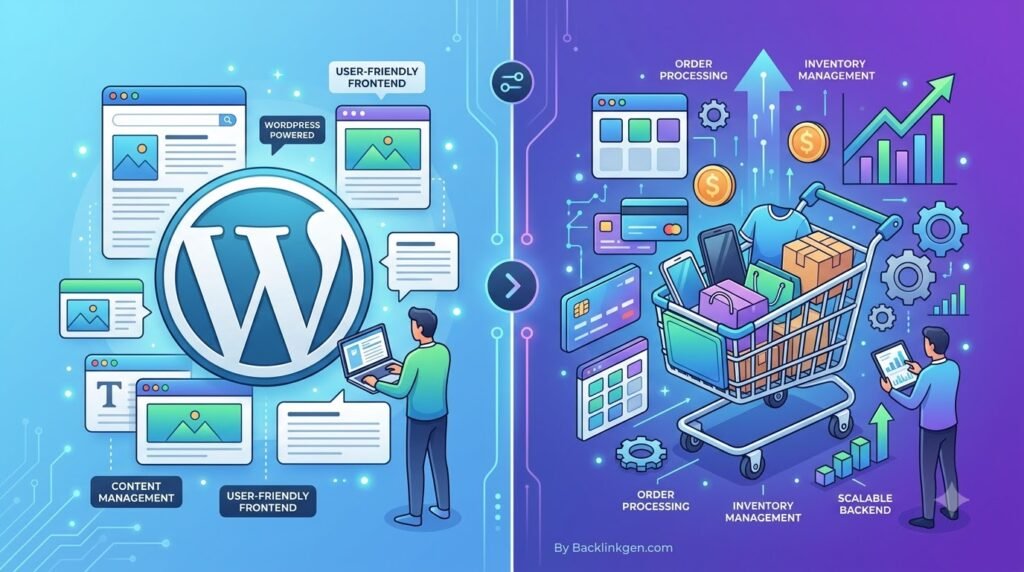
I read a lot of platform announcements in this industry, and most of them don’t warrant a second look. This one did — enough that I spent a good part of my week going through the press materials, the executive statements, and the early trade coverage before writing a word of this post. On July 29, 2026, WP Engine, one of the largest managed WordPress hosting companies in the world, announced a strategic partnership with Commerce — the parent company, trading as CMRC, behind the ecommerce platform BigCommerce. The product coming out of that partnership is called WP Engine Commerce Connect for BigCommerce, and the pitch is refreshingly simple: keep your entire WordPress front end — your content, your SEO equity, your design, your URL structure — and swap out the commerce engine underneath it for BigCommerce’s enterprise-grade infrastructure.
In plain terms: WordPress handles what it’s always been genuinely excellent at — content, SEO, editorial storytelling, page design. BigCommerce takes over what it’s built specifically for — product catalogs, inventory, payments, order management, and checkout. I want to walk through why this partnership exists, who it’s actually built for, and what I’d tell a client evaluating it, because I think the “why now” here matters as much as the “what.”
The Problem This Is Actually Solving
Every announcement like this claims to solve a real pain point, so I want to be specific about what this one is actually responding to, based on what WP Engine’s own product team has said publicly about it. Keith Fafel, WP Engine’s VP of Product, was direct about the motivation in comments to trade press: the company had been watching a consistent pattern play out across its own customer base — successful merchants hitting a genuine ceiling on WooCommerce and leaving WordPress entirely for SaaS commerce platforms once their catalog size, traffic volume, or operational complexity outgrew what a self-hosted, plugin-based commerce stack could reliably support.
That pattern will sound familiar to anyone who’s actually run a growing WooCommerce store, because I’ve lived through versions of it with clients. WooCommerce is a genuinely capable plugin for a huge range of small and mid-sized stores, and I still recommend it regularly. But it’s fundamentally a plugin bolted onto a content management system that wasn’t originally built to be a transactional commerce engine, and at real scale — large catalogs, high concurrent checkout traffic, complex inventory and fulfillment logic — that architecture starts to show its limits. Site performance degrades under load, plugin conflicts multiply as you add the extensions needed to handle payments, tax, shipping, and inventory at scale, and maintenance overhead climbs steadily as a small team tries to keep dozens of interdependent plugins updated and compatible. I’ve sat in enough of those maintenance conversations to know this isn’t a hypothetical problem — it’s the exact reason merchants have historically abandoned WordPress for commerce entirely, taking their content and SEO investment with them out the door.
What’s Actually Being Announced, Precisely
It’s worth being exact here rather than working from the marketing summary alone, because the technical details are where this either holds up or falls apart. According to the official announcement and the follow-up coverage from multiple outlets, WP Engine Commerce Connect for BigCommerce is built to let existing WordPress sites — themes, custom designs, URL structures, and existing SEO configurations — remain fully intact while BigCommerce’s platform takes over the operational commerce layer behind the scenes. WP Engine has specifically emphasized that sites stay fully operational throughout the transition, meaning a merchant isn’t looking at a disruptive rebuild or a period of downtime to make the switch, and that content migration into the new setup doesn’t interrupt existing store operations.
The stated design goals, pulled directly from WP Engine’s own materials, are worth listing precisely because they map so cleanly onto the actual pain points I described above: preserving the brand experience and front-end design investment a business has already made, maintaining always-on commerce availability during the upgrade itself, and protecting existing SEO equity and organic traffic rather than resetting it. That last point deserves particular attention from anyone who’s ever been through a platform migration that quietly tanked months of organic rankings because URLs changed or content got restructured in the move. If WP Engine and BigCommerce have genuinely solved for URL and SEO preservation during a backend swap, that alone removes one of the biggest reasons businesses have historically avoided major platform migrations altogether.
Why WP Engine and BigCommerce, Specifically
There’s a detail in the coverage I found genuinely interesting: both companies are headquartered in Austin, Texas, and according to Fafel, the relationship developed partly out of that geographic proximity — though he was clear that WP Engine evaluated other commerce platforms before settling on BigCommerce specifically. That’s a small detail, but it tells you this wasn’t a rushed, opportunistic press release; it reads like a deliberate technical evaluation that happened to be helped along by two companies being neighbors in the same city.
From the BigCommerce side, Commerce CEO Travis Hess framed the partnership around a broader shift in how brands need to compete — across multiple channels and, notably, across the AI-powered discovery layer that’s increasingly shaping how customers find and evaluate products before they ever reach a storefront. That framing lines up with something I’ve been telling clients for a while now: content and commerce can no longer be treated as separate disciplines run by separate teams. A product page that’s technically transactional but editorially thin doesn’t perform well in an environment where AI search increasingly rewards genuinely deep, well-structured content. Pairing WordPress’s content and SEO strengths with a commerce engine purpose-built for scale is, at minimum, a coherent response to that shift, even if the execution still needs to prove itself in the wild.
Who This Is Actually Built For
I want to be clear about who I think this genuinely serves, because it’s not every WordPress store, and WP Engine hasn’t pretended otherwise. The stated target is high-growth, mid-market brands — businesses that have already outgrown a starter commerce setup, are dealing with larger product catalogs, higher traffic volumes, and more sophisticated operational requirements than a typical small WooCommerce store, but aren’t necessarily ready or willing to abandon the WordPress content investment they’ve spent years building.
That’s a fairly specific and, frankly, underserved segment. A brand-new small business almost certainly doesn’t need this — WooCommerce or a simpler all-in-one platform remains the sensible starting point, and I’d tell any client just getting started to stay there. On the other end, a genuine enterprise retailer with an existing headless commerce architecture and a dedicated engineering team has other, more customized options already available to them. It’s the businesses sitting in between — the ones who’ve built real content authority and organic traffic on WordPress, but are running into WooCommerce’s ceiling as their catalog and order volume scale — where this partnership is aimed squarely, and where I think it has genuine merit.
The Questions I’d Still Want Answered Before Recommending This
I don’t make platform recommendations to clients based on a press release, and I wouldn’t tell you to either. A few things I’d want to see clearly documented before advising a client to commit to this migration: exactly how deep the WordPress-BigCommerce integration goes for things like custom checkout flows, subscription billing, and complex tax and shipping logic that many mid-market merchants already rely on; what the actual cost structure looks like once you’re paying for both WP Engine’s managed hosting and BigCommerce’s platform fees simultaneously, compared to a single consolidated platform; and how mature the plugin or connector ecosystem is at launch versus what gets promised on the roadmap.
I’d also want to see independent case studies from real merchants who’ve gone through the migration, not just the vendor’s own framing, before treating the “no downtime, no SEO disruption” claims as fully proven at scale rather than as a design goal. Ambitious integration promises like this one are common at launch; the ones that hold up under real production traffic and real edge cases are what separate a genuinely useful platform shift from an interesting idea that quietly underdelivers a year later.
My Take, for Now
Here’s where I land after going through this properly rather than reacting to the headline. The underlying problem this partnership targets is real — I’ve watched growing merchants hit WooCommerce’s ceiling firsthand, and the tradeoff they’ve historically faced, rebuild your content and SEO from scratch on a new platform or stay put and accept degrading performance, has never had a genuinely good answer. A partnership that lets a business keep its WordPress content and SEO investment while swapping in a purpose-built commerce engine underneath is solving a legitimate, specific pain point, not manufacturing a problem to sell a solution.
Whether the execution matches the ambition is something I’ll be watching closely over the coming months as real merchants start migrating and the early case studies emerge. For now, if you’re a mid-market brand feeling WooCommerce’s limits and you’ve built real equity in your WordPress content and rankings, this is a partnership worth putting on your radar and evaluating properly — not something to jump into off the strength of a launch announcement alone. I’ll be tracking this one, and I’d recommend you do too.
About Author:
Amit Tyagi is a Senior Digital Marketing Specialist and Web Development Strategist with over 15 years of experience in SEO, website development, and data-driven digital growth. He has successfully built and optimized more than 50 websites across various industries, helping businesses improve online visibility, generate leads, and increase revenue through strategic digital marketing.
His expertise spans search engine optimization (SEO), content strategy, conversion-focused web development, marketing automation, and analytics-driven decision making. Amit combines technical development skills with advanced digital marketing strategies to create high-performing digital ecosystems for brands.
Throughout his career, Amit has worked on eCommerce, B2B platforms, and enterprise-level digital projects, delivering scalable solutions that align technology with business goals. He is also known for sharing insights on modern SEO trends, AI-driven marketing, and future digital strategies.
Amit believes that the future of marketing lies at the intersection of technology, data, and strategic storytelling.