I’ve spent a good part of the last several months doing something most marketers haven’t gotten around to yet: actually reading the primary research on how AI platforms decide which brands to mention. Not the LinkedIn hot-take version of it, the actual studies — the ones with sample sizes, methodologies, and citation-tracking data across ChatGPT, Gemini, Perplexity, Claude, and the rest. And after going through a stack of 2026 reports from firms like Victorious, Ahrefs, SparkToro, BrightEdge, and Digital Authority Partners, one number keeps showing up in different forms, from different research teams, using different methodologies: somewhere in the high 80s to low 90s percent, the majority of brands tested simply don’t show up when someone asks an AI platform a category question. One widely cited Q2 2026 quarterly search study found that while AI platforms could describe the large majority of tested brands accurately when asked directly by name, roughly 89% of those same brands never appeared at all in category-level research answers — the “best X for Y” style questions that actually drive buying decisions.
That gap is the entire opportunity I want to walk you through in this piece. Direct brand recognition and category recommendation are turning out to be two almost entirely separate games, and most businesses are only playing the first one. In this post I want to lay out, with real numbers behind every claim, why this window exists, why it won’t stay open indefinitely, and exactly what I’d tell a client to do about it starting this quarter.
The Data Behind the “89%” Claim — And Why It Keeps Reappearing
I want to be precise here rather than just repeat a headline stat, because the research is more layered than a single number suggests. A separate, independently run study covering 177 brands across eight AI platforms found that only about ten percent of tested brands had any measurable AI mention rate at all in early 2026 — meaning close to ninety percent were essentially absent from AI-generated answers entirely, not occasionally missed, but structurally invisible. Another analysis from SparkToro put a sharper edge on the same finding, estimating less than a one-in-a-hundred chance that a given brand gets recommended consistently across repeated, similarly worded prompts.
What I find most convincing isn’t any single number — it’s that multiple research teams, using different brand samples, different prompt sets, and different platforms, keep landing in the same general territory. When Victorious, SparkToro, and Digital Authority Partners all independently converge on “the overwhelming majority of category conversations have no consistent default brand,” that’s not noise. That’s a real, structural feature of where AI search currently stands, and it directly contradicts a lot of the industry chatter treating AI visibility as a race that’s already been won by early movers.
There’s also useful nuance in why some brands do get consistently mentioned while most don’t. The same research found that certain industries — healthcare, SaaS, and financial services in particular — show meaningfully higher and more consistent citation rates than others. Healthcare brands benefit from clear, structured identifiers: names, locations, specialties, network affiliations. SaaS brands benefit from being actively discussed on third-party platforms like G2, Reddit, and LinkedIn. Financial services brands benefit from strong, ongoing coverage on trusted editorial platforms like Bankrate and NerdWallet. None of these advantages came from clever prompt engineering or technical SEO tricks — they came from a genuine, structured, third-party footprint built up over time. That’s the pattern I want you to notice early, because it’s going to matter for everything I recommend later in this piece.
Why This Window Is Genuinely Temporary, Not Permanent
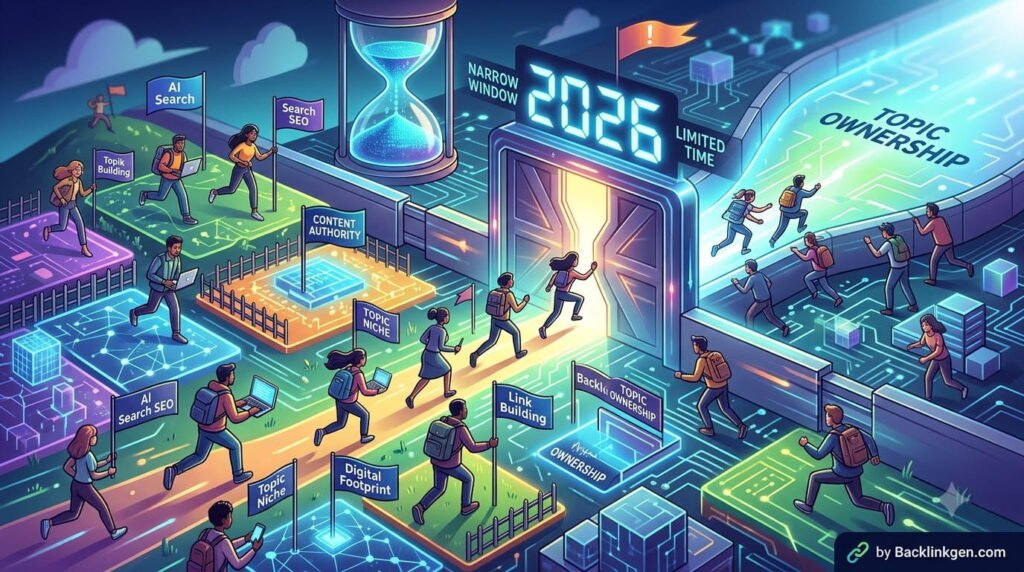
Here’s the part that turns this from an interesting statistic into something worth acting on urgently. AI platforms don’t treat every query the same way once a topic starts to “settle.” As more real-world usage data, more citation patterns, and more reinforcement signals accumulate around a given topic, the platforms increasingly converge on a smaller, more stable set of trusted sources for that topic — the same way a search engine’s top ten results tend to calcify around established players once a query has been live for years. A topic that currently has no consistent go-to brand today is not guaranteed to stay that open in twelve or eighteen months. It’s open right now specifically because these systems, and the citation ecosystems feeding them, are still relatively young and still actively forming their defaults.
I’ve watched this exact pattern play out before, just on a different platform. Early Google search, in its first several years, had comparatively wide-open competitive territory for almost any topic — a well-optimized, well-linked page from a smaller player could genuinely outrank an established brand. That window didn’t stay open. As Google’s algorithms matured and as authority signals compounded for the sites that got there early, the competitive bar for unseating an established page in a mature topic area rose dramatically. What took a modest content and backlink effort in 2008 takes a vastly larger, more sophisticated effort today for the exact same ranking position, precisely because the early movers built up a decade of accumulated trust signals that are now baked into the algorithm’s defaults.
I have no reason to believe AI search will behave differently. If anything, the compounding effect may move faster, because these models are continuously retrained and reinforced on real usage patterns, and citation behavior appears to reward brands that already show up consistently with more consistency over time — a genuine flywheel effect. The research on off-site brand signals backs this up directly: one large-scale analysis across 75,000 brands found that things like consistent video mentions, branded web mentions, and branded search volume correlate far more strongly with AI visibility than traditional backlinks do, and the strongest-performing brands in that dataset had mention volumes many multiples higher than the next tier down — a gap that’s a lot easier to prevent than it is to close after the fact.
What Actually Earns a Citation — And Why It Isn’t What Most Marketing Teams Are Doing
This is the piece I think gets misunderstood most often, and it’s worth being blunt about it: your own website is not where this battle gets won. Across the research I’ve reviewed, the consistent finding is that the overwhelming majority of citations AI platforms use to support a brand recommendation point to third-party sources, not the brand’s own domain — commonly cited figures put brand-owned content at somewhere around five to fifteen percent of the sources feeding these answers, with the rest coming from earned media, review platforms, forums, and independent editorial coverage. Multiple separate analyses, including academic peer-reviewed work presented at a public relations research conference, put earned media’s share of AI citations even higher, frequently in the eighty-plus percent range.
This reframes the whole strategic question. If you’re pouring your entire budget into your own blog and your own landing pages hoping AI platforms will start citing you, the data says you’re optimizing the smaller half of the equation. The larger, more decisive half is what other credible sources are saying about you — genuine product discussions on platforms like Reddit and G2, coverage in trusted trade publications, mentions on YouTube (which shows up as a surprisingly strong predictor of AI Overview visibility), and consistent, accurate representation across the review and comparison sites your buyers already trust. This lines up exactly with what I’ve been telling clients about backlinks and digital PR for the past year: the discipline that used to be called “off-page SEO” hasn’t become less important in the AI era, it’s become the primary lever.
There’s a second layer of nuance worth understanding here too — not all query types are equal. Research breaking down citation rates by query intent found that “best” and recommendation-style queries produce brand mentions the majority of the time, comparison queries produce them less often, natural conversational phrasing produces them even less, and plain definitional queries — the “what is X” format — produce brand mentions only a small fraction of the time. If your content strategy is built primarily around definitional, encyclopedia-style content, this data suggests that investment carries a fairly weak return for actual brand visibility, even though it may still be useful for other reasons. The queries worth building content and authority around are the ones shaped like real buying decisions: “best,” “top,” “vs.,” and the conversational, specific phrasing people genuinely use when they’re comparing real options.
The Practical Roadmap: What I’d Actually Tell You to Do This Quarter
Given everything above, here’s the sequence I’m currently running with clients, and it starts with restraint rather than volume. Pick a small number of topics — I’d say three to five, not thirty — where your business has a genuine, defensible right to be the authority. Trying to spread thin across every topic adjacent to your business dilutes exactly the kind of concentrated signal that seems to drive consistent citation behavior in the research. Depth on a few fronts beats shallow presence everywhere.
For each of those topics, build genuinely deep, original content — the kind that includes real data, named expertise, and specific, well-supported claims rather than generic overviews that already exist in a thousand other places. Then, and this is the step most businesses skip, invest deliberately in earning the third-party mentions that the research shows actually drive citation behavior: pursue coverage on the trade publications your buyers already read, participate genuinely in the review platforms and communities relevant to your category, and don’t ignore video — a consistent presence across product discussions, tutorials, and commentary on platforms like YouTube appears to be one of the stronger, more underused signals available right now.
Finally, measure this properly rather than guessing. Run actual prompts across the major platforms — ChatGPT, Gemini, Perplexity, Claude — for your target topics on a recurring basis, and track whether your presence is climbing relative to your own baseline and relative to your named competitors. This is exactly the kind of AI visibility audit I’ve written about separately, and it’s the only way to know whether the authority-building work is actually compounding the way the research suggests it should.
Conclusion
Here’s my honest, research-backed read on where things stand. The data is remarkably consistent across independent studies: the large majority of topics right now have no locked-in, consistently recommended brand, and that’s a genuinely rare kind of opportunity — a wide-open competitive field in a channel that’s rapidly becoming as important as traditional search ever was. But every pattern I’ve seen, both in this research and in the two decades I’ve spent watching search ecosystems mature, points the same direction: open fields like this compress over time, not the reverse. The brands building genuine topical authority and earning real third-party credibility right now are the ones most likely to become the entrenched default once these systems settle — and the ones sitting this out are going to face a dramatically steeper climb to unseat them a year or two from now. The window is real. It’s also not going to stay this wide for long.
About Author:
Amit Tyagi is a Senior Digital Marketing Specialist and Web Development Strategist with over 15 years of experience in SEO, website development, and data-driven digital growth. He has successfully built and optimized more than 50 websites across various industries, helping businesses improve online visibility, generate leads, and increase revenue through strategic digital marketing.
His expertise spans search engine optimization (SEO), content strategy, conversion-focused web development, marketing automation, and analytics-driven decision making. Amit combines technical development skills with advanced digital marketing strategies to create high-performing digital ecosystems for brands.
Throughout his career, Amit has worked on eCommerce, B2B platforms, and enterprise-level digital projects, delivering scalable solutions that align technology with business goals. He is also known for sharing insights on modern SEO trends, AI-driven marketing, and future digital strategies.
Amit believes that the future of marketing lies at the intersection of technology, data, and strategic storytelling.