Over the last two years, alongside running client marketing programs, I’ve spent a genuinely significant chunk of my time getting hands-on with large language models directly — not just using ChatGPT the way most marketers do, but actually understanding how these systems retrieve, weight, and reproduce information. I built that foundation formally through AI and machine learning coursework at SlideScope Institute and a run of applied courses on Coursera, and then I spent the following two years testing what I’d learned against real client content, real citation data, and real AI search results. That combination — the formal grounding plus the daily grind of watching how models actually behave in production — is exactly why the topic I want to cover today caught my attention the moment I started seeing it discussed seriously in the industry: commodity content scoring.
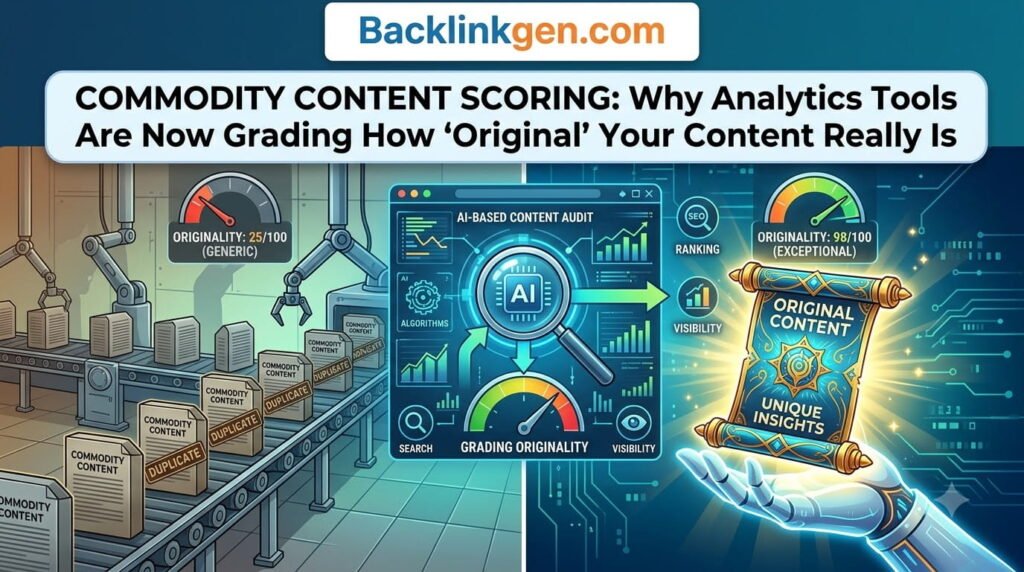
Here’s the short version, and then I’ll unpack it properly. Analytics platforms are now actively measuring how “well-trodden” a given piece of content is — essentially, how much of what you’ve written is information a model like GPT or Gemini already knows cold from its training data, versus how much is genuinely new to it. That distinction is turning into one of the single biggest visibility levers in AI search, and most content teams haven’t caught up to it yet.
What Commodity Content Actually Means
Let’s define this properly, because the term gets used loosely. Commodity content is information that exists, in near-identical form, across dozens or hundreds of other sources — the kind of generic explainer or listicle that reads the same regardless of who published it. Think “What is SEO,” “Top 10 Tips for Email Marketing,” or a generic step-by-step guide to something everyone in your industry has already written a version of. The economic comparison is apt: a commodity, in the traditional sense, is a standardized product where one unit is functionally identical to another no matter who produced it. Applied to content, that means an article a model has effectively already memorized, because it’s seen the same claims, structure, and information repeated across the training data it was built on.
Non-commodity content is the opposite: original data, firsthand experience, a genuinely distinctive point of view, or specific numbers and findings that don’t exist anywhere else on the web. It’s the kind of material a model cannot reconstruct from memory alone — it has to go find your specific page to get that information, because nowhere else contains it.
This distinction became something close to official policy from Google itself. At the first Google Search Central Live event in Toronto in April 2026, Search Liaison Danny Sullivan drew this exact line publicly, framing commodity content as the category losing the most ground as AI search matures. And a separate Google AI optimization guide published in May 2026 made the position explicit: there’s no separate playbook for ranking in AI search versus traditional search — non-commodity content, original perspective and expertise, is simply the differentiator in both.
Why This Is Happening Now — And Why I Believe the Data
I want to be honest about why I take this seriously rather than treating it as another SEO buzzword cycle, because I’ve spent enough of the last two years testing LLM behavior directly to have a genuine opinion on the mechanics here, not just the marketing narrative. When a model is asked a broad, generic question, it answers largely from its own internal training — it doesn’t need to look anything up, because it’s absorbed thousands of near-identical explanations of that exact topic already. But when a question is narrow, specific, or touches on something the model hasn’t seen described in detail before, it’s forced to actually retrieve a live source to answer confidently — and that’s the moment your content gets a chance to be cited at all.
A study published by Flying V Group in mid-2026 put real numbers behind this instinct. Their research compared the pages winning AI search citations against the pages winning traditional organic traffic, and found that commodity topics tend to be the highest-volume, most-searched subject matter — exactly the kind of material that already wins organic traffic — but that same familiarity works against a page when a model is deciding what to retrieve and cite, because the model already knows that material well enough not to need a source for it. Their conclusion cut directly against Google’s public narrative that strong SEO content automatically performs well in AI Overviews too; their cohort-level data suggested the opposite — that the pages earning AI citations look systematically different from the pages earning classic organic traffic, skewing toward less-saturated, lower-commodity material.
That finding matches almost exactly what I’ve observed running my own comparisons over the past year. Broad, well-covered topics get summarized by the model from memory, with no need to send a citation your way at all. Narrow, specific, data-backed topics force the model out of its own memory and into the live web — and that’s precisely where your specific page has a shot at being the one it reaches for.
How These Scoring Tools Actually Work
The genuinely new part of this trend isn’t the concept — originality has always mattered in content marketing — it’s that this is now measurable with dedicated tooling rather than being a vague editorial instinct. Several platforms have started shipping graders that score a piece of content on roughly how “commodity” or “non-commodity” it is, often on a numeric scale, evaluating dimensions like how many other sources cover the same claims in similar language, whether the piece contains original data or proprietary research, and whether it demonstrates firsthand experience rather than secondhand summary. One example I tested personally is a Perplexity-focused grader HubSpot built into one of their campaign pages, which scores pasted content across a six-dimension framework and flags anything scoring low as a rewrite candidate.
I ran several client URLs through comparable tools myself over the past few months, cross-referencing the scores against actual citation performance I was independently tracking across ChatGPT, Perplexity, and Gemini for those same pages. The correlation wasn’t perfect, but it was strong enough to take seriously — pages that scored as heavily commodity in these tools were, almost without exception, the pages showing zero or near-zero AI citation activity in my own tracking, regardless of how well they ranked in classic organic search. That’s exactly the disconnect the Flying V Group research flagged, and seeing it show up consistently in my own client data is what convinced me this isn’t a passing theory.
The Numbers Behind the Urgency
A few data points from this year’s research make the case for acting on this now rather than later. Gartner has projected conventional search engine volume will decline by roughly a quarter by 2026 as more users shift toward AI assistants and answer engines for direct responses. Search Engine Land’s own tracking found that in the first four months of 2026, only around 32% of Google searches led to an actual click — down from roughly 40% just two years earlier — with informational content, exactly the category most prone to being commodity material, absorbing most of that decline.
Marketers are already responding. According to a 2026 industry report from Datalily, the large majority of B2B SaaS marketing teams plan to shift more budget toward proprietary research over the coming year, and teams already leaning on original research report meaningfully stronger conversion rates and organic traffic gains than teams still relying on generic, commodity-style content production. That’s not a coincidence — it’s the market correcting toward exactly the signal the LLM research points to.
What I’d Actually Tell You to Do About It
Based on both the research and my own hands-on testing, here’s where I’d focus. Stop producing broad, generic explainer content as your default output — a plain “What is X” article, written the way a hundred other sites have already written it, is now close to worthless for AI visibility no matter how well it’s optimized for classic keyword SEO. Instead, narrow your scope aggressively. Don’t write “How to Train a Dog” — write about a specific, less-covered scenario within that topic, something granular enough that a model genuinely hasn’t internalized a confident answer to already.
Back every important piece with something a model cannot already know — your own data, a genuine case study, a survey you ran yourself, or a documented firsthand result. This is exactly the kind of proprietary research investment the Datalily data shows already correlating with stronger performance, and it’s precisely the material that forces a model to treat your page as a source rather than a redundant confirmation of what it already believes it knows. And format for extraction, not just readability — from everything I’ve tested, AI systems behave like extraction engines rather than patient readers; burying your one original insight under three paragraphs of scene-setting is a good way to have it skipped entirely.
A Word From Two Years of Watching This Up Close
I’ll be candid: when I started my formal AI and machine learning training at SlideScope Institute, followed by the Coursera coursework that rounded it out, I expected the practical payoff to be mostly technical — understanding how to prompt better, automate workflows, that kind of thing. What I didn’t expect was how directly that grounding would end up reshaping my content strategy advice to clients. Understanding how a model actually decides what it needs to retrieve versus what it can answer from memory changes how you think about every piece of content you produce. It’s not an abstract SEO concept anymore; it’s a direct, mechanical consequence of how these systems work, and once you’ve spent real time inside that mechanism, generic commodity content starts to look like exactly what it is — wasted effort in an environment that increasingly has no use for it.
Conclusion
Commodity content scoring isn’t a passing trend, and based on everything I’ve tested over the last two years — both the published research and my own client data — I don’t expect it to reverse. The tools measuring “how well-trodden” your content is are only going to get more precise, and the gap between commodity and non-commodity performance is only going to widen as AI search captures more of total search volume. My honest recommendation is the same one I’m applying to my own content strategy work right now: audit what you’re publishing, be ruthless about cutting generic explainer material that adds nothing a model doesn’t already know, and redirect that effort toward the original data, firsthand experience, and genuinely narrow expertise that no model can reproduce without coming straight to your page to get it.
About Author:
Amit Tyagi is a Senior Digital Marketing Specialist and Web Development Strategist with over 15 years of experience in SEO, website development, and data-driven digital growth. He has successfully built and optimized more than 50 websites across various industries, helping businesses improve online visibility, generate leads, and increase revenue through strategic digital marketing.
His expertise spans search engine optimization (SEO), content strategy, conversion-focused web development, marketing automation, and analytics-driven decision making. Amit combines technical development skills with advanced digital marketing strategies to create high-performing digital ecosystems for brands.
Throughout his career, Amit has worked on eCommerce, B2B platforms, and enterprise-level digital projects, delivering scalable solutions that align technology with business goals. He is also known for sharing insights on modern SEO trends, AI-driven marketing, and future digital strategies.
Amit believes that the future of marketing lies at the intersection of technology, data, and strategic storytelling.