AI Mode Has Changed What a Search Query Looks Like
For years, SEO professionals were trained to think about search queries as short phrases.
Someone searching for a digital marketing agency might type “digital marketing agency.” Someone looking for a laptop might search “best laptop 2026.” Someone researching Google Analytics might type “GA4 conversion tracking.”
Those searches still exist. But Google’s AI Mode is changing the way people formulate more complex searches.
Google’s own data shows that the average AI Mode query is now approximately three times longer than a traditional Google Search query. Google also says that AI Mode queries have more than doubled every quarter since launch, while users are increasingly asking questions, using follow-ups, and combining text with other inputs. (blog.google)
That creates an important challenge for content creators.
Your audience may be asking a long, detailed question, while your page may still be structured like a traditional SEO article where the actual answer appears after three or four paragraphs of introduction.
That structure made sense when the primary goal was encouraging a visitor to scan a page.
It becomes less effective when search systems need to identify a concise, trustworthy answer from your page and use it to help construct a response.
This is why I believe answer-first content is becoming one of the most important structural principles for AI-era SEO.
What Does “Lead With the Answer” Actually Mean?
Leading with the answer does not mean turning every article into a two-line response.
It means that when a reader or AI system reaches a section of your page, the main answer should be immediately understandable.
Instead of:
There are many different factors businesses should consider when thinking about website speed. Over the last several years, user expectations have changed considerably. Mobile browsing has also become increasingly important…
Then finally saying:
A fast website improves user experience and can support SEO performance.
Reverse the structure.
Start with:
A fast website improves user experience, reduces friction, and can support search performance, particularly when it improves Core Web Vitals and page usability.
Then explain why.
The difference is not merely writing style.
It is information architecture.
The first approach makes the reader work to discover the answer. The second gives the reader the answer and then provides the evidence, explanation, examples, and context.
That structure is much better suited to conversational search.
AI Mode Users Are Asking Questions, Not Just Keywords
Google’s one-year AI Mode data provides an important signal about changing search behavior.
Google reports that users are asking questions that are longer, more complex, and more nuanced than traditional queries. The company says the average AI Mode search is three times the length of a traditional Search query. (blog.google)
Google’s earlier AI Mode rollout in India also highlighted this behavior. Early testers were asking queries two to three times longer than traditional searches, particularly for complicated tasks such as comparisons, trip planning, and how-to questions. (blog.google)
Consider the difference.
Traditional search:
“best CRM for small business”
AI Mode-style search:
“Which CRM is best for a small service business with five salespeople if we need WhatsApp integration, automated follow-ups, simple reporting, and a monthly budget under $200?”
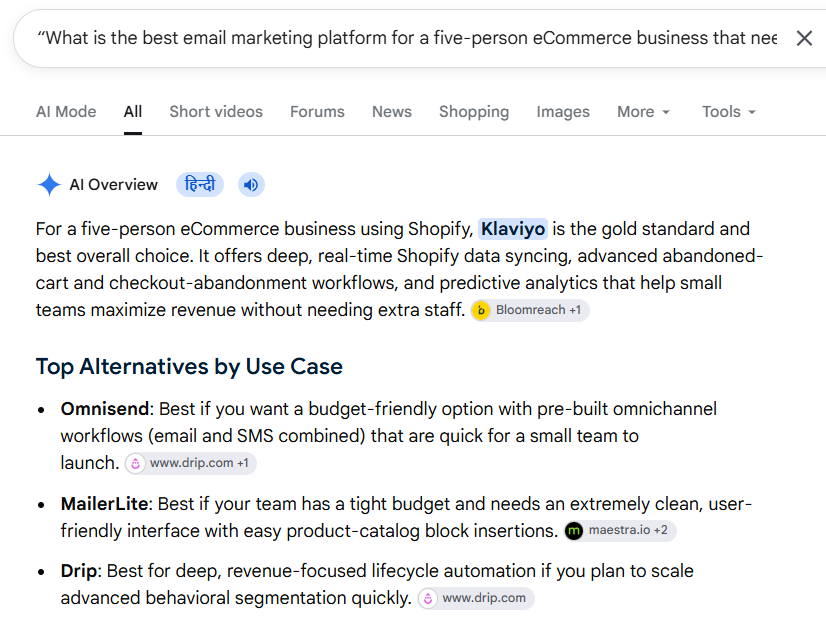
You can see the result it returns in the screenshot below:
The second query contains substantially more information.
It includes:
- The business type
- Team size
- Required integration
- Workflow requirements
- Reporting requirements
- Budget
- Decision intent
That is valuable information for an AI search system.
It also tells you something important about content strategy.
The user is no longer giving Google a keyword. The user is giving Google a problem.
Your content needs to solve that problem.
The Keyword Is Becoming the Starting Point, Not the Strategy
Traditional SEO often starts with a keyword.
AI-oriented content should increasingly start with intent.
Take the keyword:
“email marketing software.”
There are dozens of possible intentions behind it.
The user might want to:
- Understand what email marketing software does
- Compare platforms
- Find software for a small business
- Find an affordable tool
- Migrate from another platform
- Integrate email marketing with a CRM
- Build automated campaigns
- Improve deliverability
- Choose software for eCommerce
A page optimized only around the phrase “email marketing software” can easily become generic.
A page designed around a specific problem can become much more useful.
For example:
“What is the best email marketing platform for a five-person eCommerce business that needs abandoned-cart automation and Shopify integration?”
Now the content brief becomes much clearer.
The page needs to discuss:
- Platform options
- eCommerce capabilities
- Shopify integration
- Abandoned-cart automation
- Team requirements
- Pricing
- Limitations
- Recommendation
This is much closer to the way AI Mode users are now searching.
Business Case #1: SaaS Company
Imagine a SaaS company selling project management software.
Its traditional SEO strategy might target:
“project management software”
The company creates a 2,500-word article explaining project management software, its benefits, features, and history.
That article might be perfectly reasonable.
But consider the question a potential customer could actually ask:
“What project management software should a 20-person marketing agency use if clients need access to projects, employees need time tracking, and managers need workload reports?”
That is a completely different content opportunity.
A strong page could lead with:
For a 20-person marketing agency, the best project management platform is one that combines client access, task management, time tracking, workload visibility, and permission controls.
Then the page can explain which platforms meet those requirements and why.
Notice what happened.
The article did not abandon SEO.
It became more specific.
The keyword still matters, but the decision context becomes the organizing principle.
Why the First Paragraph Matters More
AI search systems do not necessarily need your entire article to understand its central point.
They can retrieve, process, compare, and synthesize information from different sources.
Google explains that AI Mode uses a technique called query fan-out, where a complex question can be broken into multiple subtopics and searched across different sources before the information is brought together. (Google Help)
That means your page may become one piece of a much larger answer.
If your most useful information is buried deep inside the article, it may be harder for an automated system to identify the exact passage that answers a particular sub-question.
This does not mean Google simply takes the first paragraph and ranks it.
That would be an oversimplification.
It means your content should make important information easy to identify, understand, verify, and connect to the surrounding context.
That’s good information architecture for both humans and machines.
The New Structure: Answer, Evidence, Explanation
For many informational pages, I recommend thinking in three layers.
1. Answer
Give the direct answer.
2. Evidence
Explain why the answer is correct.
3. Explanation
Provide examples, qualifications, alternatives, and deeper context.
For example:
Question: Is WordPress good for small businesses?
Weak opening:
WordPress has been around for many years and has become one of the world’s most popular content management systems. Businesses of all sizes use WordPress…
Answer-first opening:
Yes. WordPress can be a strong choice for small businesses because it supports flexible website development, content publishing, SEO, eCommerce, and thousands of integrations without requiring a business to build its entire platform from scratch.
Then explain the advantages and disadvantages.
This structure is simple, but it changes the experience dramatically.
Business Case #2: Local Service Business
Consider a plumbing company targeting local customers.
Its traditional page might begin:
“Welcome to ABC Plumbing, your trusted plumbing partner. We have been serving homeowners for more than 20 years…”
That is brand information.
It is not necessarily the answer to the customer’s question.
Now imagine the customer asks:
“How much does emergency plumbing usually cost in Delhi, and what should I do if a pipe bursts at night?”
A useful page could lead with:
Emergency plumbing costs vary by the problem, time of service, and materials required. A burst pipe should be shut off at the main water valve immediately, followed by professional assistance to prevent further water damage.
Then the page can explain:
- Typical pricing factors
- Emergency response
- What homeowners should do
- What not to do
- Different plumbing emergencies
- When replacement is necessary
- Local service information
The business still gets an opportunity to introduce its services.
But it earns attention by answering the problem first.
Follow-Up Questions Are Another Major Signal
AI Mode is also conversational.
Google reports that users are asking follow-up questions and continuing their searches rather than treating every search as a single isolated interaction. Google’s one-year U.S. report specifically highlights the growth of these conversational behaviors. (blog.google)
This changes how we should structure long-form content.
A page should not answer only the initial question.
It should anticipate the next questions.
For example:
Initial question:
“What is GA4?”
Likely follow-up:
“How is GA4 different from Universal Analytics?”
Then:
“How do I set up conversion tracking?”
Then:
“How do I know whether my conversions are working?”
Then:
“Why are my GA4 conversions lower than my CRM conversions?”
A strong content strategy can address that entire journey.
This is where topical depth becomes more useful than simply increasing word count.
Business Case #3: eCommerce Brand
Imagine an online furniture retailer.
A customer might ask:
“Which sofa material is best for a family with two children and a dog if the sofa will be used every day and needs to be easy to clean?”
A generic article about “best sofa materials” is not enough.
The page should lead with a practical answer:
For a busy household with children and a dog, tightly woven performance fabrics are often a practical choice because they can offer durability and easier maintenance compared with more delicate upholstery materials.
Then explain:
- Fabric types
- Leather
- Performance fabrics
- Stain resistance
- Cleaning requirements
- Durability
- Cost
- Pet considerations
The user receives an answer immediately.
The retailer then has an opportunity to move the user toward relevant products.
That is how informational content can support commercial intent without becoming an advertisement disguised as an article.
Five Search Behaviors Content Teams Should Watch
Google’s 2026 AI Mode research identifies several broad ways people are using AI Mode, including Explore, Decide, Learn, Create, and Do. (Search Engine Journal)
These are useful categories for content planning.
Explore
The user wants ideas.
Examples:
- “Ideas for…”
- “Where should I…”
- “What are some ways to…”
Create content that provides options and helps users understand possibilities.
Decide
The user wants to choose.
Examples:
- “Which is better?”
- “Which should I buy?”
- “A vs B”
Create comparison content with clear criteria and conclusions.
Learn
The user wants understanding.
Examples:
- “What is…”
- “How does…”
- “Why does…”
Lead with a simple definition before moving into deeper explanations.
Create
The user wants something produced.
Examples:
- “Create a…”
- “Give me a…”
- “How can I design…”
Provide practical frameworks, examples, templates, or processes.
Do
The user wants to accomplish something.
Examples:
- “How do I…”
- “How can I fix…”
- “What should I do…”
These pages should prioritize actionable instructions.
Stop Treating 2,000 Words as the Objective
One of the biggest mistakes I see in modern SEO is treating word count as a content strategy.
A 2,000-word article is not automatically better than a 700-word article.
If the user asks:
“How do I reset my WordPress password?”
The best answer may be relatively short.
If the user asks:
“How should a multinational company restructure its technical SEO strategy for AI search?”
A much longer answer may be justified.
The objective should be complete usefulness, not arbitrary length.
AI Mode makes this distinction even more important because users are bringing complicated questions to search.
Your job is not to make the answer long.
Your job is to make the answer complete enough for the question being asked.
Write Sections That Can Stand Alone
Another strategy I recommend is making individual sections understandable independently.
Instead of creating one enormous narrative where every paragraph depends on the previous paragraph, structure your content around meaningful questions.
For example:
What Is AI Search?
Direct answer.
How Does AI Search Differ From Traditional Search?
Direct comparison.
How Should Businesses Optimize Content?
Actionable recommendations.
Does Keyword Research Still Matter?
Nuanced answer.
How Should Content Be Structured for AI Citations?
Practical framework.
Each section becomes a useful information unit.
This is especially important because AI systems can retrieve information at different levels of granularity.
A clearly structured page gives both readers and search systems stronger signals about what each section actually answers.
What About Storytelling?
This does not mean storytelling is dead.
Brand voice still matters.
Examples still matter.
Case studies still matter.
Personal experience still matters.
Narrative can make an article memorable.
But narrative should not force the reader to wait for the information they came to find.
My preferred structure is:
Answer → Evidence → Explanation → Example → Deeper context → Next question
That gives you both clarity and depth.
You can still tell the story.
Just don’t make the reader search for the conclusion.
The Practical SEO Framework I Would Use
When creating a new article, I would ask six questions.
1. What exact problem is the user trying to solve?
Not just the keyword.
2. What is the shortest accurate answer?
Write this before writing the introduction.
3. What evidence supports that answer?
Use authoritative sources, original data, examples, demonstrations, or first-hand experience where appropriate.
4. What follow-up questions will the reader ask?
Build those into the article.
5. What decision or action should the reader be able to take?
Make the page useful beyond information.
6. Can every major section answer a question independently?
If yes, your information architecture is probably heading in the right direction.
Final Takeaway
AI Mode is not simply another Google feature that SEO professionals need to track.
It represents a broader change in search behavior.
People can now give Google much more context. Instead of entering a few words and opening several results, they can describe a situation, explain their requirements, ask for comparisons, and continue the conversation.
Google’s own data shows that the average AI Mode query is now three times longer than a traditional Search query, while planning, brainstorming, multimodal search, and follow-up interactions are also becoming important parts of the experience. (blog.google)
That means content strategy needs to evolve from keyword targeting toward problem solving.
And one of the simplest changes you can make is also one of the most important:
Put the answer first.
Do not make readers dig through 300 words of introduction to discover the point.
Do not hide your strongest insight behind generic statements.
Do not write five paragraphs about why a topic matters before answering the question in the headline.
Give the answer.
Then prove it.
Then explain it.
Then provide the examples, limitations, alternatives, and deeper context.
That structure works for humans because it respects their time.
It works for businesses because it makes content more useful.
And in an AI search environment where systems need to understand, retrieve, compare, and synthesize information from the web, it gives your content a much clearer information architecture to work with.
The future of SEO is not necessarily about writing more. It is about making the value of what you write easier to understand immediately.
The page that answers the question clearly may have a better opportunity to become part of the answer than the page that spends half its introduction explaining why the question is important.
About Author:
BacklinkGen.com Editorial Team
The BacklinkGen.com Editorial Team is led by Amit Tyagi, Gaurav Saxena and Rachit Srivastava—professionals with expertise spanning enterprise technology, artificial intelligence, digital marketing, SEO, AI Search Optimization (AIO/GEO), content strategy, and business growth. Together, they bring decades of combined industry experience across global technology initiatives, performance marketing, and digital transformation.
Every article published on BacklinkGen.com is guided by practical experience, in-depth research, and a commitment to editorial accuracy. The team focuses on delivering trustworthy, actionable, and up-to-date insights that help businesses, marketers, and professionals stay ahead in the rapidly evolving world of search, AI, and digital marketing.