The digital marketing landscape in 2026 is evolving faster than ever before. Traditional SEO alone is no longer enough to dominate search engines or build sustainable online visibility. Businesses today must adapt to AI-powered search ecosystems, advanced personalization, voice and visual search optimization, data privacy regulations, and user-first digital experiences. Brands that fail to innovate are rapidly losing market share to companies that embrace automation, analytics, and intelligent customer engagement.
Over the past 15+ years, I have worked with startups, enterprise organizations, USA-based IT firms, and government-backed digital initiatives, helping businesses improve search rankings, website performance, lead generation, and customer acquisition. One thing has remained consistent throughout every digital transformation: businesses that prioritize value, trust, and user experience always outperform competitors in the long run.
In 2026, successful marketing is no longer about simply generating traffic. It is about creating meaningful digital experiences powered by AI insights, strategic SEO frameworks, intelligent automation, and conversion-focused design. Companies must integrate SEO, PPC, analytics, web development, email marketing, and customer psychology into one unified digital growth strategy.
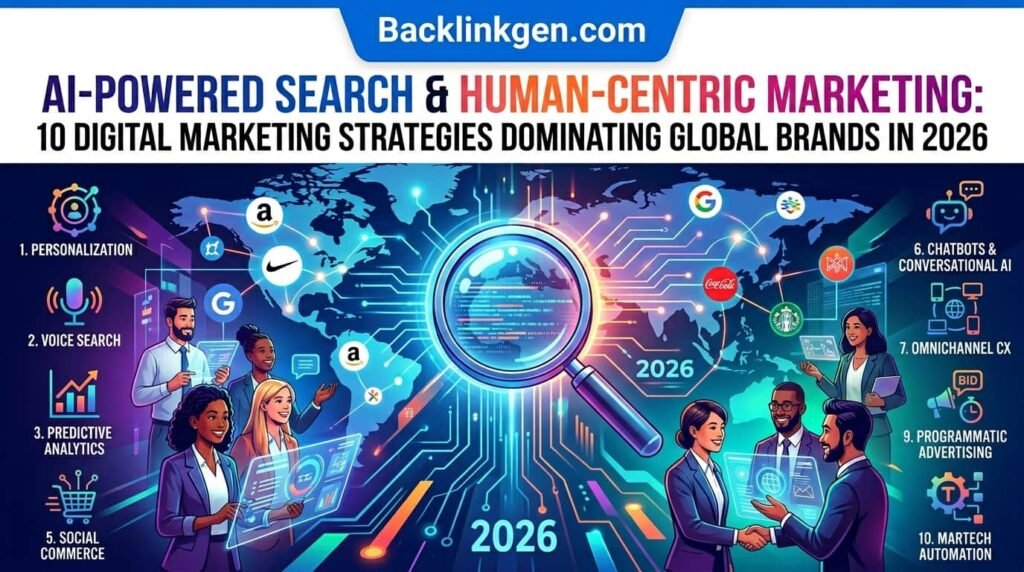
This article explores the top 10 global digital marketing strategies reshaping the industry in 2026 and explains how businesses can stay ahead in an increasingly AI-driven online marketplace.
1. AI Search Optimization Is Replacing Traditional SEO
Artificial Intelligence has fundamentally transformed how search engines deliver results. Search engines are now prioritizing contextual understanding, conversational intent, and predictive recommendations over traditional keyword matching. Businesses that still rely solely on outdated keyword stuffing techniques are rapidly losing visibility.
AI-powered search platforms now evaluate content quality through semantic analysis, user engagement metrics, behavioral signals, expertise, trustworthiness, and content depth. Search engines understand user intent more accurately than ever before, making content relevance the most important ranking factor in 2026.
To compete effectively, businesses must optimize for AI-driven discovery systems. This includes conversational content structures, FAQ-rich articles, entity-based SEO, schema markup implementation, topical authority building, and multimedia optimization. Search engines now reward websites that provide comprehensive answers rather than isolated keyword-targeted pages.
Another major shift is the rise of AI-generated search summaries. Many users now get answers directly from search engine AI interfaces without clicking traditional results. This means brands must optimize content to become the preferred source for AI summarization systems.
Successful SEO strategies in 2026 focus on expertise, structured information architecture, internal linking ecosystems, topical clustering, and content experience optimization. Businesses must also improve page speed, mobile responsiveness, accessibility, and engagement metrics to remain competitive.
The future of SEO belongs to brands that combine technical excellence with authentic human-centered content. AI can help scale optimization, but trust, authority, and genuine value remain the strongest ranking signals globally.
2. User Experience (UX) Has Become the Core Ranking Factor
In 2026, websites are no longer judged solely by design aesthetics. Search engines and consumers both prioritize seamless user experiences that deliver speed, clarity, accessibility, and engagement across all devices.
Modern users expect websites to load instantly, function flawlessly on mobile devices, and guide them naturally toward solutions. Even a few seconds of delay can significantly reduce conversions, engagement, and customer trust. Search engines actively measure these interactions through behavioral signals such as bounce rates, session duration, click patterns, and user satisfaction metrics.
Businesses must now invest heavily in UX-driven development strategies. Clean navigation structures, intuitive layouts, accessibility compliance, optimized typography, mobile responsiveness, and simplified conversion funnels directly influence rankings and revenue generation.
Consumers are also increasingly impatient with cluttered websites. Excessive popups, confusing interfaces, slow-loading pages, and intrusive advertisements damage user trust instantly. Companies that prioritize simplicity and usability consistently outperform competitors.
Another critical trend is personalization. Websites powered by behavioral analytics and AI-driven recommendations create tailored experiences for users based on browsing behavior, geographic location, and customer intent. Personalized experiences increase retention, improve engagement, and maximize ROI.
UX optimization also supports SEO by improving crawl efficiency and helping search engines better understand website structures. Strong internal linking, logical content organization, and accessible design enhance both user journeys and search visibility.
In the modern digital ecosystem, user experience is no longer optional. It is a direct growth driver influencing customer trust, conversion rates, search rankings, and long-term brand authority across global markets.
3. Video Marketing Is Dominating Every Digital Platform
Video content has become the most powerful communication format in global digital marketing. Short-form videos, educational explainers, webinars, product walkthroughs, and live streams are generating significantly higher engagement than traditional text-based content.
Consumers today prefer visual learning and fast content consumption. Platforms prioritizing video distribution are receiving massive organic reach advantages, making video marketing essential for brand growth in 2026.
Search engines are also integrating video results more aggressively into search pages. Optimized video content now appears in featured snippets, AI summaries, and visual discovery feeds. Businesses investing in video SEO are gaining stronger visibility across multiple search ecosystems.
Successful brands are using video content strategically throughout the customer journey. Awareness-stage videos educate audiences, while product demonstrations, testimonials, and tutorials help nurture leads and increase conversions.
Authenticity has become a major competitive advantage in video marketing. Audiences respond better to genuine, informative, and relatable content compared to overly polished advertisements. Human storytelling, expert insights, and behind-the-scenes transparency build stronger emotional connections.
Video marketing also improves website engagement metrics significantly. Visitors spend more time on pages containing relevant videos, reducing bounce rates and increasing conversion opportunities. This indirectly strengthens SEO performance as well.
In 2026, businesses should focus on creating educational, value-driven video ecosystems optimized for multiple platforms including websites, search engines, social media channels, and AI recommendation systems. Captions, transcripts, schema markup, and keyword-rich metadata are essential for discoverability.
Brands that fail to embrace video-first communication strategies risk becoming invisible in increasingly visual digital environments.
4. First-Party Data Is Becoming the Foundation of Marketing
Global privacy regulations and the decline of third-party cookies have reshaped digital advertising and customer targeting strategies. Businesses can no longer rely heavily on external tracking systems to understand audiences.
First-party data has become one of the most valuable digital assets in 2026. Companies that ethically collect customer insights through websites, subscriptions, surveys, CRM systems, and engagement platforms are building stronger marketing ecosystems.
First-party data enables businesses to create personalized campaigns, improve customer retention, and optimize advertising performance without depending on invasive tracking technologies. Consumers are also more willing to share information with brands they trust.
Email marketing, loyalty programs, gated resources, webinars, and interactive tools are becoming essential methods for building first-party databases. Businesses must focus on delivering genuine value in exchange for customer information.
Transparency is equally important. Companies must clearly explain how user data is collected, stored, and utilized. Ethical data practices improve trust and reduce compliance risks under global privacy laws.
Advanced analytics tools powered by AI now help businesses transform first-party data into actionable insights. Brands can predict customer behaviors, segment audiences intelligently, and automate personalized experiences across multiple digital channels.
Search engines and advertising platforms are also adapting to privacy-focused ecosystems. Businesses with strong first-party data strategies gain competitive advantages because they maintain better customer relationships and more accurate targeting capabilities.
In the future of digital marketing, owning audience relationships will be far more valuable than renting attention through third-party advertising networks.
5. Voice Search and Conversational Queries Are Rapidly Growing
Voice-enabled devices and AI assistants are changing how consumers search for information online. Users increasingly prefer conversational queries over traditional keyword-based searches.
People now ask complete questions such as “What is the best digital marketing strategy for small businesses in 2026?” instead of typing fragmented keywords. This shift requires businesses to rethink their SEO and content strategies.
Conversational optimization focuses on natural language patterns, long-tail keywords, FAQ structures, and direct-answer content formats. Websites optimized for spoken queries gain stronger visibility in voice search results and AI-generated summaries.
Local businesses especially benefit from voice search optimization because many voice searches involve location-based intent. Queries such as “best SEO consultant near me” or “top digital marketing agency nearby” continue growing globally.
Schema markup plays a critical role in helping search engines interpret conversational content. Structured data enhances visibility in featured snippets, knowledge panels, and AI-driven recommendation systems.
Brands should also optimize content readability for voice interfaces. Clear sentence structures, concise answers, and conversational tones improve compatibility with AI assistants and voice-enabled search systems.
As AI-powered assistants become more integrated into daily life, conversational discovery will continue replacing traditional search behavior. Businesses that adapt early will capture stronger organic visibility and audience engagement.
Voice search is no longer an experimental trend. It is now an essential component of modern SEO and customer acquisition strategies.
6. Content Authority Matters More Than Content Volume
Publishing large amounts of generic content no longer guarantees search visibility. Search engines now prioritize topical expertise, authority, and depth over sheer publishing frequency.
Businesses must focus on becoming trusted knowledge leaders within specific industries. High-authority content ecosystems outperform websites that publish low-quality articles at scale.
Topical authority is built by covering subjects comprehensively through interconnected articles, guides, case studies, research insights, videos, and expert commentary. Search engines reward brands that demonstrate consistent expertise across entire subject categories.
In-depth content also improves engagement metrics and increases the likelihood of backlinks, citations, and social sharing. Readers prefer valuable educational resources over shallow promotional content.
Content quality indicators in 2026 include expertise, originality, research accuracy, user engagement, multimedia integration, and structured organization. AI-generated content without human refinement often lacks authenticity and strategic depth.
Successful businesses are now combining AI-assisted workflows with human expertise to create scalable yet trustworthy content strategies. Human insight, experience, and storytelling remain essential differentiators.
Content authority also strengthens brand reputation beyond search rankings. Businesses recognized as industry experts gain higher customer trust, improved lead generation, and stronger conversion rates.
The future belongs to brands that educate audiences rather than simply selling to them.
7. Email Marketing Is Experiencing a Massive Revival
Despite the rise of new platforms, email marketing remains one of the highest ROI-generating digital channels in 2026. However, modern email marketing is vastly different from outdated mass-broadcast approaches.
Today’s successful email strategies focus on personalization, automation, behavioral triggers, and customer journey optimization. AI-driven segmentation allows businesses to deliver highly relevant content based on user interests and actions.
Modern consumers expect value-driven communication rather than aggressive sales messaging. Educational newsletters, personalized recommendations, industry insights, and exclusive resources perform significantly better than generic promotions.
Automation platforms now enable businesses to create intelligent nurturing systems that engage leads automatically at different stages of the customer lifecycle. Welcome sequences, abandoned cart flows, re-engagement campaigns, and loyalty programs improve customer retention substantially.
Interactive email experiences are also becoming more common. Dynamic content, embedded forms, surveys, countdown timers, and personalized offers increase engagement rates.
Email marketing supports long-term brand relationships because businesses own the communication channel directly. Unlike social media platforms where algorithms control visibility, email provides consistent audience access.
Strong email strategies also integrate closely with SEO, PPC, content marketing, and CRM systems, creating unified customer experiences across digital touchpoints.
In an increasingly AI-driven digital ecosystem, personalized human communication through email continues to build trust, loyalty, and long-term customer value.
8. PPC Advertising Is Becoming Smarter Through AI Automation
Paid advertising platforms have evolved dramatically with AI-driven bidding systems, predictive analytics, and automated optimization technologies. Modern PPC campaigns now rely heavily on machine learning for performance improvements.
AI-powered advertising systems analyze user intent, browsing behavior, demographics, engagement patterns, and conversion probabilities in real time. This enables businesses to target audiences more accurately while maximizing advertising ROI.
However, automation alone is not enough. Successful PPC strategies still require human expertise in audience psychology, creative messaging, funnel optimization, and campaign architecture.
Businesses must now focus on integrated PPC ecosystems rather than isolated campaigns. Landing page optimization, conversion tracking, remarketing strategies, and audience segmentation are critical for sustainable performance.
Video ads, interactive formats, AI-personalized creatives, and omnichannel campaigns are generating stronger engagement compared to traditional static advertisements.
Another major trend is predictive advertising. AI tools can now forecast conversion probabilities and allocate budgets dynamically across platforms for maximum efficiency.
Transparency and ethical advertising are also increasingly important. Consumers are becoming more selective about the brands they trust, making authenticity essential in ad messaging.
The future of PPC belongs to marketers who combine AI automation with strategic creativity and deep customer understanding.
9. Analytics and Data-Driven Decision Making Are Essential
Modern digital marketing success depends heavily on analytics, performance tracking, and data interpretation. Businesses that rely on assumptions instead of measurable insights struggle to compete effectively.
Advanced analytics platforms now provide real-time visibility into customer journeys, conversion paths, engagement behaviors, and campaign performance. These insights enable businesses to optimize marketing strategies continuously.
In 2026, marketers must move beyond vanity metrics such as impressions and likes. The focus has shifted toward meaningful KPIs including customer acquisition cost, lifetime value, retention rates, conversion efficiency, and ROI.
AI-powered analytics tools are helping businesses uncover patterns that humans may overlook. Predictive analytics enables smarter forecasting, audience segmentation, and marketing automation decisions.
Cross-platform attribution has also become increasingly important. Businesses must understand how SEO, PPC, email marketing, social media, and content strategies interact throughout the customer journey.
Data visualization and reporting clarity are essential for strategic decision-making. Simplified dashboards help organizations identify growth opportunities faster and improve operational efficiency.
Companies that build strong analytics cultures gain major competitive advantages because they can adapt rapidly to changing market conditions and customer behaviors.
Digital marketing without analytics is no longer sustainable in highly competitive global markets.
10. Integrated Digital Strategies Deliver the Highest ROI
One of the biggest mistakes businesses make is treating SEO, PPC, web development, email marketing, and social media as isolated activities. In reality, the highest-performing brands use integrated digital ecosystems.
Modern consumers interact with businesses across multiple touchpoints before making purchasing decisions. A customer may discover a brand through search engines, watch a video, subscribe to emails, read reviews, and then convert through retargeting campaigns.
Integrated strategies create consistent messaging and seamless user experiences throughout this journey. SEO improves discoverability, PPC accelerates lead generation, content builds authority, UX improves engagement, and analytics optimize performance continuously.
Web development also plays a crucial role because technical performance directly impacts every marketing channel. Fast-loading, mobile-friendly, conversion-optimized websites improve campaign efficiency across the board.
Collaboration between marketing, design, analytics, and development teams is essential in 2026. Businesses that align these functions achieve stronger growth, better ROI, and improved customer retention.
Integrated marketing also enhances scalability. Businesses can automate workflows, unify customer data, and optimize campaigns more effectively when systems work together cohesively.
The future of digital success belongs to organizations that build connected digital ecosystems rather than fragmented marketing campaigns.
Conclusion
Digital marketing in 2026 is being shaped by AI innovation, evolving consumer expectations, data privacy regulations, and increasingly intelligent search ecosystems. Businesses that continue relying on outdated strategies risk losing visibility, engagement, and market relevance.
Success today requires a combination of AI-powered optimization, user-first experiences, strategic analytics, authoritative content, integrated marketing systems, and ethical customer engagement. Companies must embrace innovation while maintaining authenticity and trust.
As a digital marketing strategist with over 15 years of experience across government initiatives and global business projects, I strongly believe that sustainable growth comes from balancing technology with human-centered marketing principles.
The brands that will dominate the next decade are not necessarily the ones spending the most money. They are the ones delivering the best digital experiences, solving real customer problems, and adapting continuously to technological evolution.
About Author:
BacklinkGen.com Editorial Team
The BacklinkGen.com Editorial Team is led by Amit Tyagi, Gaurav Saxena and Rachit Srivastava—professionals with expertise spanning enterprise technology, artificial intelligence, digital marketing, SEO, AI Search Optimization (AIO/GEO), content strategy, and business growth. Together, they bring decades of combined industry experience across global technology initiatives, performance marketing, and digital transformation.
Every article published on BacklinkGen.com is guided by practical experience, in-depth research, and a commitment to editorial accuracy. The team focuses on delivering trustworthy, actionable, and up-to-date insights that help businesses, marketers, and professionals stay ahead in the rapidly evolving world of search, AI, and digital marketing.