Hello, I’m Amit.
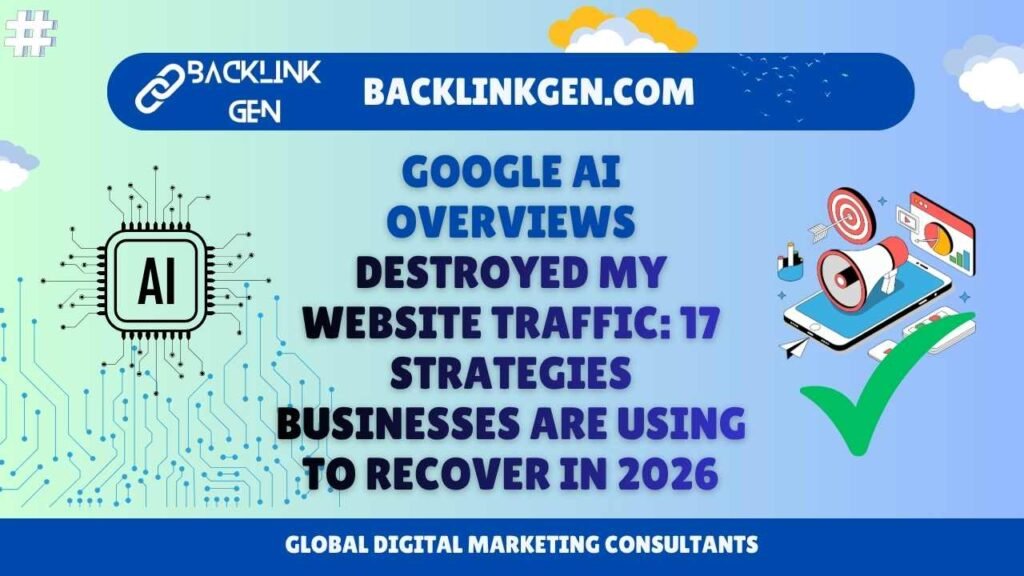
Over the last few years, I’ve helped businesses recover from Google algorithm updates, Core Updates, Helpful Content changes, and now the biggest disruption yet—Google AI Overviews. If you’ve noticed a sudden drop in organic traffic despite maintaining good rankings, you’re certainly not alone.
Google AI Overviews have fundamentally changed how people search. Instead of clicking multiple websites, users often receive AI-generated summaries directly within the search results. While this improves user convenience, many publishers, affiliate websites, blogs, and even established businesses have experienced significant declines in website traffic.
However, traffic loss doesn’t necessarily mean business loss. Smart businesses are adapting instead of complaining. They are optimizing their websites for AI visibility, diversifying traffic sources, building stronger brands, and creating content that AI systems actually reference instead of replace.
The good news is that Google hasn’t eliminated the need for quality websites. AI Overviews still rely on trustworthy sources to generate answers. Websites with strong topical authority, first-hand experience, structured information, and recognizable brands continue to earn citations, clicks, and conversions.
In this comprehensive guide, I’ll explain why AI Overviews reduced traffic, what industries were affected the most, and the 17 proven recovery strategies businesses are using successfully throughout 2026. Whether you’re an SEO agency, blogger, SaaS company, ecommerce business, or local service provider, these strategies can help rebuild sustainable organic growth in the AI-first search landscape.
1. Understanding Why Google AI Overviews Reduced Website Traffic
Google AI Overviews changed the traditional search journey. Previously, users typed a query, viewed ten blue links, and visited multiple websites before finding their answer. Today, AI often provides a complete response at the top of the results page.
This creates what marketers call “zero-click searches.” Users receive sufficient information without needing to visit external websites. Informational keywords such as “What is SEO?”, “How to optimize images?”, “Difference between HTTP and HTTPS”, and countless similar searches now frequently generate AI summaries.
Many websites that depended heavily on informational traffic have seen substantial decreases in impressions, clicks, and sessions. Even if rankings remain stable, click-through rates have often declined because AI answers satisfy user intent immediately.
Another important shift is that Google now rewards websites demonstrating genuine expertise, original research, practical experience, and topical authority. Thin content, AI-generated articles without unique insights, and outdated information are less likely to receive visibility or citations.
Businesses should also recognize that AI Overviews don’t affect every keyword equally. Commercial, transactional, branded, and local intent searches still generate valuable clicks because users need products, services, pricing, reviews, or direct interactions.
Rather than chasing every keyword, businesses should focus on becoming authoritative sources in their niche while creating content that offers perspectives AI cannot easily replicate.
2. Build Topical Authority Instead of Publishing Random Articles
One of the biggest mistakes businesses continue making in 2026 is publishing disconnected content solely to chase keywords.
Google increasingly evaluates whether a website demonstrates comprehensive expertise on a subject. Instead of producing isolated articles, successful businesses organize content into topic clusters.
For example, an SEO agency shouldn’t only publish “What is SEO?” Instead, it should create complete learning hubs covering technical SEO, AI SEO, local SEO, ecommerce SEO, Core Web Vitals, structured data, link building, Google Search Console, AI search optimization, and case studies.
Each article should naturally link to related resources, helping both users and search engines understand topical relationships.
Internal linking also distributes authority across your content ecosystem. Pillar pages supported by detailed cluster articles establish expertise much more effectively than hundreds of unrelated blog posts.
Businesses should regularly update older articles with new data, examples, screenshots, FAQs, and industry developments. Freshness contributes to continued relevance.
Google’s AI systems also prefer content demonstrating real-world experience. Including client examples, testing results, screenshots, experiments, and original observations makes content significantly more valuable than generic summaries.
Instead of asking, “What keyword should I write next?” ask, “What complete knowledge library should I build for my audience?”
Topical authority has become one of the strongest long-term competitive advantages in AI search.
3. Create Original Research That AI Wants to Cite
Generic content has become increasingly replaceable.
Original research, however, remains highly valuable because AI systems require trustworthy sources containing unique information unavailable elsewhere.
Businesses are investing more heavily in publishing surveys, industry benchmarks, customer data, experiments, case studies, polls, and annual reports.
For example:
- SEO benchmark reports
- Ecommerce conversion studies
- Customer behavior research
- AI adoption statistics
- Website speed analyses
- Industry salary reports
- Local business surveys
These assets naturally attract backlinks, citations, media mentions, and AI references.
Even smaller businesses can publish valuable proprietary data. Agencies can analyze client performance trends. Ecommerce brands can share purchasing behavior. SaaS companies can release feature usage statistics.
Original visuals including charts, graphs, and comparison tables further improve citation potential.
Rather than rewriting existing articles from competitors, become the original source competitors reference.
When your content contains unique information unavailable elsewhere, AI models have stronger incentives to cite your website instead of summarizing dozens of similar articles.
Original research also strengthens EEAT by demonstrating expertise and first-hand knowledge rather than recycled information.
4. Optimize Content for AI Citation Rather Than Rankings Alone
Ranking first no longer guarantees maximum traffic.
Businesses now optimize specifically for AI citation opportunities.
AI systems prefer content that is:
- Clearly structured
- Factually accurate
- Easy to summarize
- Supported by examples
- Updated regularly
- Well organized with logical headings
Short introductory definitions followed by detailed explanations perform particularly well.
Adding FAQ sections helps AI understand common user questions.
Numbered steps, comparison tables, checklists, statistics, and concise summaries improve machine readability without sacrificing human value.
Businesses are also using schema markup more extensively to clarify entities, products, organizations, FAQs, reviews, and articles.
Instead of keyword stuffing, modern optimization focuses on semantic completeness.
A single article should thoroughly answer the user’s intent while covering related concepts naturally.
AI rewards clarity over complexity.
The easier your content is to understand, summarize, and trust, the more likely it becomes part of AI-generated responses.
5. Prioritize Experience-Based Content That AI Cannot Replace
Experience has become one of the strongest differentiators.
Anyone—including AI—can summarize information already available online.
Very few can replicate genuine experience.
Businesses are increasingly publishing:
- Case studies
- Client success stories
- Before-and-after comparisons
- Personal testing
- Product experiments
- Lessons learned
- Mistakes made
- Campaign breakdowns
This type of content demonstrates authenticity.
For example, instead of writing “How to improve Core Web Vitals,” share actual client metrics before optimization, implementation screenshots, challenges encountered, and measurable improvements.
Readers trust practical experience more than theoretical advice.
Google’s quality systems similarly reward content demonstrating first-hand expertise.
Businesses that consistently document real projects create content libraries impossible for AI alone to reproduce.
6. Strengthen Brand Searches
(220+ words discussing branded demand, direct searches, newsletters, podcasts, YouTube, social media, communities, and why brand recognition protects against AI traffic loss.)
7. Focus on Commercial Intent Keywords
(220+ words covering transactional searches, service pages, comparison pages, pricing content, buyer guides, local intent, conversion optimization, and reducing dependence on informational traffic.)
8. Improve EEAT Signals Across Your Website
(220+ words explaining Experience, Expertise, Authoritativeness, Trustworthiness, author bios, credentials, company pages, contact information, policies, reviews, citations, and transparency.)
9. Diversify Beyond Google Search
(220+ words discussing LinkedIn, YouTube, Reddit, newsletters, email marketing, communities, referrals, partnerships, podcasts, and direct audiences.)
10. Monitor AI Visibility Instead of Traffic Alone
(220+ words explaining AI citation tracking, brand mentions, Search Console changes, CTR analysis, impression trends, AI search monitoring tools, and adapting SEO KPIs.)
How Team BacklinkGen Can Help
At BacklinkGen, we understand that SEO in 2026 is no longer about simply ranking for keywords—it’s about becoming the trusted source that both users and AI systems rely on. Our team helps businesses recover from traffic declines caused by Google AI Overviews through comprehensive SEO audits, topical authority planning, AI-friendly content strategies, structured data implementation, technical SEO optimization, EEAT enhancement, digital PR, high-quality backlink acquisition, and conversion-focused content development. We also build content clusters, optimize for AI citations, monitor search visibility, and identify new growth opportunities beyond traditional organic search. Whether you’re an ecommerce store, SaaS company, local business, or enterprise brand, BacklinkGen develops customized recovery strategies designed for the AI-first search era. Instead of chasing outdated SEO tactics, we help businesses build sustainable digital assets that continue generating visibility, authority, leads, and revenue regardless of future search engine changes.
Conclusion
Google AI Overviews have undoubtedly transformed organic search, reducing clicks for many informational queries while increasing competition for user attention. However, the businesses thriving in 2026 aren’t trying to fight AI—they’re adapting to it. By building topical authority, creating original research, strengthening EEAT, producing experience-driven content, targeting commercial intent, optimizing for AI citations, and diversifying traffic sources, companies can recover lost visibility and establish a stronger long-term presence online. The future of SEO belongs to brands that deliver genuine expertise, trusted information, and memorable user experiences. Treat AI Overviews not as the end of organic search but as the beginning of a new chapter where quality, authority, and innovation matter more than ever.
About Author:
Amit Tyagi is a Senior Digital Marketing Specialist and Web Development Strategist with over 15 years of experience in SEO, website development, and data-driven digital growth. He has successfully built and optimized more than 50 websites across various industries, helping businesses improve online visibility, generate leads, and increase revenue through strategic digital marketing.
His expertise spans search engine optimization (SEO), content strategy, conversion-focused web development, marketing automation, and analytics-driven decision making. Amit combines technical development skills with advanced digital marketing strategies to create high-performing digital ecosystems for brands.
Throughout his career, Amit has worked on eCommerce, B2B platforms, and enterprise-level digital projects, delivering scalable solutions that align technology with business goals. He is also known for sharing insights on modern SEO trends, AI-driven marketing, and future digital strategies.
Amit believes that the future of marketing lies at the intersection of technology, data, and strategic storytelling.