Last Update – September 2026
Google is making its new Search Profiles available to a much broader group of publishers and content creators.
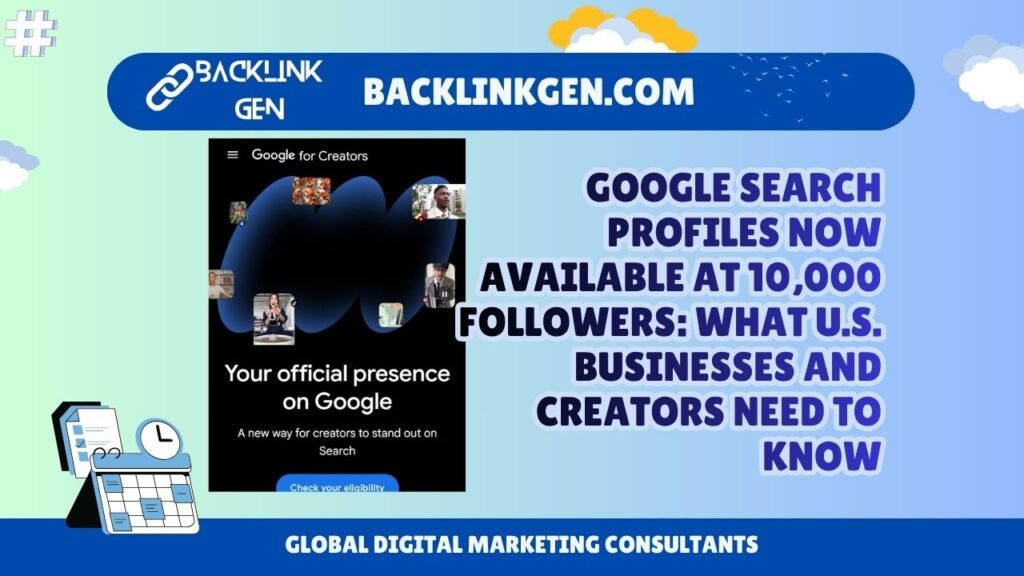
The biggest change is simple: you now need 10,000 followers or subscribers on just one supported platform to become eligible for a Google Search Profile in the United States. The supported platforms are YouTube, Instagram, X, and TikTok.
This is a major reduction from the original requirement when Google launched Search Profiles in June 2026. At launch, creators generally needed 100,000 followers on YouTube, Instagram, or X, or 300,000 on TikTok. Google later reduced that requirement to 35,000 and has now reduced it again to 10,000.
For U.S. businesses, publishers, personal brands, media organizations, and established content creators, this changes the practical value of the feature.
But there is an important point that needs to be understood from the beginning:
A Google Search Profile is not an SEO ranking boost.
Google explicitly says that creating a Search Profile does not directly affect how your content ranks in Google Search. Instead, it creates another way for people to discover your content, follow you, and potentially see more of your content through Google Discover.
That distinction is important because I would not recommend treating Search Profiles as another technical SEO trick. Think of them as a Google-controlled audience and content-discovery layer sitting alongside your existing SEO, social media, email, and content strategy.
What Exactly Is a Google Search Profile?
A Search Profile is essentially a centralized Google presence that brings together your online content.
Instead of someone searching for your brand and having to visit your website, YouTube channel, Instagram account, X profile, or TikTok account separately, Google can provide a more unified view of your identity and content.
Google describes Search Profiles as a customizable, verified home base where publishers and creators can consolidate social accounts, articles, and other links.
For example, imagine a U.S. marketing consultant who has:
- 15,000 YouTube subscribers
- A company website
- An active LinkedIn presence
- An Instagram account
- A collection of published articles
- A podcast
- An X account
Traditionally, these properties are distributed across different platforms.
A Search Profile gives Google another way to connect those pieces around the creator or brand.
Google says people may encounter a Search Profile when searching for the creator’s name or handle. Profiles can also be discovered from content appearing in Google Discover.
That makes the feature particularly interesting for businesses that have already invested heavily in content.
Check Availability here: https://creators.google/profile
The 10,000-Follower Requirement Changes the Game
The most significant change is the eligibility threshold.
As of September 16, 2026, Google says you need at least 10,000 followers or subscribers on one supported platform.
The supported platforms are:
| Platform | Minimum followers/subscribers |
|---|---|
| YouTube | 10,000 |
| 10,000 | |
| X | 10,000 |
| TikTok | 10,000 |
You do not need 10,000 followers on every platform.
If your YouTube channel has 10,000 subscribers but your Instagram account has only 3,000 followers, the YouTube audience can satisfy the requirement.
Google’s current documentation confirms that Search Profiles are available to eligible users who have at least 10,000 followers on a single supported platform.
This is a very different proposition from the launch requirements.
For example, a creator with a 10,000-subscriber YouTube channel may now qualify even if the creator’s website receives relatively modest organic traffic.
That matters because Google is effectively recognizing the creator’s existing audience as part of its broader search ecosystem.
Search Profiles Are Currently U.S.-Only
There is another important limitation.
Google’s Search Profile documentation currently states that the feature is available only in the United States.
Google has previously indicated plans to expand Search Profiles to additional countries, but the current eligibility documentation remains U.S.-specific.
For this reason, U.S. businesses and creators should pay attention to the feature now, while organizations outside the United States should not assume that they can immediately claim one.
This is particularly relevant for international businesses.
A company may have a global audience, but eligibility and availability are still determined by Google’s current rollout.
Google Is Also Making Multi-Brand Management Easier
The follower threshold isn’t the only change.
Google has introduced multi-account support that allows publishers to manage multiple Search Profiles from a single Google login.
This is particularly relevant to media companies and organizations operating multiple publications or brands.
Imagine a U.S. media company managing:
- A technology publication
- A finance publication
- A business publication
- A marketing publication
- A regional news publication
Previously, managing separate Search Profiles could mean dealing with separate Google accounts.
Google’s new system allows eligible organizations to claim and manage profiles for multiple brands from one login. Google’s help documentation currently says you can create up to 10 separate Search Profiles for eligible brands or identities from a single Google account.
For larger publishers, agencies, and businesses with multiple digital properties, this is a meaningful operational improvement.
It reduces account management complexity and makes Search Profiles more realistic as part of a broader publishing strategy.
Google Has Also Improved How Articles Appear
Google is also changing the way articles are displayed inside Search Profiles.
The company says it has optimized image thumbnails and increased the length of article headlines. The goal is to make published content easier to discover and give individual articles more visual presence inside the profile.
This may sound like a relatively small design update, but presentation matters.
Consider a publisher with hundreds of articles.
If the article cards show weak imagery and truncated headlines, the profile becomes little more than a list of links.
Better thumbnails and longer headlines give users more information before they click.
For content creators, this means your article titles and featured images deserve attention even beyond conventional Google Search results.
However, there is an important practical lesson here.
Don’t start writing clickbait headlines simply because Google displays more of the headline.
The better approach is to create headlines that communicate the actual value of the article quickly.
A strong headline should tell the reader what the content solves, explains, compares, or reveals.
The Follow Feature Could Be More Important Than the Profile Itself
From a marketing perspective, I find the following mechanism particularly interesting.
Google says users who follow a Search Profile may see more of that source’s content in Google Discover.
That changes the relationship between Google and your audience.
Traditional SEO works largely around queries.
Someone searches for something.
Google provides results.
The user clicks.
Discover works differently.
Content can appear in front of users based on their interests and behavior without them entering the exact query at that moment.
A Search Profile adds a following relationship to this ecosystem.
That means a creator could potentially build an audience on Google that is not dependent entirely on users repeatedly searching the creator’s name.
For content creators, this is worth watching carefully.
For businesses, it could become another distribution mechanism for educational content, product content, industry commentary, and news.
But I would still avoid treating Google Discover followers as equivalent to an email subscriber list.
You don’t own the Google audience.
Google controls the platform and its distribution systems.
Therefore, your Search Profile should complement—not replace—your email list, website, customer database, and social communities.
Does a Search Profile Improve Google Rankings?
This is probably the question SEO professionals will ask first.
The answer from Google’s documentation is straightforward:
No, creating a Search Profile does not directly improve your Google Search rankings.
This distinction is extremely important.
I have seen businesses repeatedly make the mistake of interpreting every new Google feature as a ranking signal.
That’s not how you should approach this.
You should continue focusing on the fundamentals:
- Helpful content
- Search intent
- Technical SEO
- Internal linking
- Website performance
- Structured data where appropriate
- Strong information architecture
- Original research
- Author credibility
- Digital PR
- Relevant backlinks
- User experience
- Conversion optimization
A Search Profile should sit on top of that strategy.
It isn’t a substitute for it.
In fact, if a website has poor content and poor SEO fundamentals, simply obtaining a Search Profile won’t magically solve those problems.
Why This Matters for U.S. Content Creators
The 10,000 threshold brings Search Profiles into reach for a much larger group of creators.
Consider a YouTube creator with 12,000 subscribers.
Previously, the creator may have been too small to qualify.
Now the creator can potentially claim a Search Profile, assuming the other eligibility requirements are satisfied.
That gives the creator another opportunity to establish a stronger Google presence around their identity.
For personal brands, this can be especially useful.
A creator might publish:
- YouTube videos
- Blog posts
- Instagram posts
- TikTok videos
- X updates
- Podcast episodes
Search Profiles can help Google connect these pieces.
This is particularly relevant for consultants, coaches, educators, journalists, analysts, authors, industry experts, and niche creators whose personal identity is closely connected to their business.
Why Businesses Should Pay Attention
Businesses should not think of Search Profiles only as a creator feature.
Google specifically discusses publishers and organizations alongside creators.
For a business, the bigger opportunity is brand consolidation and content distribution.
Suppose a SaaS company has 20,000 YouTube subscribers.
Its content strategy may already include:
- Product tutorials
- Industry reports
- Blog articles
- Case studies
- YouTube videos
- Social content
- Research
- Webinars
A Search Profile gives Google another structured destination around that content ecosystem.
This can strengthen the discoverability of the brand’s content and give users another way to follow the source.
But again, this shouldn’t replace the company’s website.
Your website remains the primary asset you control.
The Search Profile is a distribution and discovery layer.
Add a Search Profile Badge to Your Website
Google has also introduced documentation explaining how website owners and creators can add a Search Profile badge to their websites.
This is strategically interesting because it creates a loop.
Your website gets visitors.
Some visitors become Search Profile followers.
Google may subsequently expose those followers to more of your content through Discover.
That means the website doesn’t simply send users away to social networks.
It can also help build an audience inside Google’s ecosystem.
For eligible businesses and creators, I would consider placing the badge in logical locations rather than aggressively pushing it everywhere.
Potential locations include:
- Author bio sections
- About pages
- Content author boxes
- Footer areas
- Creator pages
- Media pages
- Podcast pages
The objective should be to make following easy without damaging the user experience.
What Content Should You Publish?
If you’re eligible for a Search Profile, don’t suddenly publish content just to fill the profile.
Your existing content strategy should remain focused on audience needs.
For businesses, useful content could include:
- Industry research
- Original data
- Product education
- Customer case studies
- Expert commentary
- How-to guides
- Comparisons
- Tutorials
- Frequently asked questions
- Market analysis
For creators, the strategy can revolve around the creator’s expertise.
For example, a digital marketing creator might publish content covering SEO, PPC, AI search, analytics, content marketing, and conversion optimization.
The key is consistency.
A Search Profile containing three articles and an inactive social account isn’t going to represent the same value as a regularly updated content ecosystem.
Search Profiles and the Future of Content Discovery
There is a larger trend behind Google’s move.
Search is no longer just about ten blue links.
Google is increasingly connecting traditional Search, Discover, creator content, social signals, visual content, and personalized discovery experiences.
Search Profiles fit into that broader direction.
Google’s original announcement described them as a way for publishers and creators to shape their presence on Search and help audiences follow their content across the web.
For marketers, this means we need to think beyond ranking individual URLs.
The future of search visibility increasingly involves building recognizable entities, trusted brands, identifiable authors, useful content ecosystems, and audiences that actively want to consume your content.
That is a much broader SEO strategy than simply targeting keywords.
What U.S. Businesses and Creators Should Do Now
If you’re based in the U.S. and have at least 10,000 followers on YouTube, Instagram, X, or TikTok, check whether you’re eligible.
Google recommends checking whether a profile has already been generated for you before creating a new one. You can search your name or creator handle and look for the Search Profile option.
If you’re eligible, review the profile carefully.
Make sure your:
- Name is accurate
- Profile image is appropriate
- Bio clearly explains who you are
- Social accounts are correct
- Website links are correct
- Content represents your current brand
- Articles have strong titles and images
If you’re a company with multiple brands, decide how you want your Google accounts and brand ownership structured before claiming profiles.
This is especially important for agencies and publishing groups managing several identities.
My Take as a Digital Marketing Professional
I would not classify Google Search Profiles as a replacement for SEO.
I would classify them as another audience-discovery asset.
The reduction to 10,000 followers is what makes the feature considerably more interesting.
At launch, the very high threshold meant only a relatively small number of publishers and creators could participate. At 10,000 followers, a much wider group of established U.S. creators and businesses can potentially enter the ecosystem.
The most interesting part isn’t simply the profile page.
It is the combination of:
Search + Discover + following + creator identity + cross-platform content.
That combination could become valuable for businesses that already have a strong content operation.
But don’t chase 10,000 followers simply to unlock a Search Profile.
Build the audience because the audience matters.
If your YouTube, Instagram, TikTok, or X community is genuinely engaged, the Search Profile becomes another distribution channel.
If you have a large follower number but weak engagement and poor content, the profile itself isn’t going to transform your marketing performance.
That’s the distinction marketers need to understand.
Final Thoughts
Google lowering Search Profile eligibility to 10,000 followers is an important expansion of the program.
For eligible U.S. creators, publishers, and businesses, the barrier to entry is now dramatically lower than it was when Search Profiles launched.
At the same time, Google has added multi-profile management for organizations, improved article presentation, and provided a way to encourage website visitors to follow a Search Profile.
The opportunity is not about gaining an instant ranking advantage.
It is about creating another connection between your brand, your content, your audience, Google Search, and Google Discover.
My recommendation for businesses is simple: don’t build your entire strategy around this feature. Instead, integrate it into the larger ecosystem.
Build the website.
Build the brand.
Create genuinely useful content.
Grow your audience.
Develop recognizable expertise.
Then use every legitimate distribution channel—including Google’s own Search Profile ecosystem—to make that content easier for the right audience to discover.
For U.S. businesses and creators already crossing the 10,000-follower threshold, this is a feature worth testing now rather than ignoring.
Disclaimer: This article is based on publicly available information from Google and other reputable sources available at the time of writing. Google may change eligibility requirements, availability, features, policies, or functionality without notice. Readers should verify current requirements directly through Google before making business, marketing, SEO, or content strategy decisions based on this information.
About Author:
BacklinkGen.com Editorial Team
The BacklinkGen.com Editorial Team is led by Amit Tyagi, Gaurav Saxena and Rachit Srivastava—professionals with expertise spanning enterprise technology, artificial intelligence, digital marketing, SEO, AI Search Optimization (AIO/GEO), content strategy, and business growth. Together, they bring decades of combined industry experience across global technology initiatives, performance marketing, and digital transformation.
Every article published on BacklinkGen.com is guided by practical experience, in-depth research, and a commitment to editorial accuracy. The team focuses on delivering trustworthy, actionable, and up-to-date insights that help businesses, marketers, and professionals stay ahead in the rapidly evolving world of search, AI, and digital marketing.