For years, SEO professionals had a relatively clear way to investigate whether a page was discoverable and indexed. We could use Google Search Console, Bing Webmaster Tools, server logs, search operators, crawling tools, and index coverage reports to identify technical problems.
AI search has introduced another layer.
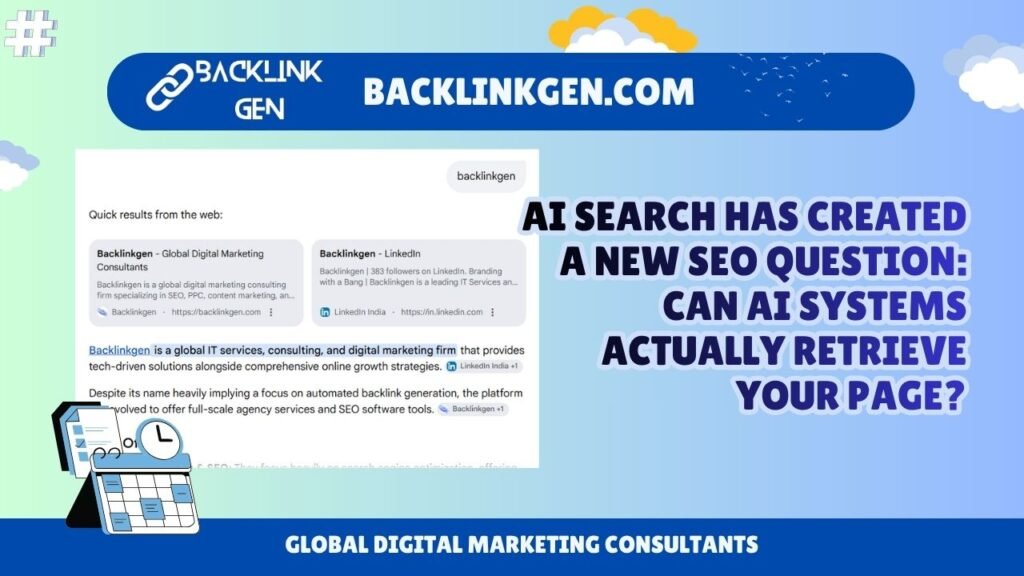
A page can be technically live, indexed by traditional search engines, and even performing well in Google, while marketers still have very little visibility into whether AI-powered search systems can actually retrieve that page when answering a user’s question.
That distinction is becoming increasingly important.
A recent Search Engine Journal article highlighted a practical way to test this problem: take a distinctive passage from your webpage, place it into an exact-match search request inside an AI chatbot with web-search capability, and see whether the system can retrieve the original page.
I find this approach particularly interesting because it changes the way we should think about GEO and AI visibility.
Before asking, “Why isn’t AI citing my website?” we should first ask, “Can AI retrieve my website at all?”
Those are two completely different questions.
Retrieval Is Not the Same as Ranking
This is probably the most important distinction marketers need to understand.
Traditional SEO often revolves around ranking.
We ask:
- Is Google indexing the page?
- What position does it rank at?
- Which keywords generate impressions?
- How many clicks does it receive?
- Which competitors rank above it?
AI search introduces another stage before the final answer is generated.
The system first needs to find potentially relevant information. Depending on the product and query, this can involve a search or retrieval process that identifies web sources. The retrieved information can then contribute to the answer and potentially become a cited source.
Therefore, I would look at AI visibility as a funnel:
Discovery → Crawlability → Retrieval → Selection → Citation → Traffic/Conversion
A problem at any earlier stage can affect what happens later.
If your page cannot be discovered or retrieved, improving the writing style alone will not solve the problem.
And this is where I think many businesses are currently approaching GEO incorrectly.
They are jumping directly into content optimization, entity optimization, prompt testing, or citation tracking without first establishing whether their important pages are technically retrievable.
The exact-match testing method gives marketers a practical diagnostic starting point.
The Simple Test I Would Add to an AI Visibility Audit
Take an important page from your website.
Do not choose the homepage automatically. Pick a page that matters commercially or strategically.
For example:
- A service page
- A product page
- A detailed industry guide
- A research article
- A comparison page
- An original case study
- A location page
- A technical resource
Now find a distinctive passage of approximately 20–30 words.
The passage should contain unusual wording, specific facts, numbers, terminology, or an original explanation.
Avoid generic sentences such as:
“Contact us today for high-quality digital marketing services.”
Thousands of websites could contain something similar.
Instead, select a sentence that has a much higher probability of identifying your page.
Then use an AI chatbot with web-search capability and ask it to search for that exact passage and return pages containing the exact text.
If the system retrieves your page and correctly associates the passage with your URL, you have useful evidence that the page can be reached through that particular search/retrieval pathway.
The important word here is evidence.
It is not absolute proof of universal AI indexing.
The article itself makes this limitation clear: AI responses can vary because different sources may be used, and the chatbot output should not be treated as a replacement for traditional technical SEO diagnostics.
That distinction is critical.
Why You Should Test Multiple Passages
One of the mistakes I would avoid is running the test once and making a final conclusion.
AI search systems can use different sources and retrieval paths.
So suppose you test one sentence and the page doesn’t appear.
That does not automatically mean your page is invisible to AI systems.
The selected sentence itself could be the problem.
Maybe it is too generic.
Maybe another website has copied it.
Maybe the chatbot’s underlying search source did not return your page during that particular request.
Maybe the page has only recently been published.
Maybe the system simply did not retrieve that URL during that query.
For that reason, I would test several distinctive passages from the same page.
For example:
Test 1: A unique definition
Test 2: An original statistic
Test 3: A specific technical explanation
Test 4: A distinctive sentence containing a product/service term
Test 5: Another unique paragraph from deeper in the page
If several different passages consistently lead back to the same URL, your confidence increases.
This is much more useful than testing a single generic sentence and declaring that a website is “not indexed by AI.”
What If Your Page Cannot Be Retrieved?
This is where the exercise becomes genuinely useful for SEO.
A failed retrieval test should trigger an investigation rather than an immediate content rewrite.
I would work through the technical SEO checklist first.
1. Check Discoverability
Can search systems discover the URL?
Start with the basics.
Is the page linked from relevant areas of the website?
Is it included in your XML sitemap?
Can a crawler reach it through internal links?
Is the page accidentally orphaned?
This is particularly important for large websites where new pages are frequently generated automatically.
A page can exist in the CMS without having a strong discovery path.
That is not an AI-specific problem. It is a fundamental SEO problem that can also affect AI retrieval.
The source article specifically highlights discoverability and sitemap accessibility as areas worth checking when an exact-match retrieval test fails.
2. Check Robots and Security Controls
Next, investigate whether something is preventing automated systems from accessing the page.
Check:
- robots.txt
- WAF rules
- bot protection
- CDN security settings
- rate limiting
- firewall rules
- server responses
- authentication requirements
Modern websites often have aggressive security systems.
That is useful for security, but incorrectly configured bot protection can also interfere with legitimate search crawlers or other automated systems.
Don’t assume that because a human can open the URL in Chrome, every automated system can access it.
Those are different environments.
3. Check Whether the Content Can Actually Be Extracted
A page being accessible does not necessarily mean its meaningful content is easy for an automated system to process.
Look at how the page is rendered.
Is the main content present in the HTML?
Does the page depend heavily on JavaScript?
Are important sections loaded dynamically?
Is the visible content hidden behind interaction?
Are headings and paragraphs represented properly?
Does the server return the expected content?
This is where traditional technical SEO knowledge continues to matter enormously.
AI search does not eliminate technical SEO.
In many cases, it makes good technical foundations even more important.
4. Check Indexability Signals
Review the page’s indexing configuration.
Look for:
noindex- canonical tags
- incorrect canonical URLs
- accidental redirects
- HTTP status problems
- duplicate URLs
- incorrect hreflang implementation where relevant
- sitemap inconsistencies
A page pointing its canonical somewhere else deserves investigation.
Likewise, a page carrying an accidental noindex directive should not be expected to behave like a normal indexable document.
Traditional technical SEO tools remain essential here.
The exact-match AI test can tell you that something may be wrong, but it cannot reliably tell you why.
That distinction is important.
Content Distinctiveness Matters More Than Many SEOs Realize
Now we reach the interesting part.
Suppose your website is technically accessible.
The URL is indexable.
The sitemap is correct.
The content is visible.
There are no obvious crawling problems.
But your exact-match passage still doesn’t reliably identify your page.
One possibility is that the content itself isn’t distinctive enough.
Imagine 500 websites discussing the same topic using nearly identical wording.
Even if every website is technically accessible, the information retrieval problem becomes more complicated.
This is why I increasingly recommend that businesses invest in first-party expertise and original information, rather than producing another generic version of an existing article.
Ask yourself:
What does this page contain that another 100 pages don’t?
It could be:
- Original research
- Proprietary data
- First-hand experience
- Expert commentary
- Unique examples
- Original calculations
- Industry-specific observations
- Case studies
- Before-and-after results
- Unique methodology
- Clear definitions
- Original frameworks
This is valuable for traditional SEO as well as AI search.
The objective isn’t to manufacture sentences that an AI system will quote.
The objective is to create information that is genuinely useful and identifiable.
Retrieval Does Not Guarantee an AI Citation
This is another point I want businesses to understand clearly.
Passing the retrieval test does not mean your website will automatically appear in AI answers.
Think of retrieval as getting your page through the door.
After that, there can still be competition.
Suppose ten websites provide information about the same topic.
All ten may be retrievable.
The AI system still has to decide which information is useful for the user’s particular query.
That means retrieval and citation are separate optimization questions.
The source article explicitly separates this initial retrieval problem from the larger question of why a retrievable page may not be selected or drive traffic.
This is why I would not report to a client:
“Your page is retrievable, therefore your GEO is successful.”
That would be an oversimplification.
A better report would say:
Technical retrieval confirmed for the tested pathway. Further analysis is required to understand source selection, relevance, authority, citations and traffic.
That is a much more meaningful statement.
How I Would Add This to a GEO Audit
For businesses investing in AI search optimization, I would add a dedicated Retrieval Layer to the audit.
My process would look something like this:
Step 1: Select Important URLs
Start with your most commercially important pages rather than attempting to test the entire website immediately.
Step 2: Extract Distinctive Passages
Choose several unique passages from each page.
Prioritize original information over generic marketing language.
Step 3: Run Exact-Match Retrieval Tests
Use AI systems with web-search functionality and ask them to locate the exact passage.
Step 4: Record the Result
Create a spreadsheet containing:
| URL | Snippet | Retrieved? | Correct URL? | Platform | Notes |
|---|---|---|---|---|---|
| Page A | Snippet 1 | Yes | Yes | AI Search | Retrieved |
| Page A | Snippet 2 | Yes | Yes | AI Search | Retrieved |
| Page B | Snippet 1 | No | — | AI Search | Investigate |
| Page C | Snippet 1 | Yes | No | AI Search | Attribution issue |
This turns an interesting experiment into an actual SEO workflow.
Step 5: Investigate Failed Pages
For pages that repeatedly fail, check:
- Internal linking
- Sitemap inclusion
- Robots directives
- WAF/security
- HTTP response
- Rendering
- Canonicalization
- Noindex
- Content duplication
- Content distinctiveness
Step 6: Separate Retrieval From Citation
Once retrieval is established, begin a separate analysis of AI visibility.
Ask:
- Is the brand appearing for relevant queries?
- Are competitors appearing instead?
- Is the website being cited?
- Which pages are cited?
- What types of queries generate citations?
- Is the cited information accurate?
- Does the citation lead to the correct page?
- Are citations coming from original content or third-party references?
That creates a much more complete GEO strategy.
Don’t Throw Away Your Traditional SEO Tools
There is a temptation in the AI-search conversation to treat everything that came before as obsolete.
I don’t agree with that.
Google Search Console, Bing Webmaster Tools, crawling tools, analytics, server logs and technical SEO audits still provide valuable information.
They answer questions that a chatbot cannot reliably answer.
For example, an AI retrieval test might tell you that a page could not be found through a particular search pathway.
It cannot conclusively tell you whether the cause is:
- Crawling
- Indexing
- Security
- Rendering
- Discovery
- Duplicate content
- Retrieval-source selection
- Timing
That requires additional investigation.
The original article also emphasizes that this approach is a workaround rather than a direct replacement for established webmaster and access-log data.
So my recommendation is simple:
Don’t replace technical SEO with GEO. Connect them.
My Bigger Takeaway for Businesses
The biggest lesson here isn’t the exact prompt used for the test.
The bigger lesson is that AI visibility needs to be broken into measurable stages.
For years, we largely focused on:
Crawl → Index → Rank → Click
Now the ecosystem increasingly requires us to think about:
Discover → Crawl → Process → Retrieve → Select → Cite → Click → Convert
That doesn’t mean every AI platform uses exactly the same architecture. They don’t.
But from a practical SEO perspective, this framework helps marketers diagnose problems more intelligently.
If your content isn’t being retrieved, work on technical accessibility and content discoverability.
If it is being retrieved but rarely cited, investigate relevance, authority, information quality and competitive differentiation.
If it is being cited but doesn’t generate meaningful business results, examine the search intent, page experience, offer, conversion path and attribution.
That is a much better approach than simply publishing hundreds of AI-generated articles and hoping an AI assistant eventually mentions the brand.
Final Thoughts
AI search optimization is still developing, and measurement remains less mature than traditional search.
That’s exactly why simple, repeatable tests are valuable.
The exact-match retrieval approach discussed in the recent Search Engine Journal article gives SEOs another diagnostic signal: can an AI-powered search experience actually find a distinctive piece of your webpage and connect it with the correct URL?
I would not treat one successful or unsuccessful test as definitive.
Instead, use multiple distinctive passages, test repeatedly, compare platforms where appropriate, and combine the results with your existing technical SEO data.
Most importantly, remember that retrieval is only the beginning.
Your real objective isn’t to make an AI chatbot repeat a sentence from your website.
Your objective is to build web content that is discoverable, accessible, technically sound, distinctive, useful, authoritative and genuinely valuable to the people searching for it.
That is where SEO, AEO and GEO start coming together.
And for businesses preparing for the next stage of search, that is a much more sustainable strategy than chasing individual AI prompts or trying to engineer artificial citations.
Disclaimer: This article is based on information from reputable sources, industry observations, and personal research. AI search systems, retrieval methods, crawling behavior, and citation patterns can change over time. The testing methods discussed here should be treated as practical diagnostic techniques, not guaranteed measures of indexing, ranking, visibility, or traffic. Always verify important SEO and business decisions using current official documentation, technical data, analytics, and independent testing.
About Author:
BacklinkGen.com Editorial Team
The BacklinkGen.com Editorial Team is led by Amit Tyagi, Gaurav Saxena and Rachit Srivastava—professionals with expertise spanning enterprise technology, artificial intelligence, digital marketing, SEO, AI Search Optimization (AIO/GEO), content strategy, and business growth. Together, they bring decades of combined industry experience across global technology initiatives, performance marketing, and digital transformation.
Every article published on BacklinkGen.com is guided by practical experience, in-depth research, and a commitment to editorial accuracy. The team focuses on delivering trustworthy, actionable, and up-to-date insights that help businesses, marketers, and professionals stay ahead in the rapidly evolving world of search, AI, and digital marketing.