
Choosing web hosting is one of those decisions that many small and medium businesses make too quickly.
A business owner may compare hosting providers based on the lowest advertised price, get a domain and hosting package, install WordPress, and move on to website development. The problem is that hosting is not simply a place where your website files are stored. It directly influences website speed, uptime, security, backups, scalability, email, maintenance, and ultimately the user experience.
From an SEO and digital marketing perspective, I also look at hosting differently. A technically weak hosting environment can create performance problems that become visible in Core Web Vitals, crawling, conversions, and customer experience.
For an SMB website, you generally do not need an expensive dedicated server on day one. You need reliable hosting with enough resources, good support, security, backups, and a sensible upgrade path.
Based on these considerations, here are five hosting providers worth evaluating for small and medium business websites in 2026.
What Should a Small Business Look for in Web Hosting?
Before comparing providers, understand what actually matters.
Website Performance
Your hosting server is one part of the website performance equation. Server response time, storage technology, caching, CDN availability, database performance, and server resources can all affect how quickly pages are delivered.
For a business website, I prefer hosting that provides modern SSD or NVMe storage, server-side caching options, CDN integration, and sufficient CPU and memory.
Security and Backups
A business website should never depend on a single copy of its data.
Look for SSL certificates, malware protection, firewall features, automated backups, and easy restoration. Backup frequency matters too. A weekly backup may be acceptable for a basic brochure website, while a business handling daily transactions may need more frequent backups.
Scalability
Your website may start with 1,000 visitors a month and eventually receive 50,000 or more.
The important question is not whether your entry-level hosting can handle today’s traffic. The question is whether you can upgrade without rebuilding the entire website.
Support
Small businesses often do not have a dedicated server administrator.
Good support can therefore save hours of troubleshooting. I recommend checking whether support is available 24/7 and whether the provider offers migration assistance, WordPress-specific help, and useful technical documentation.
1. Hostinger
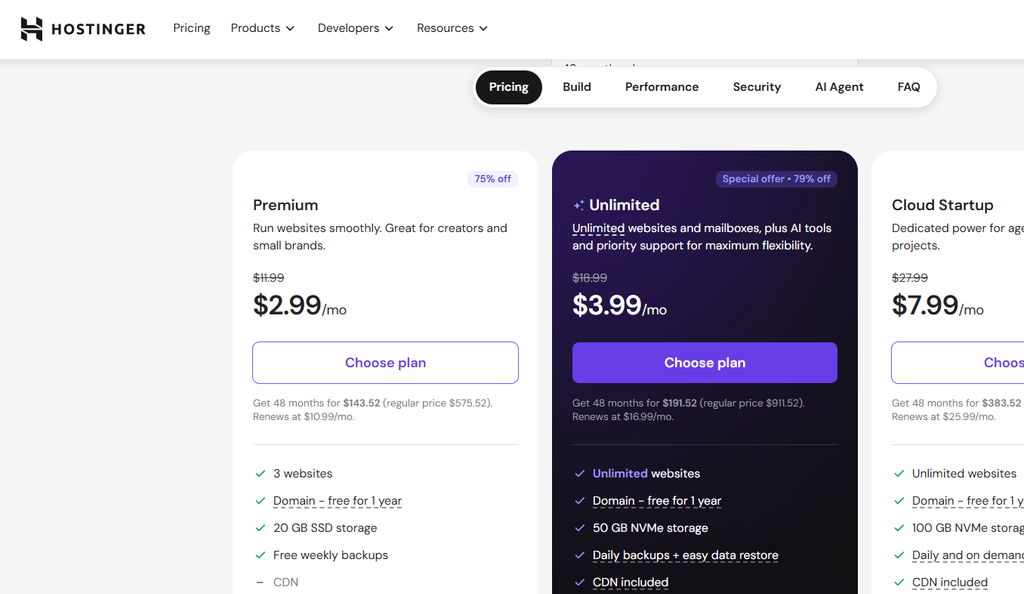
Hostinger is one of the strongest choices for SMBs that want a combination of affordability, performance, and ease of management.
Its current hosting offerings include WordPress support, AI website-building tools, CDN functionality, SSL, backups, email, and upgrade paths toward cloud hosting. Its India plans also provide pricing in INR, which makes comparison easier for Indian businesses.
Why I Consider Hostinger for SMB Websites
The biggest advantage is the balance between features and cost.
For a typical company website, service business, consultant website, agency website, blog, or smaller WooCommerce implementation, you can get many of the essential hosting components without building a complicated infrastructure stack yourself.
Hostinger also supports WordPress, PHP/HTML websites, and other development approaches, making it suitable for businesses that may change their technology stack later.
Its current infrastructure highlights NVMe storage, LiteSpeed servers, CDN, Object Cache, automated backups, SSL, and malware scanning.
Who Should Choose Hostinger?
I would consider Hostinger for:
- Small business websites
- WordPress websites
- Startups
- Service businesses
- Portfolio and professional websites
- Small WooCommerce stores
- Businesses looking for affordable hosting
- Agencies managing multiple smaller websites
One important point: never judge hosting only by the introductory price. Check the renewal price, contract period, included resources, backup policy, and migration terms before purchasing.
2. SiteGround
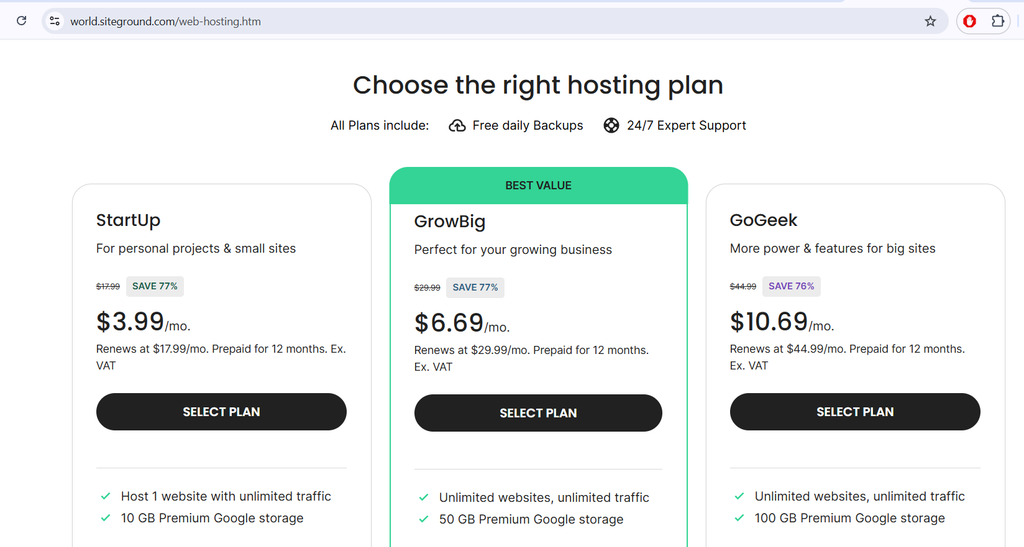
SiteGround is another strong option, particularly for businesses that put greater emphasis on managed hosting, support, security, and performance.
SiteGround currently promotes features including free SSL, CDN, daily backups, free website transfers, email, caching, security features, and 24/7 expert support.
Why SiteGround Stands Out
One reason I would consider SiteGround for a business client is the overall managed experience.
A business owner may not want to spend time understanding server configuration, caching layers, backups, and security settings. A managed hosting environment can reduce that operational burden.
SiteGround also positions its hosting around performance and security rather than simply competing on the lowest possible price.
Who Should Choose SiteGround?
SiteGround can be a good fit for:
- Professional business websites
- WordPress websites
- Agencies
- Businesses that prioritize support
- Websites where reliability is more important than the lowest hosting cost
- Businesses that want managed hosting features
The major consideration is price. SiteGround’s promotional pricing can be attractive initially, but renewal pricing is significantly higher. Its current public pricing shows this distinction clearly.
Therefore, calculate the cost over several years rather than making the decision based only on the first-year offer.
3. Bluehost
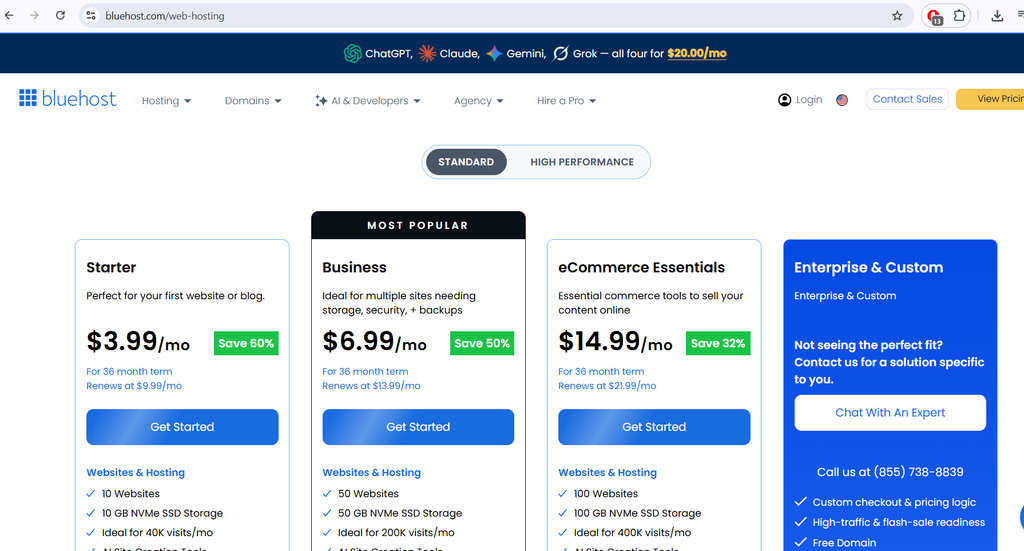
Bluehost is particularly relevant for businesses using WordPress.
It has a long association with WordPress hosting and currently offers WordPress-focused plans with features such as NVMe storage, CDN, managed WordPress updates, SSL, malware scanning, backups, staging, and WordPress-oriented tools.
Why Bluehost Makes Sense for WordPress Businesses
If your website is going to be built on WordPress, having a hosting provider with a strong WordPress ecosystem can simplify management.
Bluehost’s business-focused offerings include AI website creation tools, free domain registration for the first year on eligible plans, free migration tools, CDN, managed WordPress updates, security features, and support.
For businesses planning to run content marketing, lead generation, WooCommerce, or service pages on WordPress, these capabilities can be useful.
Who Should Choose Bluehost?
I would consider Bluehost for:
- WordPress business websites
- Small ecommerce websites
- Businesses starting with WordPress
- Companies wanting an integrated website setup
- Businesses that may need multiple WordPress websites
- Users who prefer a relatively beginner-friendly management experience
As with other hosts, compare renewal pricing and the actual resource allocation rather than simply comparing the promotional monthly price.
4. DreamHost
DreamHost is another established hosting provider worth considering for SMB websites, particularly businesses looking for straightforward hosting with room to grow.
Its current web hosting plans include features such as NVMe storage, automated backups, SSL certificates, free domain registration for the first year on eligible plans, email allowances on selected plans, and website capacity that increases with higher tiers.
Why DreamHost Is Worth Considering
DreamHost’s approach is relatively straightforward.
For a small business that does not need a highly specialized hosting architecture, straightforward hosting can actually be an advantage. You want to be able to manage domains, websites, SSL, backups, and hosting resources without unnecessary complexity.
DreamHost also provides different tiers, making it possible to move toward higher-capacity hosting as the website grows.
Who Should Choose DreamHost?
DreamHost can be considered by:
- Small business websites
- Bloggers and content-driven businesses
- WordPress websites
- Startups
- Businesses looking for simple hosting management
- Websites that expect gradual growth
The important thing is to select the plan based on actual traffic and resource requirements rather than choosing the largest package simply because it has more storage.
5. Namecheap
Namecheap is widely known for domain services, but it also provides shared hosting, WordPress hosting, VPS hosting, and dedicated server options.
Its current hosting offering emphasizes affordability, easy setup, 24/7 support, SSD-based hosting, WordPress compatibility, free migration assistance, and a 99.9% uptime guarantee.
Why Namecheap Can Work for Smaller Websites
If you are launching a relatively simple website and want hosting without a large initial investment, Namecheap can be worth evaluating.
Its shared hosting plans are positioned for beginners, blogs, small business websites, and WordPress starters. Some plans also support multiple websites and multiple mailboxes.
For businesses that manage several domains, having domain and hosting services under one provider can also make administration more convenient.
Who Should Choose Namecheap?
Namecheap may be suitable for:
- Small business websites
- Basic WordPress websites
- Startup websites
- Portfolio websites
- Blogs
- Businesses managing multiple domains
- Cost-conscious website owners
However, if your website is heavily dependent on performance, ecommerce transactions, or high traffic, I would compare its resources and performance characteristics against more performance-oriented alternatives before making a final decision.
How I Would Compare These Five Hosting Providers
There is no single hosting company that is best for every business.
My practical comparison would look like this:
Best Overall Value: Hostinger
For most SMBs that want affordability, modern hosting infrastructure, WordPress compatibility, performance features, and an easy management experience, Hostinger is a strong starting point.
Best for Managed Experience: SiteGround
If support, managed features, security, and performance are higher priorities than getting the cheapest possible hosting, SiteGround deserves serious consideration.
Best for WordPress-Focused Businesses: Bluehost
If WordPress is at the center of your website strategy, Bluehost is one of the providers I would shortlist.
Best for Straightforward Hosting: DreamHost
DreamHost is worth considering when you want a relatively simple hosting platform with a clear path to higher-capacity plans.
Best Budget-Friendly Alternative: Namecheap
Namecheap can make sense for smaller websites where cost, simplicity, and domain management are important considerations.
Don’t Choose Hosting Based Only on Price
This is one of the biggest mistakes I see businesses make.
A hosting plan advertised at ₹100 or ₹200 per month may look cheaper than another provider’s ₹500 or ₹800 plan. But that number does not tell you everything.
You should compare:
- Renewal price
- CPU and RAM allocation
- Storage type
- Backup frequency
- CDN availability
- Server-level caching
- SSL
- Malware protection
- Migration assistance
- Email accounts
- Number of websites allowed
- Datacenter locations
- Support quality
- Upgrade options
For example, if your website generates leads worth thousands of rupees every month, saving a few hundred rupees on hosting is rarely a meaningful optimization.
Hosting Is Also an SEO Decision
Hosting is not an SEO strategy by itself, but it can influence the technical foundation on which your SEO strategy operates.
If your website is consistently slow, experiences downtime, struggles under traffic, or has poorly configured server resources, your marketing investment can suffer.
I generally look at hosting as one layer of the complete website performance stack:
Hosting → Server configuration → CDN/cache → WordPress/PHP → Theme/plugins → Images → JavaScript/CSS → Page experience
Improving only the hosting layer will not automatically make a website fast.
A poorly optimized WordPress website can remain slow even on expensive hosting.
On the other hand, good hosting gives your development and optimization work a stronger foundation.
My Recommendation for Small and Medium Businesses
If I were selecting hosting for a new SMB website today, I would first identify the website’s actual requirements.
For a standard corporate WordPress website with moderate traffic, I would shortlist Hostinger, SiteGround, and Bluehost.
For a simple startup or small business website where budget is important, Hostinger or Namecheap may be sufficient.
For a business that expects significant growth, I would focus less on the cheapest shared hosting package and more on the provider’s upgrade path.
For ecommerce, I would be more conservative. WooCommerce stores have different requirements because database queries, product images, plugins, checkout processes, payment integrations, and traffic spikes can consume considerably more resources than a five-page corporate website.
Final Thoughts
Web hosting should be treated as part of your business infrastructure rather than simply another recurring expense.
The right provider can give your website a reliable foundation for performance, security, backups, SEO, lead generation, and future growth.
My five providers for SMB websites are Hostinger, SiteGround, Bluehost, DreamHost, and Namecheap. But the ranking should not be interpreted as a universal rule.
Your best choice depends on your website platform, traffic, location, budget, technical requirements, ecommerce needs, and growth expectations.
Most importantly, don’t purchase hosting simply because a banner says “80% off.”
Look at the renewal price, server resources, backups, security, support, performance features, and scalability.
As a digital marketing and web development professional, I would rather spend a little more time selecting the right hosting environment at the beginning than spend months troubleshooting performance and reliability problems after the website is already generating business.
A website is often one of the most important digital assets a small or medium business owns. Its hosting deserves to be selected with the same seriousness as the website design, SEO strategy, analytics setup, and advertising infrastructure.
Disclaimer
Hosting plans, pricing, promotional offers, features, resource limits, renewal rates, and availability can change by country and subscription term. The information in this article is intended for general educational and comparison purposes. Always verify the current plan details and terms directly with the hosting provider before purchasing.
About Author:
Amit Tyagi is a Senior Digital Marketing Specialist and Web Development Strategist with over 15 years of experience in SEO, website development, and data-driven digital growth. He has successfully built and optimized more than 50 websites across various industries, helping businesses improve online visibility, generate leads, and increase revenue through strategic digital marketing.
His expertise spans search engine optimization (SEO), content strategy, conversion-focused web development, marketing automation, and analytics-driven decision making. Amit combines technical development skills with advanced digital marketing strategies to create high-performing digital ecosystems for brands.
Throughout his career, Amit has worked on eCommerce, B2B platforms, and enterprise-level digital projects, delivering scalable solutions that align technology with business goals. He is also known for sharing insights on modern SEO trends, AI-driven marketing, and future digital strategies.
Amit believes that the future of marketing lies at the intersection of technology, data, and strategic storytelling.